Imaginary interview with Anne Royall
by Charactorium · Anne Royall (1769 — 1854) · Literature · Society · 5 min read

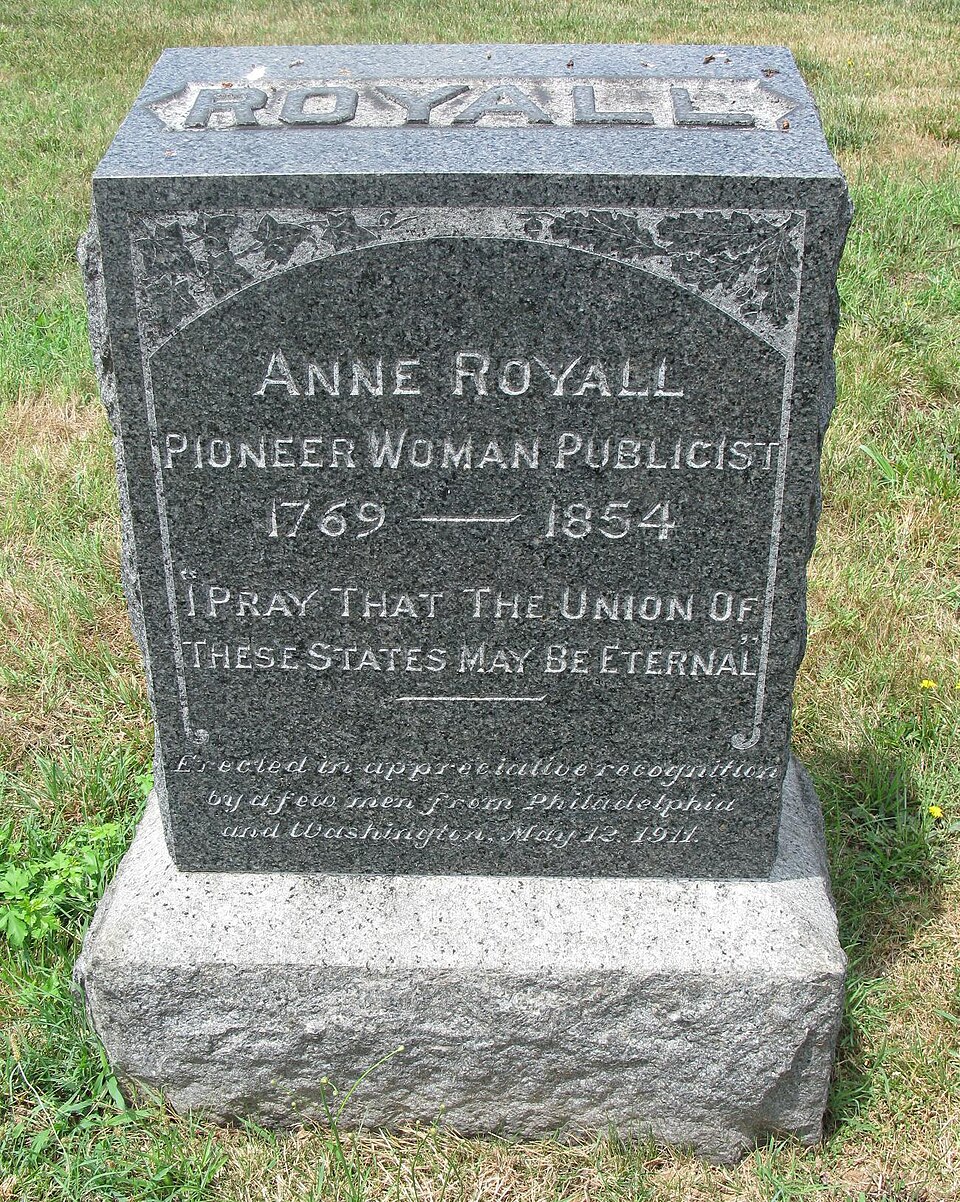
Washington, a gray morning in 1849. In a room cluttered with papers, printing type, and old yellowed issues, a woman past eighty receives us unceremoniously, her pen already dipped. Anne Royall, widow, ruined, feared, still runs The Huntress with a dry hand. She agrees to talk, on condition, she says, that we not put foolish words in her mouth.
—How did you become a writer, you who were never meant to be one?
I did not choose the pen, sir: it was misery that put it in my hands. I had married William Royall, a veteran of the Revolution, on his lands at Sweet Springs, Virginia, where I served before becoming his wife. When he died in 1812, his family pounced on the will like a pack, and the courts, after years, stripped me of everything. So there I was, past fifty, penniless, without a secure roof. So I packed my trunk and took to the road to sell subscriptions and write what I saw. My first Sketches of 1826 were born of that necessity, not of a salon vocation.
I did not choose the pen: it was misery that put it in my hands.
—What do you keep from that inheritance battle that cost you so much?
I keep an iron distrust of lawyers and pious heirs. I was promised the fortune of a husband who loved me; they made me a beggar in the name of the law. Understand this: it was not the hardships of the Frontier that hardened me, but the well-heated law offices where they strip a widow with smiles. When justice ruled against me, around 1823, I had nothing left but my eyes and my anger. That is why, I believe, I smell the plunder of the powerful so well: I tasted it first.
I keep an iron distrust of lawyers and pious heirs.
—Do you remember your years on the road, traveling the young Republic?
Thousands of miles, sir, jolted in the stagecoach over broken roads that shook your bones. My old travel trunk, a chest of wood and leather, held all my possessions. I went down to Huntsville, Alabama, at the far edge of the Frontier, and from it I drew my Letters from Alabama — the settlers, the cabins, the mud, the rough manners of the South. Where other travelers counted pretty landscapes, I noted prices, customs, the hypocrisy of the notables. The Black Book came out of those notebooks. One sees a country better from the bottom of a stagecoach than from the top of a pulpit.
One sees a country better from the bottom of a stagecoach than from the top of a pulpit.
—What drove you to observe people so keenly on the road?
Curiosity, and the need to sell the truth. A subscriber pays in advance; he wants to find in my pages what he will never see himself. So I watched the inns, the provincial courts, the faces at the market. I wrote about the United States what the fine minds of the East deigned not to see: a new nation, rough-hewn, full of sap and rogues. My Sketches of 1826 were that first — a mirror without flattery held up to this country. For me, traveling was not fleeing: it was investigating, page after page.
For me, traveling was not fleeing: it was investigating, page after page.
—Tell us about your newspapers: why did you become a publisher at an age when others rest?
Because no one else would do it in my place. Past sixty, I founded Paul Pry in 1831, then The Huntress in 1836, which I still run today. A manual printing press, a few helpers, type and paper: that is my army. Every afternoon I go up to the Capitol or the departments, without an appointment, and I question senators and clerks until they let out what I want to know. In the evening, I correct proofs by candlelight. They call me old and poor — so be it. As long as this press creaks, corruption has an enemy that does not sleep.
As long as this press creaks, corruption has an enemy that does not sleep.
—They say politicians feared you. Where did that fear come from?
From the fact that they never knew what I would print about them. Many subscribed to my newspaper less out of taste than prudence: better to read one's own name than to learn it from a laughing neighbor. I would drop into their offices without warning, ask my questions, note their evasions. The spoils system installed after Jackson's election in 1828 had made positions sprout like mushrooms — and with them, the small vermin of favors. I named them. That is why some, seeing me approach at the Capitol, suddenly looked busy.
Better to read one's own name than to learn it from a laughing neighbor.
—What happened during that trial of 1829 that caused such a stir?
They dragged me before a court in Washington and declared me guilty of being a common scold — a quarrelsome shrew, if you will, an old charge rarely brought out of the closet. Imagine, they seriously discussed the ducking stool, that chair where the condemned is plunged into the river: they wanted to dip me in the Potomac like a witch of yore! The judge, more sensible, fined me — paid, mind you, by two journalists who came to support me. I laughed, deep down. One does not so easily hang a woman who runs a press.
They wanted to dip me in the Potomac like a witch of yore.
—In hindsight, what do you think of having been judged for your too-free tongue?
That they punish in a woman what they celebrate in a man. A male pamphleteer who inveighs against the powerful is a vigilant citizen; I am treated as a common scold and they invoke the ducking stool of the past century. That conviction of 1829 was, they say, one of the last of its kind — so be it, I will at least have closed an old infamy. But it taught me this: my voice disturbed enough that they sought a moldy law to silence it. They do not raise such apparatus against a silent woman.
My voice disturbed enough that they sought a moldy law to silence it.

—Why this relentless war against the influence of the clergy in public affairs?
Because I see rising, with what they call the Second Great Awakening, an army of preachers and missionaries who would lay hands on the state. In The Black Book, I named them, these people who confuse the pulpit and the government. Our Republic was built on a simple and new idea: the separation of church and state. Let me pray or not pray as I wish, but let no sect seize Congress! That earned me furious enemies among the devout. So much the better: one knows a man by the quality of his adversaries.
One knows a man by the quality of his adversaries.
—These evangelical enemies, how did they retaliate against your attacks?
With contempt, slanders, and finally that shrew trial they applauded with both hands. They painted me as a godless old fury — I who do not fight faith, but the grip of the devout on public affairs. When I attacked the missionaries by name in my travel volumes, they saw blasphemy; I saw only a republican duty. My press kept creaking, issue after issue, under Paul Pry then The Huntress. One can ruin a woman, but one does not so quickly reduce a printed opinion.
One can ruin a woman, but one does not so quickly reduce a printed opinion.
—If you imagined being read a century from now, what would you want to be remembered?
Little, and much. Not that I was poor and quarrelsome — that, my enemies will see to. But that a woman, alone, without fortune or protector, went up to the Capitol to question the powerful and ran two newspapers, from 1831 to this day, to say aloud what was whispered. If they remember that there was, in the young Republic, an old lady with a quill pen who called a thief a thief, then my press will not have creaked for nothing. The rest — the fine, the misery, the ducking stool — is but anecdote.
An old lady with a quill pen who called a thief a thief.
This imaginary interview was generated by artificial intelligence from sources documented in Anne Royall's profile. It dramatises what the figure might have said based on what we know about them, but does not constitute attested historical testimony. For primary sources and factual documentation, refer to the full profile.