Imaginary dialogue between John Quincy Adams and Anne Royall
by Charactorium · Anne Royall (1769 — 1854) · Literature · Society · 5 min read

It is in a cluttered lodging in Washington, a stone's throw from the Capitol, that John Quincy Adams comes to find Anne Royall in this spring of 1842. The smell of ink and the wood of the hand press fill the low room, where papers, proofs, and subscription ledgers are piled up. A former president turned stubborn representative, he has long known this feared woman who prowled the corridors of power without ever asking for an audience. He sits down among the newspapers, curious to understand, before it is too late, what forged the first woman reporter of the Republic.
—Anne, you were known as a widow without a penny after your husband's death. Did ruin truly make you a woman of letters?
That is the plain truth, and I am not ashamed of it. When William died in 1812, his family pounced on his will like a pack, and the courts took everything from me in 1823. Past fifty, with no roof or income, I had to live or die: I chose to live by my pen. I took the stagecoach, my inkwell, and a trunk, and set off to look this country in the face and tell its story. You, who have always had a name and a station, do not know what it is to owe everything to your own audacity. Misery stripped away my illusions, but it gave me my trade.
Misery stripped away my illusions, but it gave me my trade.
—Your first Sketches appeared in 1826. What did you hope for, throwing your observations on the young Republic into the public's face?
I hoped to eat, first of all, I won't lie to you. But in writing those Sketches of History, Life, and Manners, I discovered that I had an eye for what others did not want to see: the vanity of cities, the stupidity of the great, the real life of the small. I went from town to town, noting everything, the customs, the streets, the faces. The book sold, and I understood that my gaze was worth money and, better still, that it disturbed. They thought I was finished, an old woman on the roads; I answered with one book, then another. That is how I was first read before being feared.
—I saw you more than once burst into the corridors, without an appointment, notebook in hand. How did you dare to force the door of senators and ministers?
I dared because no one else did, and because those gentlemen counted on it. I would go up to the Capitol in the afternoon, settle in, and wait for a senator to pass so I could question him straight in the eye. The appointment, you see, is the weapon of the powerful to brush off the nuisance: so I refused it to them in turn. You yourself, when I came to find you, did you ever manage to dismiss me with a word? A man with nothing to hide answers; one who evades incriminates himself. I did not seek favor, I sought the truth, and I took it where it stood.
The appointment is the weapon of the powerful to brush off the nuisance: so I refused it to them.
—It is whispered that many politicians subscribe to your paper less out of taste than for fear of appearing in it. Is that a reputation you cultivate?
I do not cultivate it, I deserve it. An honest official has nothing to fear from Paul Pry or The Huntress; it is the rogue who pales at seeing my name on the envelope. So yes, many pay their subscription like an insurance premium, hoping the pen will stick in the neighbor rather than in them. Good for them: their money feeds my press, and my press continues to watch them. I have made fear of scandal a tool of public virtue. What does it matter if they read me out of admiration or fear, as long as they read me and keep straight.
Many pay their subscription like an insurance premium, hoping the pen will stick in the neighbor.
—Since we are among ourselves, Anne: that story where you supposedly questioned me while sitting on my clothes as I bathed in the Potomac — what is the truth?
Ah, you are well placed to set the record straight, and yet I see you smiling! I leave you the joy of denying what the people prefer to believe. What is certain is that the legend has served me as much as it has caricatured me: people attribute that audacity to me because they have seen me do greater elsewhere. People need an image, a woman who fears nothing, not even a president in the water. Let them keep it. I know what I did and what I did not do, and that is enough for me. The truth, dear sir, is often more austere than the fable — and far less marketable.
The truth is often more austere than the fable — and far less marketable.
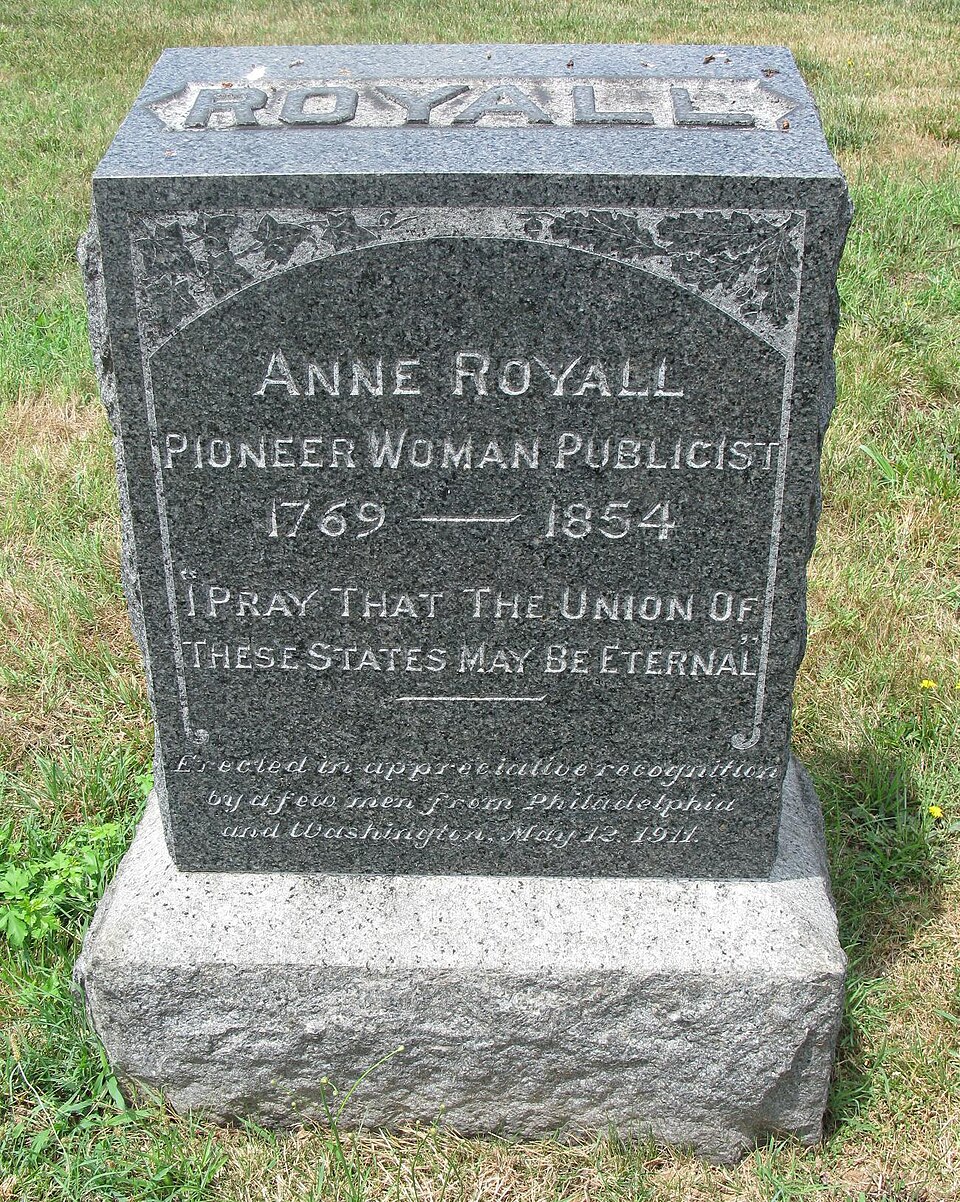
—In 1829, you were dragged before a court in this same city and declared a common scold. How did you experience that trial as a quarrelsome shrew?
As an outrage disguised as justice, that is how. Judging me as a 'common scold,' me, while they let a hundred thieves of public funds run free! It was a moldy law brought out on purpose to silence a woman who spoke too loudly. I stood before that court without lowering my head, because yielding would have given them reason. They wanted to cover me in ridicule, but the ridicule fell back on those who dug up laws from another age for a quarrel of the pen. I gained more readers than enemies from it. A woman dragged to court for telling the truth becomes, whether they like it or not, a banner.
They judged me for my tongue, while they let a hundred thieves of public funds run free.
—I heard they even spoke of plunging you into the river tied to a chair. Did that ducking stool seriously threaten a woman of your age?
Seriously, yes, and that tells you in what century we still live. They actually mentioned tying me to the ducking stool and dipping me in the Potomac, as in the time of witches. Imagine: an old woman, guilty of having wielded too free a pen, half-drowned as an example. The judge fortunately recoiled before the grotesque and fined me. And do you know who paid it? Two journalists, two colleagues who came to support me. That warmed my heart more than the sentence had chilled me. That day, I understood that the press, when it sticks together, is stronger than old drowning chairs.
They would have half-drowned an old woman, guilty of having wielded too free a pen.

—Your Black Book caused a scandal by naming missionaries. Why were you so set against men of religion?
Because I do not attack faith, sir, but those who use it as a lever of power. In The Black Book, I pointed out missionaries and pious societies who, under cover of saving souls, wanted to get their hands on our schools, our laws, our Republic. These people of the Second Great Awakening dream of a government submissive to the pulpit; I defend a nation where the pastor stays in the temple and the magistrate in the court. They called me impious for that. So be it. I have seen too closely the hypocrisy of those who preach charity and practice intrigue. I prefer their hatred to their blessing.
I do not attack faith, but those who use it as a lever of power.
—You place the separation of Church and State at the heart of your fight. Is that, in your view, the business of your whole writing life?
It is the red thread, yes, running from Paul Pry to The Huntress. Our fathers built a Republic by keeping the altar at a distance from the government, and today I see zealots wanting to undo that work with sermons and petitions. As long as I hold a pen, I will cry that freedom of conscience dies the day a sect dictates the law. It is a fight that has cost me friends, subscribers, my peace. But a Republic without that wall between throne and altar is only a theocracy unaware of itself. I love this country too much to let it slide there without warning.
Freedom of conscience dies the day a sect dictates the law.
—You have run your paper alone for so many years, old and without fortune. What still keeps you every morning before that press?
The unfinished work, simply. As long as there is a rogue in the Capitol and a soul ready to read me, I will correct my proofs in the evening by candlelight. The Huntress is my last battlefield, and I intend to die standing, ink on my fingers. I have neither fortune nor descendants; this newspaper is my legacy, the only thing my husband's family could not steal from me. They think me a stubborn old woman in her paper hovel: so be it. That stubborn woman opened a door that other women, after me, will cross with heads held high. That is why I get up every morning before that press.
I intend to die standing, ink on my fingers.


This imaginary interview was generated by artificial intelligence from sources documented in Anne Royall's profile. It dramatises what the figure might have said based on what we know about them, but does not constitute attested historical testimony. For primary sources and factual documentation, refer to the full profile.