Kids interview Anne Royall
by Charactorium · Anne Royall (1769 — 1854) · Literature · Society · 5 min read
Two twelve-year-old visitors on a school trip to Washington push open the door of a small apartment cluttered with papers. An old woman in dark dresses sets down her pen and smiles at them. She is Anne Royall, and she has a thousand stories to tell.
—How old were you when you started writing books?
You know, my child, I was already over fifty. Imagine: at that age, most women are resting by the fire. But I had just lost everything. My husband William Royall had died, and his family took away the inheritance he had left me. Lawsuits for years! In 1823, the court ruled against me. Ruined, without a penny. So I packed my bags in an old trunk and traveled across the country, by stagecoach, on terrible roads. I wrote down what I saw, and I sold my books to eat. It was misfortune that made me a writer.
It was misfortune that made me a writer.
—What was it like traveling alone by stagecoach in those days?
Ah, it was no pleasure trip, believe me! Imagine a wooden carriage pulled by horses, bouncing over every rut in the road. No engine, just the sound of hooves and the creaking of wheels. I traveled thousands of miles, shaken like a sack. My first book, the Sketches, in 1826, was born from those roads. I observed everything: the towns, the people, their follies and virtues. An old woman alone asking too many questions disturbs people. But my eyes were my real treasure, and no one could steal them.
My eyes were my real treasure, and no one could steal them.
—How did you manage to talk to politicians? Did you have an appointment?
An appointment? Never, my dear! I went straight to the Capitol, that great building where those who make the laws sit. I walked into the ministers' offices without knocking too hard, and I asked my questions. The senators would see me coming and turn a little pale. Do you know why? They were afraid of ending up in my newspaper! Many subscribed not out of love for me, but out of fear that I would tell of their little dishonesties. An old woman afraid of nothing is better than an army. Speaking plainly was my weapon.
An old woman afraid of nothing is better than an army.
—Is the story about the president swimming naked in the river true?
Ha! You've heard that legend too, have you? They say I caught President John Quincy Adams bathing in the Potomac, the great river of Washington. I supposedly sat on his clothes, refusing to give them back until he answered my questions! It's a fine story, isn't it? But I must be honest with you: it's almost certainly not true. People invented it because it sounds like me. That's what happens when you are known for your audacity: they attribute to you exploits you never committed.
That's what happens when you are known for your audacity.
—What was your newspaper? What did it talk about?
I had two, my child! The first was called Paul Pry, starting in 1831. Then, in 1836, I replaced it with The Huntress, which I ran until my death. A huntress, you see? I hunted down the thieves and cheats of the state. Every week, on my old printing press of wood and iron, I made my sheets, line by line. I denounced corrupt officials who stole the people's money. And I championed an idea dear to my heart: that Church and State should remain separate, each in its place, without mixing.
I hunted down the thieves and cheats of the state.
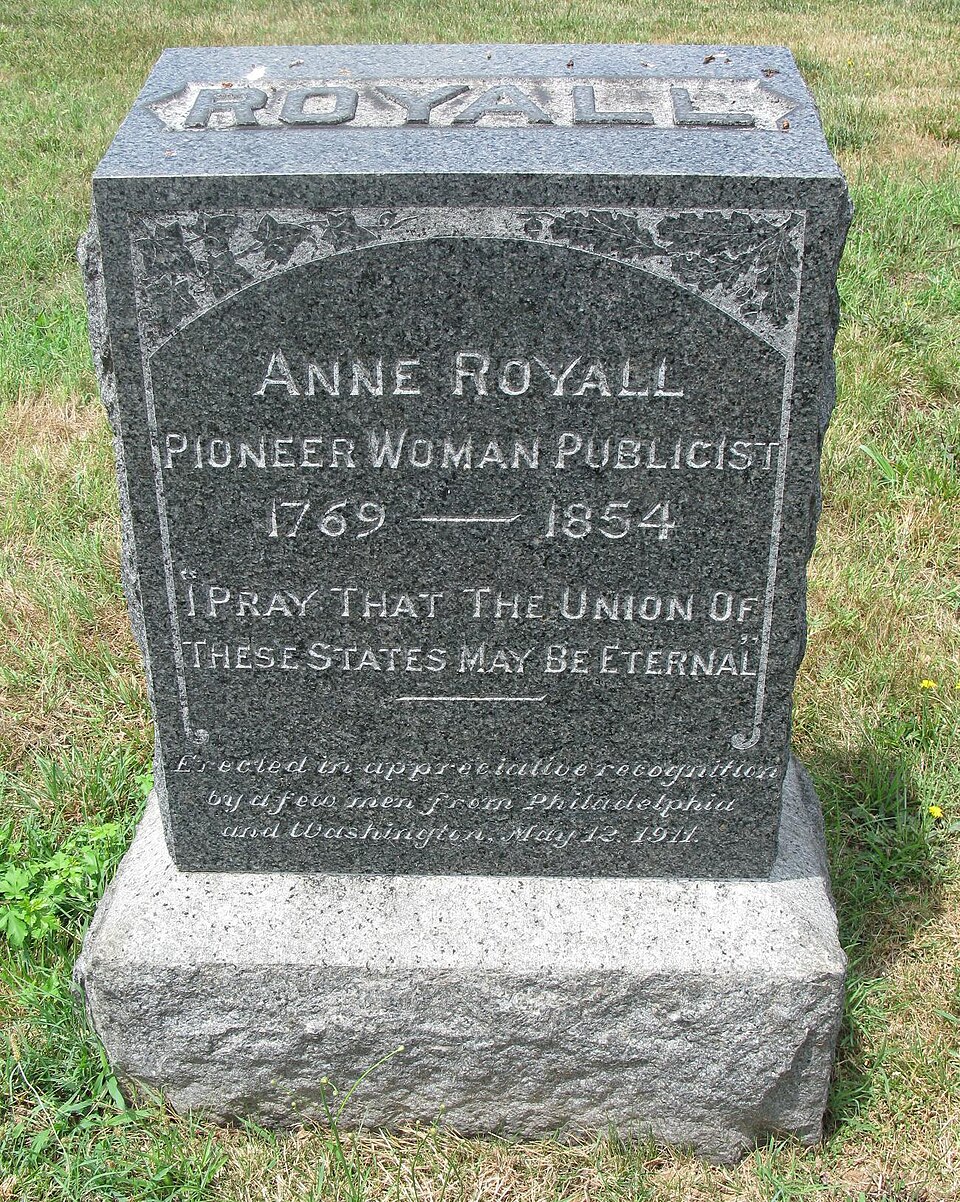
—How did you earn money with your newspaper?
Good question, little one! A newspaper is not given away; it is sold. I had a register, a big ledger, where I wrote down each subscriber. A subscription is money paid in advance by a reader to receive my sheets for the whole year. It was my only income. In the morning, I read my subscribers' mail; in the evening, I corrected proofs before printing. I lived poorly, you know: bread, some vegetables, a little meat on good days. But every penny came from readers who believed in my voice. No rich man paid me to keep quiet.
No rich man paid me to keep quiet.
—Is it true you were put on trial? What had you done?
Yes, in 1829, in Washington! And do you know what I was accused of? Being a common scold — in the old language, that means a quarrelsome woman who disturbs the peace by shouting her truths too loudly. A crime from another age! They even talked of punishing me with the ducking stool: imagine a chair fastened to a long wooden arm, where they tie you up to plunge you into the icy river. Fortunately, the judge chose a simple fine. And guess who paid it? Two journalists who came to support me. You don't silence a woman by getting her wet.
You don't silence a woman by getting her wet.
—Were you afraid during your trial?
Afraid? A little, I won't lie to you, my child. I was old and poor, alone before a whole court. Imagine yourself standing in a room full of men staring at you like a strange animal. Your heart pounds, your legs tremble. But you know, fear never stopped me from speaking. I had understood one thing: if I kept silent that day, all the corrupt men in Washington would have won. So I held my head high. My conviction was one of the last of its kind in our history. I am almost proud of it, you know.
Fear never stopped me from speaking.
—Why were you angry at church people?
Careful, my dear, I was not against faith! I was against those who use it to seize power. In my time, a great religious movement was stirring the country: it was called the Second Great Awakening. Preachers and missionaries wanted to control everything, even the affairs of state. In my book The Black Book, in 1828, I attacked them by name. I said they threatened the liberty of the young Republic. That earned me many enemies, believe me. But I think a priest should stay in his church, and a lawmaker in his court. Each in his place.
A priest in his church, a lawmaker in his court.
—How did it feel to have so many enemies because of your ideas?
You know, my child, enemies are the price of truth. Every time I wrote a name in The Huntress, I knew I was making one more adversary. The missionaries hated me, the officials feared me. Some evenings, alone in my small apartment cluttered with papers, I felt very tired. But imagine for a moment that I had kept quiet to be liked: what good would I have been? None. A pen that dares say nothing is not worth the ink it drinks. I preferred to be feared and free rather than sweet and mute.
A pen that dares say nothing is not worth the ink it drinks.
—If people remembered one thing about you, what would it be?
Oh, what a lovely question to end with! If you remember only one thing, remember this: a woman, old and penniless, dared to ask questions that no one else dared to ask. I ran my newspapers alone, until I was eighty-five, in this city of Washington. They call me one of the first women reporters in the United States. That title touches me. But what I truly want to leave you is courage. The courage to look the powerful in the eye and speak aloud what is just. That is my real legacy, now it is yours to carry.
The courage to speak aloud what is just.
This imaginary interview was generated by artificial intelligence from sources documented in Anne Royall's profile. It dramatises what the figure might have said based on what we know about them, but does not constitute attested historical testimony. For primary sources and factual documentation, refer to the full profile.