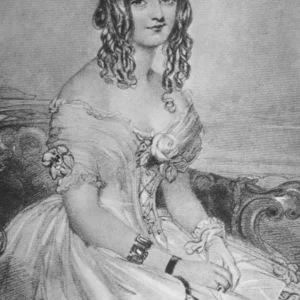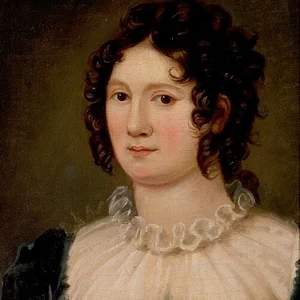

British woman of letters and step-sister of Mary Shelley. Part of the circle of English Romantic poets, she had a daughter, Allegra, with Lord Byron. Her journals and correspondence are a valuable testimony to the Romantic era.
Claire Clairmont(1798 — 1879)
Claire Clairmont
Royaume-Uni de Grande-Bretagne et d'Irlande
5 min read
Frequently asked questions
Key Facts
- Born on 27 April 1798 in Brislington, near Bristol
- Step-sister of Mary Shelley, she shared the summer of 1816 at the Villa Diodati on the shores of Lake Geneva with Byron and the Shelleys
- Gave birth in 1817 to Allegra, daughter of Lord Byron, who died in 1822
- Worked as a governess and tutor in Russia and across Europe after the deaths of the Shelleys
- Died on 19 March 1879 in Florence
Works & Achievements
A first-hand account of the daily life, travels, and conversations of the English Romantic circle. A major source for literary historians.
Letters documenting their relationship and Claire's struggle to keep a connection with her daughter Allegra. A precious window into Byron in private.
Exchanges revealing the friendship and tensions between the two women, as well as the circulation of ideas within the circle.
For decades the keeper of unpublished letters and manuscripts, she became a figure sought after by collectors — the inspiration for Henry James's novella “The Aspern Papers.”
Anecdotes
In the summer of 1816, Claire Clairmont stayed with Mary and Percy Shelley near Lake Geneva, very close to the Villa Diodati rented by Lord Byron. It was during those rainy evenings, when the group challenged one another to write ghost stories, that Mary Shelley conceived *Frankenstein*.
It was Claire who, first among the circle, wrote to Lord Byron to meet him, and not the other way around. From this affair a daughter, **Allegra**, was born in **1817**; Byron agreed to acknowledge her but refused to let her be raised by her mother.
Byron placed little Allegra in a convent near Ravenna, despite Claire's desperate protests. The child died there of fever in **1822**, at only five years old — a loss that haunted Claire for the rest of her life.
To earn a living, Claire worked for years as a governess and tutor, notably in Russia in Moscow, far from the romantic turmoil of her youth. She was fluent in several languages.
Having lived to the age of 80, Claire outlived nearly the entire Romantic circle. Toward the end of her life in Florence, admirers sought to buy from her the letters of Shelley and Byron that she had kept — a situation that inspired Henry James's novella *The Aspern Papers*.
Primary Sources
Personal journal kept by Claire during her travels with the Shelleys on the Continent, a direct testimony of daily life within the Romantic circle.
A strange young woman who deeply admires you wishes to speak with you privately on a matter of the utmost importance.
Letters exchanged with Mary Shelley, Lord Byron and others, documenting in particular the drama surrounding their daughter Allegra.
Key Places
Region near Bristol where Claire Clairmont was born in 1798. She then grew up in London in the household of William Godwin.
Near Geneva, site of the famous summer of 1816 that brought together Byron, the Shelleys and Claire. It was there that “Frankenstein” took shape.
Village near Ravenna whose convent took in little Allegra, who died there in 1822. The site of one of the greatest tragedies of Claire's life.
City where Claire worked as a governess in the 1820s to support herself, far from the Romantic circle.
City where Claire spent her final years and died in 1879, keeper of the memories and papers of the Shelley-Byron circle.
Typical Objects
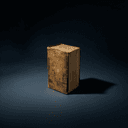
Handwritten notebook in which Claire recorded her travels, her readings and her emotions. These journals are a precious source on the daily life of the Romantics.

Writing instruments essential to the abundant correspondence she kept up with Mary Shelley and Byron. The letter was the main link between travellers.

Large leather-and-wood chest carrying her belongings during her many journeys between England, Switzerland, Italy and Russia. Her life was marked by wandering.

High-waisted gown in light muslin, in the fashion of the early 19th century. A typical outfit for the young women of Romantic European society.

Claire had received a musical education and sang; music was part of the circle's entertainments. She sometimes taught singing and piano.

Small piece of jewellery containing a miniature portrait or a lock of hair, an intimate keepsake of loved ones that people wore. Claire long kept the memory of her daughter Allegra.
School Curriculum
Vocabulary & Tags
Key Vocabulary
Tags
Daily Life
Morning
In her youth within the Shelley circle, Claire would rise to read, study languages and write in her journal. Mornings were devoted to reading and to her writing work.
Afternoon
Afternoons were spent on walks, shared readings and lively literary discussions with Mary, Percy and their friends. Later in life, as a governess, she gave lessons to the children in her care.
Evening
The Romantic evenings were filled with music, conversation and sometimes invented tales, as during the famous Swiss summer. They would read aloud and debate poetry and philosophy.
Food
Influenced by Percy Shelley, an advocate of a vegetarian diet, the circle favoured bread, vegetables, fruit and milk, and was wary of meat and alcohol. Meals were often simple and frugal.
Clothing
Claire wore the high-waisted Empire-style dresses in light muslin, with shawls and bonnets in keeping with early 19th-century fashion. Her attire remained that of a cultivated young woman of the middle class.
Housing
Her life was marked by instability: lodgings rented as her travels through Switzerland and Italy required, governess's rooms in Russia, then apartments in Florence. She never owned a true home of her own.
Historical Timeline
Period Vocabulary
Liens externes & ressources
Références
Œuvres
Journaux (The Journals of Claire Clairmont)
1814-1827
Correspondance avec Lord Byron
1816-1822
Correspondance avec Mary Shelley
1814-1851
Conservation des papiers Shelley-Byron
1822-1879