Imaginary dialogue between Créon and Antigone
by Charactorium · Antigone · Mythology · 6 min read
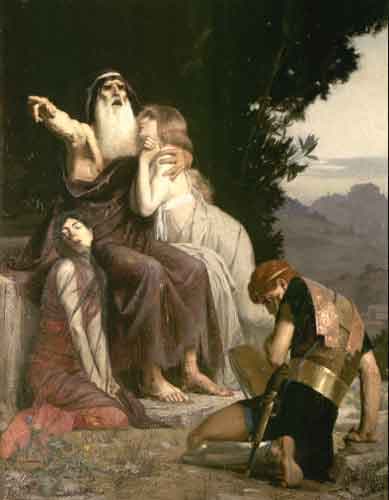
It is at the threshold of the sealed cave, outside the walls of Thebes, that Creon descends one last time before the stone is rolled. The torches spit red light onto the damp rock, and the air already smells of the tomb. Uncle and niece face each other as they have always faced each other: he, the king who has just begun to doubt, warned by the seer Tiresias; she, the daughter of Oedipus who has never backed down. They have known each other since Antigone's childhood in the Cadmea, and Creon comes to understand, before it is too late, what he failed to hear.
—Antigone, my niece, I have been told that you built no pyre for Polyneices — just a little dust thrown over him. Why so little?
You reason like a king, uncle, who measures everything by the weight of things. But before the dead, three handfuls of dust are worth a cedar pyre. I scattered earth over my brother's body, three times, as custom demands — and that is enough for his shade to stop wandering and finally descend to the Underworld. You see a tiny gesture, almost nothing under your guards; I see the only rite the gods require. Polyneices lay without tears, given to dogs and birds, he who was of your blood as much as mine. I could not walk past. This bit of earth, Creon, was his entire right to rest in peace.
You see a tiny gesture; I see the only rite the gods require.
—Yet you knew my edict had the force of law in Thebes. In whose name, you who are of my own house, did you trample it underfoot?
In the name of something older than you, uncle. Your edict is of yesterday; the laws I followed have neither beginning nor end. I did not think your edicts had enough power to compel a mortal to transgress the unwritten and unfailing laws of the gods. For these laws are not of today or yesterday; they are eternal, and no one knows when they were born. You command the living, and I do not dispute that. But over the dead, it is the gods below who decide, not the king of Thebes. I chose to obey those who will always reign, rather than him who reigns only for a time.
Your edict is of yesterday; the laws I followed have neither beginning nor end.
—I still see your father, my brother-in-law, leaving blind on the roads, your hand guiding his. This curse of your blood, how did you bear it?
As one bears a burden born before oneself, Creon. I am the daughter of Oedipus and Jocasta — and you know better than anyone what that means in our house: my mother was also my grandmother, and the curse of the Labdacids has weighed on us since Laius. When my father put out his eyes and was driven out, I took his hand and led him to Colonus. I was his eyes in exile, his daughter and his guide. I saw up close what the gods make our lineage pay. So when my two brothers killed each other beneath the walls, I was not surprised by the misfortune — only determined not to add the abandonment of a dead man without burial.
—As a child, you played in this same Cadmea under my eyes. Today I am your judge, I, your mother's brother. What do you feel in standing up to me?
No joy, I swear to you. It is not you I fight, uncle, but the order you proclaimed. I remember the Cadmea, your hand when I was little, and that makes things heavier, not lighter. If you had asked me to betray the city, I would have refused just as much. But you asked me to leave my brother to rot in the sun, and there I could not obey you without betraying myself. You confuse the respect I owe you with the submission you demand: they are not the same. I can love you as the uncle of my childhood and disobey you as the king who orders injustice. See my courage, Creon — not my contempt.
I can love you as the uncle of my childhood and disobey you as the king who orders injustice.
—I wanted to spare you bloodshed — to wall you alive in the rock rather than strike you, so as not to pollute the city. Do you understand that at all?
I understand your fear of pollution, uncle; you want to keep your hands pure before the gods. But to shut me alive in stone, is that really purer than the sword? You give me a tomb for a dwelling and still call me alive. I will not wait for you to die. Better to end it by my own hand than to languish in the dark counting the hours. I chose my fate the day I took the dust; this cave is only its conclusion. Do not think you have spared me: you have only delayed the moment of looking at what you have done. I go down to join my father, my mother, and my two brothers — all my house awaits me below.

—The seer Tiresias warned me, and my son Haemon, your betrothed, is inconsolable. Do you fear what your death will unleash on us?
I fear it for you, Creon, more than for myself. Haemon loved me, and I know he will not bear to see me sealed in the rock. When you have lost me, it will not be a single death you have caused, but a chain that nothing will stop. The gods you offended by leaving a dead man without a tomb are not paid with a single body. You have come too late, I see it on your face: Tiresias opened your eyes as one opens the eyes of a blind man, and now you run after what you can no longer hold back. Weep if you will, but weep for your house, not for mine. Mine is already entirely among the dead.
It will not be a single death you have caused, but a chain that nothing will stop.
—Tell me, my niece: if I let you live, would you maintain that your gesture was worth the price? That one day others will dare to defy an unjust edict?
I know nothing of the times to come, uncle, and I do not have the pride to guess. But I know this: as long as there are dead to mourn and kings to forbid it, there will be someone to lift the earth and throw it despite the ban. The unwritten laws do not die with me. You can seal me in stone, but you do not bury what I have done. An edict is revoked, a fear subsides; the duty toward the dead always returns, generation after generation. I did not act so that people would speak of me — I acted because it was right. And what is right, Creon, asks no one's permission to be reborn elsewhere.
You can seal me in stone, but you do not bury what I have done.
—Your sister Ismene trembled and refused to follow you. You, daughter of Oedipus, where does this firmness come from that the rest of your blood does not have?
Do not judge Ismene too quickly, uncle — she was afraid, and fear is not a fault, only a weakness. We are of the same blood, but we do not bear the curse of the Labdacids in the same way. She wanted to live; I could not live leaving Polyneices without a tomb. My firmness, as you call it, does not come from a courage I have and she lacks. It comes from having already lost everything: a dishonored and blind father, a mother hanged, two brothers who gutted each other. When you have seen all that with your own eyes, uncle, death no longer frightens you. It almost feels like a return to one's own people.
—Explain to me, for I find it hard to grasp: how does a little earth poured change the fate of a man already dead under the sky?
Because for us, uncle, a dead person without burial has not truly left this world. His shade wanders on the shores, refused by the Underworld, without rest or place among the departed. The earth I pour, even three handfuls, is the passage he lacks: it tells the gods below that the living have given him back, that he can be welcomed. Without this rite, Polyneices would remain suspended between two worlds, neither alive nor dead, dishonored for eternity. That is what your edict did to him: not a death, but an absence of death, which is worse. You thought you were punishing a traitor; in truth you condemned a soul to never have peace. That is what I could not let happen.
—Before the stone separates you from the light, my niece: do you regret anything of what you have chosen?
I do not regret the gesture, Creon — I would do it a hundred times. If I had left my brother without a tomb to obey you, that is what would have gnawed at me even in death. What I leave with sorrow is not my life as a princess, nor the palace, nor even the marriage promised with Haemon. It is to go down without having known all that, without leaving a child, still young. That is my only grief. But on the essential, my conscience is bare and straight: I have honored my own and the gods below. When I appear before my father, I will not have to lower my eyes. Keep, you, the worry of knowing whether you can say as much when the day comes.
This imaginary interview was generated by artificial intelligence from sources documented in Antigone's profile. It dramatises what the figure might have said based on what we know about them, but does not constitute attested historical testimony. For primary sources and factual documentation, refer to the full profile.