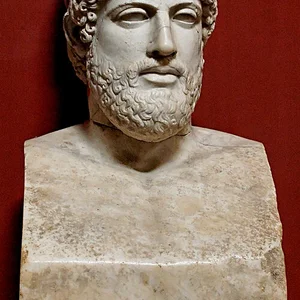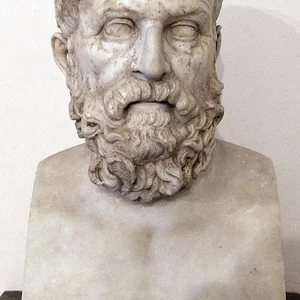

Solon (629–559 BC) was an Athenian statesman and lawmaker who profoundly reformed the city of Athens in the early 6th century BC. His laws laid the foundations of Athenian democracy by limiting the power of the aristocracy and granting rights to citizens.
Solon(629 av. J.-C. — 559 av. J.-C.)
Solon
Athènes
7 min read
Frequently asked questions
Key Facts
- 594 BC: appointed archon in Athens and given the authority to reform the laws
- Abolition of debt slavery, freeing impoverished citizens
- Creation of social classes based on wealth rather than birth, opening access to public offices
- Establishment of the Ecclesia (citizen assembly) and strengthening of the people's role in governance
- Writing of a constitution, marking a clear break from the previous aristocratic regime
Works & Achievements
A set of political and economic reforms that transformed Athens by abolishing debt slavery and reorganizing society. These reforms laid the foundations of Athenian democracy by curbing aristocratic power.
A landmark reform that freed Athenian citizens who had been enslaved due to their debts. This measure marked a turning point in the recognition of the rights of poorer citizens.
A reform creating a magistracy more accessible to citizens beyond the aristocracy, gradually opening political power to a broader portion of the Athenian population.
Solon had Athens's laws written down and publicly displayed, putting an end to aristocratic arbitrariness and guaranteeing theoretical equality before the law for all citizens.
Solon restructured Athenian society based on wealth rather than birth alone, allowing wealthy non-noble citizens to access public offices and magistracies.
Creation of a popular court of justice composed of ordinary citizens, foreshadowing the Athenian democratic legal system and placing judicial power in the hands of the people.
Solon composed poems and elegies to justify and explain his political reforms, using literature as a tool for political communication with the citizens of Athens.
Anecdotes
Solon voluntarily gave up absolute power after enacting his reforms. Although he was offered the position of tyrant of Athens, he refused and went into self-imposed exile for ten years to let his laws take effect without his interference. His rejection of personal power shows his commitment to the common good over his own ambitions.
Solon abolished debt slavery, a practice that reduced poor citizens to bondage if they could not repay their debts. This landmark reform, known as the 'Seisachtheia' (the 'shaking off of burdens'), freed thousands of Athenians and transformed the social fabric of the city.
As a poet, Solon used verse to persuade the Athenians to reconquer the island of Salamis, which had been lost to the Megarians. His martial poems, known as 'elegies', so inspired his fellow citizens that they retook the island and restored their political pride.
Solon created a classification of citizens based on wealth rather than aristocratic birth. This innovation allowed wealthy men of non-noble origin to access public offices, significantly weakening the political monopoly held by the Athenian aristocracy.
Solon established the Ekklesia, the assembly of citizens, as the sovereign authority of Athens. By giving ordinary citizens a voice in this assembly, he laid the institutional foundations of Athenian democracy, which would fully flourish a century later.
Primary Sources
Solon established that no one could sell his children or his wife, and that any man indebted to another would be freed from personal servitude.
Solon, having been appointed arbitrator and mediator, freed the people from the servitude into which they had fallen, and established the laws by which the citizens were to be governed.
Solon divided the citizens into four classes according to wealth and assigned to each its duties and privileges, so that all might have a share in the government.
I gave the people as much power as was sufficient, neither diminishing nor adding to their honor; and for those who held power and wealth, I took care that they too should suffer no injustice.
Key Places
Capital of Attica where Solon served as magistrate and carried out his major legislative reforms. It was in Athens that he abolished debt slavery and reorganized civic society.
The central public square of Athens where Solon proclaimed his laws and citizens gathered to participate in civic life. This place symbolizes the emergence of political participation that Solon championed.
The regional territory surrounding Athens that Solon unified administratively through his reforms. His laws applied to the entire region and all its inhabitants.
A neighboring island where Solon is said to have stayed and drawn inspiration for his political positions. The region was caught up in the conflicts that Solon sought to resolve.
A Greek city-state that Solon is said to have visited after his reforms in order to observe other political models. His travels allowed him to test his ideas against those of other cities.
A country Solon is said to have traveled to in order to broaden his knowledge and study other systems of government. These journeys influenced his approach to reform and his broader political vision.
Typical Objects

Writing materials used by Solon to draft and compile his laws. These wax-coated tablets allowed text to be written and erased with ease, making them an essential tool for a lawmaker developing major reforms.

A stone monument on which Solon's laws were inscribed and publicly displayed in Athens. These stelae allowed citizens to consult the legal texts directly, symbolizing the transparency at the heart of his reforms.

A ceramic vessel characteristic of the Archaic period, used to store oil and wine. This everyday object reflects the Athenian economy that Solon reshaped through his commercial reforms.

Athens' silver currency, a symbol of Solon's economic and monetary reforms, which restructured the city-state's financial system and promoted trade.

A traditional Greek tunic worn by Athenian citizens in the 6th century BCE, illustrating the everyday dress of the statesmen and citizens of Solon's era.

A pointed instrument used to inscribe text onto wax or stone tablets, an indispensable tool for the scribes who transcribed the Solonian laws.

A symbol of honor and recognition bestowed upon great Greek statesmen. Solon, as a respected reformer, would likely have received this emblem of civic prestige.

The central gathering place of Athens where Solon met with citizens to debate laws and public affairs, embodying the birthplace of the nascent democracy he helped establish.
School Curriculum
Vocabulary & Tags
Key Vocabulary
Tags
Concept
Daily Life
Morning
Solon rises at dawn and begins his day with ritual ablutions in cold water, a common practice among Athenian citizens. He puts on his himation and prepares to take part in public affairs, for as a statesman he devotes his mornings to political meetings and discussions with other magistrates at the Agora.
Afternoon
In the afternoon, Solon goes to the Agora — Athens' political and commercial hub — where he meets with citizens and listens to their concerns about debt and social injustice. He may also take part in philosophical debates with other prominent figures, or oversee the enforcement of his legislative reforms among the magistrates.
Evening
In the evening, Solon shares a meal (deipnon) with family or influential friends, providing an opportunity for intellectual and political exchange. He may attend a symposium — a convivial gathering reserved for men — where politics, philosophy, and poetry are discussed over wine diluted with water.
Food
Like all prosperous Athenians, Solon's diet consists mainly of barley bread, vegetables (lentils, broad beans), cheese, and salted fish. Fruit, olive oil, and wine (diluted) also play an important role in his meals, while meat is reserved for religious sacrifices.
Clothing
Solon wears the himation, a large rectangular cloak draped over one shoulder, over a simple wool or linen tunic (chiton). As a man of political distinction, he is clean-shaven or wears a well-kept beard, and his hair is short — all markers of the free Athenian citizen of the era.
Housing
Solon lives in a typical Athenian aristocratic home (oikos), built around a central courtyard (aule). His dwelling includes separate rooms for men and women, with stone or mudbrick walls, a tiled roof, and few outward-facing windows — a design chosen for security and privacy.
Historical Timeline
Period Vocabulary
Visual Style
Un style inspiré de la céramique grecque antique (technique des figures rouges), combinant rigueur géométrique et noblesse classique. L'ambiance évoque l'austérité de l'époque archaïque, avec des teintes terracotta chaleureuses et une iconographie athénienne traditionnelle.
Sound Ambience
Une ambiance urbaine antique immergée dans l'atmosphère de l'Athènes archaïque, mêlant les bruits de débats politiques, de réformes législatives et de vie civique avec les sons naturels méditerranéens, créant un fond sonore évocateur des transformations démocratiques orchestrées par Solon.
Liens externes & ressources
Références
Œuvres
Réformes de 594 av. J.-C.
594 av. J.-C.
Abolition de l'esclavage pour dettes
594 av. J.-C.
Création de l'Archontat démocratique
594 av. J.-C.
Codification des lois écrites
594 av. J.-C.
Réorganisation des classes sociales par la richesse
594 av. J.-C.
Institution de l'Héliée
594 av. J.-C.
Poésies et élégie politique