Kids interview Antigone
by Charactorium · Antigone · Mythology · 5 min read
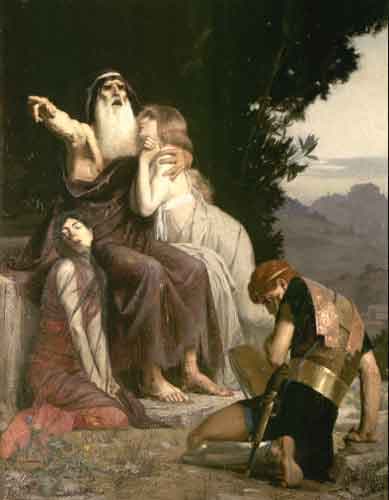
Two young visitors of twelve push open the door of a cool room, at the foot of the citadel of Thebes. A young woman in a linen tunic waits for them, calm and grave. This is Antigone — and she agrees to tell them everything.
—What was it like, having a father like Oedipus?
You know, my child, my family carries an old wound. They call it the curse of the Labdacids — like a shadow cast over us for generations. My father, Oedipus, killed his own father without knowing it, then married his own mother, Jocasta. And Jocasta was also my mother. So imagine: I am both her daughter and her granddaughter. That is heavy for a child to bear. I did not choose this fate; it was there before my birth. But I was never ashamed of my father. When you are born in the night, you quickly learn to walk straight.
When you are born in the night, you quickly learn to walk straight.
—And your blind father, where did you accompany him?
Everywhere, my child. When the truth came out, my father gouged out his own eyes and had to leave Thebes. A king turned beggar, driven out onto the roads. No one wanted him. So I took his hand. I was his eyes. Imagine a long walk in the dust, not knowing where to sleep at night, under the sun and rain. We went as far as Colonus, near Athens, and that is where he ended his life. I did not need to be told to stay by his side. You do not let your father fall by the wayside. Never.
—And for your brother, what exactly did you do?
My brother Polyneices had died in battle, before the walls of Thebes. But the king had forbidden his burial. His body lay there, abandoned, outside. Can you imagine? No tomb, nothing. So one night, I went out. I bent over him. And I poured three handfuls of dust and earth on his body. That is all. Not a grand procession, no music. Just my hands and a little dry earth. But that small gesture was my most sacred duty to him. And it was also, I knew, my death sentence.
—But why just dust — was that enough?
Good question, my child. You think three handfuls of earth are trivial? But among us, in my time, it was sufficient. We believed that a dead person left unburied wandered without rest, never finding peace. His soul could not descend to join the world of the dead. A few handfuls of dust, and the door opened for him. Imagine a tiny key that opens a huge door. That is what my gesture was. Tiny in the hand, enormous in the sky. That is why I dared: I could not leave my brother outside, like a forgotten beast.
Tiny in the hand, enormous in the sky.
—Why did you disobey King Creon?
Because there are laws higher than those of a king, my child. Creon had written his prohibition, his human decree — we call that the nomos. But above it, there are the laws of the gods, those that no one ever wrote and no one can erase. Before him, I said that I did not believe his edicts strong enough to make me transgress 'the unwritten and unfailing laws of the gods.' Those laws date neither from yesterday nor today. They are eternal. A king can command the living. He does not command the dead.
A king commands the living. He does not command the dead.
—Weren't you afraid to speak to him like that, to a king?
Yes, of course. My heart was pounding. Imagine yourself, so young, standing in the great hall of the palace, before the most powerful man in the city, his guards all around. And he looks down at you from his throne. But you know, I had already lost everything: my father, my mother, my two brothers. When you have nothing left to lose, fear becomes very small. So I did not lower my eyes. I told him the truth to his face. It is not extraordinary courage, my child. It is just that I refused to lie to save myself.
—And as punishment, what did Creon do to you?
He chose a terrible thing, my child. He did not want to shed my blood in the city — he feared polluting it, defiling it in the eyes of the gods. So he ordered that I be walled up alive. Do you understand that word? They locked me in a stone cave, and sealed the entrance. Alive, in the dark, with a little food, so that hunger would take me, not his sword. Imagine a night that never ends, without a single star. He thought he could wash his hands of it. But you do not wash your hands of such a thing.
—And afterward, in the cave, what happened?
Then, my child, everything collapsed at once. The old prophet Tiresias, who reads the will of the gods, warned Creon: he was making a terrible mistake. The king took fright, he wanted to free me. He ran to the tomb. But he arrived too late. I had already hanged myself in the dark. And his own son, Haemon, who was to marry me, killed himself on my body in despair. One death called another, like stones falling. Creon had wanted to protect his power. He ended up alone, in an empty house.
One death called another, like stones falling.
—They say your story is still performed long after. Why do you think?
Because my story is not really mine, my child. It returns every time a person stands alone before an unjust order. On one side, there is the city, the king, the law of men. On the other, there is the family, the heart, what you know deep down to be right. Both have their reasons — that is what makes it so heartbreaking. As long as there is someone forced to choose between obeying and doing right, they will remember the little girl from Thebes who said no. I have become a question that people never stop asking.
I have become a question that people never stop asking.
—If a girl today had to choose between obeying and doing what is right, what would you tell her?
I would take her hand, as I took my father's on the roads. And I would tell her: listen, my child, disobedience is not a game. I transgressed a human law in the name of a higher law, and it cost me my life. Think carefully, do not do it out of anger or pride. But if it is about honoring someone you love, defending what is sacred, then let no one tell you it is wrong. A handful of earth poured out of duty is worth more than a great silence out of fear. The rest, the gods will judge.
A handful of earth poured out of duty is worth more than a great silence out of fear.
This imaginary interview was generated by artificial intelligence from sources documented in Antigone's profile. It dramatises what the figure might have said based on what we know about them, but does not constitute attested historical testimony. For primary sources and factual documentation, refer to the full profile.