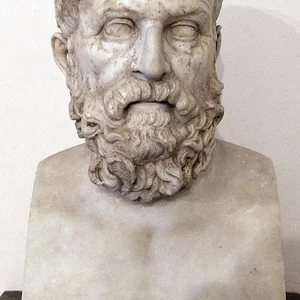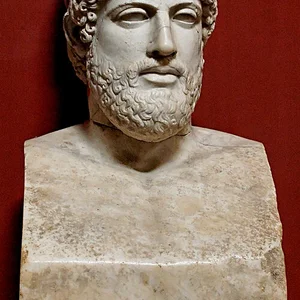

Pericles (495–429 BC) was an Athenian statesman who presided over the golden age of Athenian democracy in the 5th century BC. A dominant political leader for more than thirty years, he transformed Athens into the cultural and artistic center of ancient Greece, most notably by overseeing the construction of the Parthenon.
Pericles(493 av. J.-C. — 428 av. J.-C.)
Pericles
Athènes
7 min read
Frequently asked questions
Famous Quotes
« Our constitution is called a democracy because power is in the hands not of a minority but of the greatest number.»
« We love beauty without extravagance, and wisdom without softness.»
Key Facts
- Political leader of Athens from 461 BC, dominating public life for approximately 30 years
- Strengthened Athenian democracy by expanding the political rights of citizens
- Launched the construction program for the Parthenon and the monuments of the Acropolis (between 447 and 432 BC)
- Led Athens into the Peloponnesian War against Sparta (431–404 BC)
- Died in 429 BC, most likely from the plague that struck Athens during the war
Works & Achievements
Temple dedicated to Athena Parthenos, a masterpiece of classical Greek architecture built under the direction of Phidias. It symbolizes the height of Athenian civilization under Pericles.
The monumental gateway to the Acropolis designed by the architect Mnesicles. This imposing structure reflects the grandeur Pericles envisioned for the entrance to the sanctuary of Athena.
A concert and performance hall built at the foot of the Acropolis, the first roofed building in Athens intended for musical competitions. It bears witness to the cultural policy of Pericles.
Pericles instituted a payment (misthos) for jurors and magistrates, enabling poorer citizens to actively participate in political life. This reform deepened Athenian democracy.
A speech delivered at the funeral of the first Athenian soldiers killed in the Peloponnesian War. This text is considered the greatest definition of democracy from Antiquity.
Pericles transformed the defensive alliance against Persia into a maritime empire dominated by Athens, using tribute from allies to finance the city's power and influence.
Anecdotes
Pericles always wore his general's helmet in public, to the point that Athenian comic poets nicknamed him 'the onion head' because of the elongated shape of his skull that he thus concealed. Plutarch reports that he was very conscious of his image and showed himself only rarely in order to preserve an aura of authority.
During the great solar eclipse of 431 BC, the Athenian fleet was seized with panic. Pericles, to reassure his terrified helmsman, held his cloak in front of the sailor's eyes and asked him whether it hurt — no, the man replied. 'Well, the only difference between the eclipse and my cloak is the size of what is blocking the sun.'
Pericles was the close friend of the philosopher Anaxagoras, who believed that the sun was a ball of fire and not a god. This friendship earned him accusations of impiety. Pericles had to use all of his influence to save his friend from a trial that could have cost him his life, demonstrating his loyalty in friendship.
Upon the death of his two legitimate sons, carried off by the plague, Pericles — a man renowned for his composure — broke down in tears in public at the funeral. He exceptionally obtained from the Athenian Assembly that his illegitimate son with Aspasia be granted Athenian citizenship, the very right he had himself denied through his own law of 451 BC.
Primary Sources
Pericles surpassed all others not only in eloquence, but also in the nobility of his life and the purity of his character. He was never known for corruption or baseness.
Athens is the school of Greece, and each Athenian is capable of adapting to the most varied situations with remarkable grace and versatility.
Our constitution does not copy the laws of neighbouring states; we are rather a pattern to others than imitators ourselves. Its administration favours the many instead of the few; this is why it is called a democracy.
He reproached Pericles for squandering the allies' money to beautify Athens, like a vain woman adorning herself with precious stones and gilded statues.
Key Places
Sacred hill where Pericles had the Parthenon, the Propylaea and the Erechtheion built. This vast construction project, entrusted to Phidias, made Athens the most beautiful city in the Greek world.
Hill in Athens where the Ecclesia, the Assembly of citizens, convened. It was from this rostrum that Pericles delivered his speeches and persuaded the Athenian people of his policies.
The great port of Athens, connected to the city by the Long Walls whose construction Pericles reinforced. This port was the heart of the maritime and commercial power of the Athenian empire.
Sacred island in the Aegean Sea where the treasury of the Delian League was held. Pericles had this treasury transferred to Athens around 454 BC, thereby funding the great works of the Acropolis.
Village in Attica where Pericles was born, son of Xanthippus and Agariste, an aristocratic family of the Alcmaeonids. This deme is a reminder of his noble origins despite his commitment to democracy.
Typical Objects

Pericles is almost always depicted wearing his crested bronze helmet, a symbol of his role as strategos. He also wore it in public to conceal the unusual shape of his skull.

A common writing medium in ancient Athens, used to draft decrees, legislative proposals, and speeches. Pericles recorded his proposals on them before submitting them to the Assembly.

A two-handled ceramic cup used at banquets (symposia) where Athenian elites debated politics and philosophy. Pericles frequented these intellectual circles alongside Aspasia and Socrates.

The architects Ictinus and Callicrates presented their plans to Pericles in the form of scale models. He personally oversaw the great building project on the Acropolis, entrusted to his friend the sculptor Phidias.

An instrument used to sound signals at sea, a reminder that Athens under Pericles was above all a maritime power. The Athenian fleet was the essential tool of his empire.

Under Pericles, a stipend was introduced to allow poorer citizens to participate in democratic life (court juries, assemblies). These tokens symbolize his landmark democratic reform.
School Curriculum
Vocabulary & Tags
Key Vocabulary
Tags
Concept
Daily Life
Morning
Pericles rose early, a habit common among Athenian politicians. He would go to the Agora at dawn to greet citizens and discuss public affairs, practicing closeness with the people according to Plutarch. He regularly inspected the construction sites on the Acropolis in the company of Phidias.
Afternoon
The afternoon was devoted to sessions of the Ecclesia on the Pnyx or to meetings of the Council of Five Hundred (Boule). Pericles would present his legislative proposals and carefully prepared speeches, whose rhetorical effectiveness was unanimously recognized.
Evening
Evenings were often spent at symposia (refined banquets) at his home, in the company of his companion Aspasia, the philosopher Anaxagoras, and artists such as Phidias. These gatherings blended wine, music, philosophy, and political debate in a refined atmosphere.
Food
Like the majority of wealthy Greeks, Pericles ate olives, barley bread, cheese, dried legumes, fish, and meat on sacrificial occasions. Wine diluted with water was the daily beverage, consumed in moderation outside of symposia.
Clothing
Pericles wore the chiton (linen tunic) and the himation (large draped woolen cloak), the standard garments of the Athenian aristocrat. As a strategos, he wore his bronze Corinthian helmet during ceremonies and official public appearances.
Housing
Pericles lived in a house (oikos) befitting the Athenian aristocracy, modest in outward appearance but comfortable inside: a central peristyle courtyard, a gynaeceum (women's quarters), and a triclinium for banquets. Plutarch notes that he lived without ostentation despite his dominant position.
Historical Timeline
Period Vocabulary
Visual Style
L'esthétique de la Grèce classique : marbre blanc éclatant sous le soleil méditerranéen, ciel bleu égéen profond, drapés ocre et blancs, et la grâce idéalisée des frises du Parthénon.
Sound Ambience
L'ambiance sonore d'Athènes au Ve siècle : le fracas du grand chantier du Parthénon, l'agitation de l'Agora et le souffle marin du Pirée, ponctués des débats de l'Assemblée populaire.
Liens externes & ressources
Références
Œuvres
Le Parthénon
447-438 av. J.-C.
Les Propylées
437-432 av. J.-C.
L'Odéon de Périclès
vers 445 av. J.-C.
Réforme démocratique et instauration du misthos
vers 462-451 av. J.-C.
Oraison funèbre (rapportée par Thucydide)
431 av. J.-C.
Consolidation de la Ligue de Délos en empire athénien
454-430 av. J.-C.