Imaginary interview with Antigone
by Charactorium · Antigone · Mythology · 6 min read
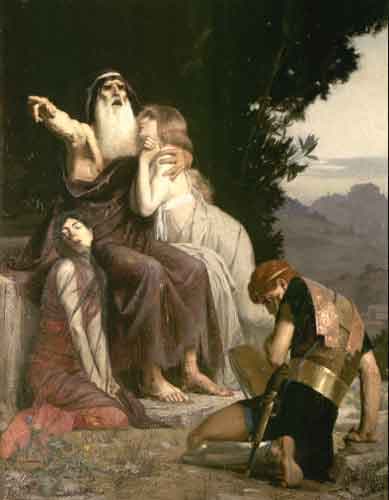
Thebes, before dawn. In a silent courtyard of the Cadmea palace, a young woman with hands still stained with earth agrees to answer a few questions. She already knows what awaits her; yet her voice does not tremble.
—Do you remember the exact gesture you performed on your brother's body?
People imagine it requires a pyre, libations, a long procession. No. I walked to the plain of Thebes, where my brother Polynices lay without a tomb, left for dogs and birds. I bent down, took earth in my palms, and scattered three handfuls of dust over him. Three, no more. That was enough. The gods below demand neither gold nor many tears: a little earth poured on a dead man, and his shadow ceases to wander, finally crossing the threshold of the Underworld. That is what Creon never wanted to understand. He thought he had forbidden me the impossible—royal funeral rites. But I needed only my two hands and a handful of that Theban earth to give Polynices what he was owed.
—Why risk so much for what others considered a detail?
A detail? To refuse burial to a dead man is to kill him a second time—worse, it condemns him to wander without rest, banished from the kingdom of shadows. My sister Ismene trembled, she begged me to submit, to spin wool and keep silent as a woman was expected to. But I could not leave Polynices to rot in the sun while the living wove crowns for the victors. Funeral rites are not an ornament: they are the last bond between the dead and those who loved them. I would have washed his body, anointed it, poured libations, placed the marks of mourning upon him. Everything was forbidden to me. So I gave the bare minimum that the gods require—and that was already everything.
—When you stood before Creon, what did you find to answer him?
He asked if I had dared to defy his edict. I did not deny it. I told him: 'I did not think your edicts had enough force to oblige a mortal to transgress the unwritten and unchanging laws of the gods. For these laws are not of today or yesterday; they are eternal, and no one knows when they were born.' His decree, his nomos, was no more than a parchment signed the day before by a man. The laws I invoked had neither author nor date. Creon ruled over the living of Thebes; he did not rule over the gods below. That is what drove him mad: that a girl should oppose him with an authority older than his throne.
His decree was no more than a parchment signed the day before by a man.
—Would you say that disobeying was a choice or a necessity for you?
A choice? I never experienced it that way. To disobey a man in order to obey the gods is not a revolt; it is the order of things set right. Creon confused his will with justice; he forgot that above the nomos of cities watch the divine laws, those that no herald has proclaimed and that no king can repeal. I am said to be the first to have set conscience against the law of the city. Perhaps. But I had no doctrine, only a brother without a tomb and a clear duty. When a mortal's edict commands impiety, obeying it would be the true fault. I preferred death to that denial—and I would do the same gesture again, a thousand times, on the plain where Polynices lay.
—Your family is said to be marked by a curse. How do you bear this heritage?
I was born from a knot that no one should be able to untie. My father Oedipus killed his own without knowing it, then married his own mother, Jocasta—who was thus both my mother and my grandmother. Understand what that means: I am the daughter and the granddaughter of the same woman. The curse of the Labdacids did not fall upon me one fine morning; it flowed in my blood from my first breath. When the truth burst forth, when my father gouged out his eyes and my mother killed herself, I understood that our house was doomed to misfortune generation after generation. Eteocles, Polynices, I—we were only the last links in a chain forged long before our birth.
I am the daughter and the granddaughter of the same woman.

—You accompanied your blind father on the roads of exile. What remains of those years?
When my father was driven from Thebes, blind and cursed, who was left to guide him? His sons were already quarreling over his throne. I took his hand. We walked dusty roads, begging for hospitality, until we reached a sacred grove near Athens, at Colonus. There my father at last found rest, welcomed by a land that would make his tomb a protective talisman. I was his eyes during those years of wandering, his staff and his voice. I am known for what I dared at the death of Polynices, but before burying my brother, I had already learned from my father what loyalty and duty to one's kin are worth. It was on those roads that my courage took root, long before Creon's edict.
—What sentence did Creon pronounce against you?
He did not want to shed my blood in the public square—that would have defiled his city, and he was attached to his tyrant's cleanliness. So he imagined worse: to have me walled up alive in a stone cave, with a little food, so that the gods might decide, he claimed, and his hands remain clean. I was led to that sealed tomb as a bride is led to her nuptial chamber—but death awaited me as a bridegroom. Locked in the dark, cut off from the living and not yet admitted among the dead, I floated between two worlds. Creon thought himself washed of my blood. In truth, he had ordered everything. I was not going to let him savor that comedy.
—How did this sentence end?
The seer Tiresias, the blind man who sees farther than those with eyes, finally warned Creon: the gods were offended, his house would pay. The king took fright, he ran to my cave to free me. Too late. I had hanged myself in the darkness, with my own hands, rather than wait for hunger to consume me. And misfortune avalanched: Haemon, his son, my betrothed, threw himself upon my body and killed himself on me. His mother Eurydice, learning the news, took her own life in turn. Creon had wanted to spare his city defilement; he found himself alone, alive among his dead. The chain I had opened with a gesture of dust closed upon him.
He found himself alone, alive among his dead.
—Did you think, when defying Creon, that people would still speak of you long after your death?
How could I have? A girl of Thebes who scatters three handfuls of earth on her brother does not think of glory—she thinks of a shadow that must be appeased. But if I could imagine that I would be read in a hundred years, in a thousand years, I would dare to hope this: that my gesture might serve others, one day, standing before a king too sure of his right. For there will always be Creons, and always dead men whom someone will want to deprive of burial. If my name should survive, let it not be for my death, but for what it affirms—that an unjust law obliges no one. I would then be less a lost princess than a warning to all the powerful.
—If your story were to inspire those who resist injustice, what meaning would you give it?
I would not want them to make of me a simple rebel who spits on all authority. That would be too convenient, and false. Creon, in his own way, defended something real: the city, order, the fear of chaos after a fratricidal war. Polynices had marched in arms against his own homeland. That is the true tragedy—not good against evil, but two duties that cannot coexist. I, family, the dead, the gods below; he, the state and the living. Each had his share of reason, and that is why we shattered against each other. If anything is remembered from my story, let it be this: that sometimes one must choose between two loyalties, and pay for that choice with one's life. I chose the unwritten laws. I regret nothing.
Not good against evil, but two duties that cannot coexist.
This imaginary interview was generated by artificial intelligence from sources documented in Antigone's profile. It dramatises what the figure might have said based on what we know about them, but does not constitute attested historical testimony. For primary sources and factual documentation, refer to the full profile.