Imaginary interview with Antoine de Lavoisier
by Charactorium · Antoine de Lavoisier (1743 — 1794) · Sciences · 6 min read
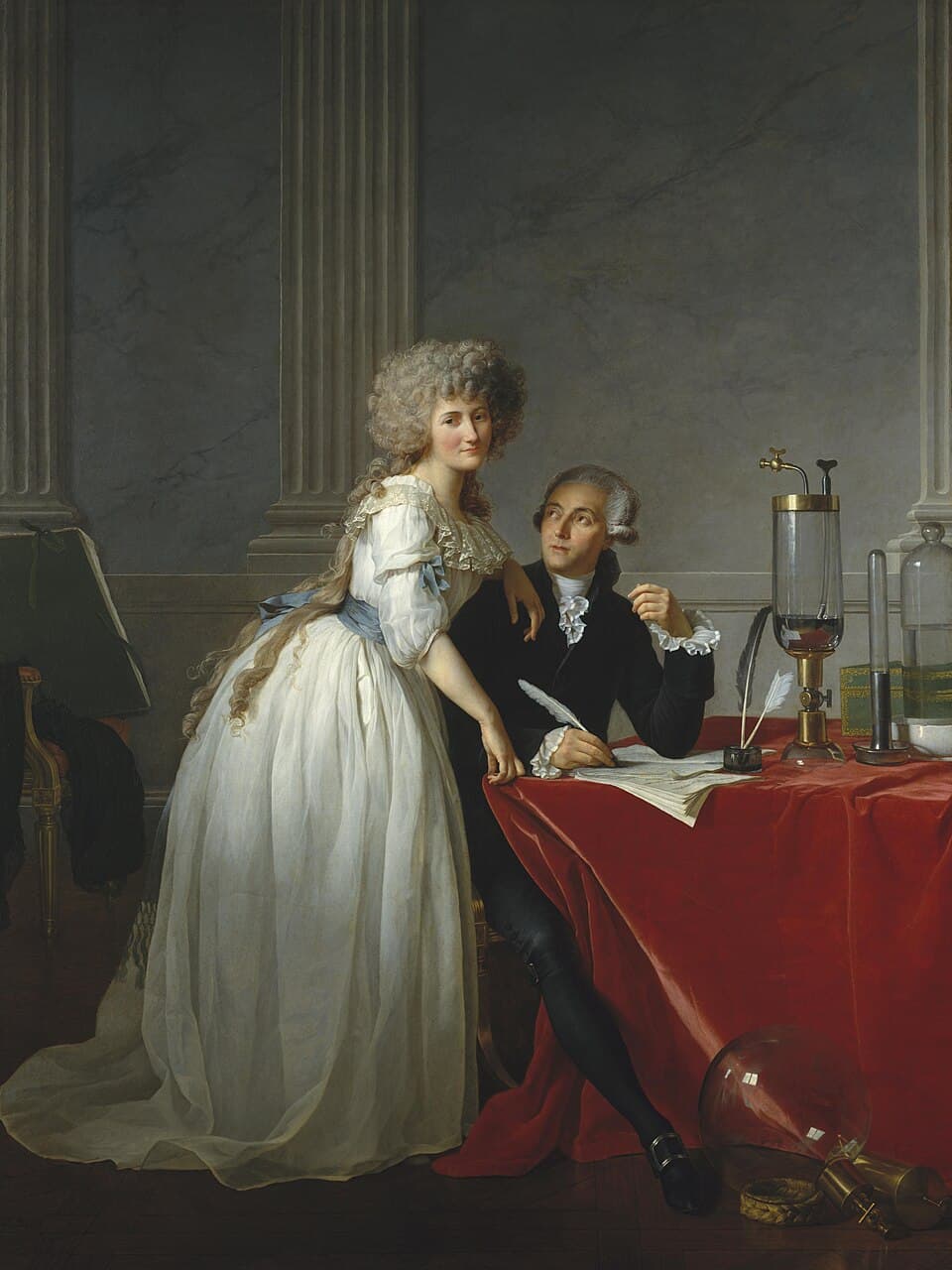
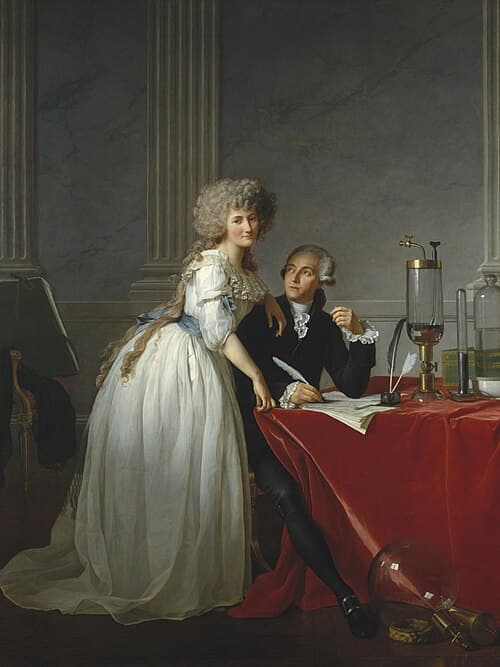
Paris, one winter evening around 1788. We are received in the apartment at the Arsenal, where the smell of mercury mingles with that of candle wax. Between a scale under a glass dome and ledgers covered in figures, a man with a methodical gaze sets down his canvas apron and agrees to answer. His wife, at the neighboring table, sharpens a pencil.
—Why does this scale occupy such a central place in your laboratory?
Come closer, but do not breathe on it. This scale weighs to the grain, roughly one-twentieth of a gram, and it is this scale, far more than my reasoning, that decides. Before me, people talked, they supposed, they invoked spirits and invisible principles; I weigh. When I calcine a metal in a sealed retort, I weigh everything that goes in and everything that comes out, and the accounts balance exactly. That is how I dared to write, in my Elementary Treatise on Chemistry of 1789, that “in every operation, there is an equal quantity of matter before and after the operation.” Nothing is gained by magic, nothing disappears by chance. Chemistry ceases to be a kitchen of soothsayers and becomes a science of exact accountants.
People talked and supposed; I weigh.
—How did you come to make measurement the very heart of your method?
I realized very early that an opinion weighs nothing and a figure weighs everything. Look at these notebooks: with Marie-Anne, we record every experiment, the temperature, the weight of materials, even the hour. An experiment that cannot be repeated and verified to the gram is nothing but a parlor anecdote. I wanted, as I wrote in my Reflections on Phlogiston, to bring our science to a more rigorous way of reasoning and to strip it of everything that prejudice adds to it. See this ice calorimeter, designed with Laplace: it measures the heat of a reaction by the amount of ice melted. Where others felt a vague warmth, we counted ounces of water. Nature does not lie on a scale; it is men who lie around it.
An opinion weighs nothing and a figure weighs everything.
—What convinced you to overthrow the old theory of phlogiston?
Phlogiston was that imaginary fire that metals were supposed to release when burning. But here is the absurdity: when you calcine a metal, it does not lighten, it becomes heavier! How could a substance that loses something gain weight? In my Memoir on Combustion in General, in 1777, I showed that calcination and combustion are due only to pure air, and that the increase in weight is exactly equal to the amount of air absorbed. There was no fluid escaping, but air being fixed. I gave a name to this pure air: oxygen, which in Greek means acid-generator. A century-old theory collapsed, not under a fine speech, but under the verdict of the scale.
How could a substance that loses something gain weight?
—Do you remember what you owed to the Englishman Joseph Priestley in this matter?
I am not ashamed to acknowledge it: in 1774, Priestley isolated a gas which he called, faithful to the old ideas, “dephlogisticated air.” He held the object in his hand without understanding its true significance. He saw the absence of a fluid; I saw the presence of a real body, which combines, is weighed, and is named. That is why I renamed it oxygen in our Method of Chemical Nomenclature of 1787, written with Guyton de Morveau, Berthollet, and Fourcroy. For languages, we wrote, serve not only to express ideas: they are true methods for moving from the known to the unknown. Naming correctly is already understanding. Priestley found the thing; it fell to me to give it its truth and its name.
Priestley found the thing; it fell to me to give it its name.
—What did you want to prove by decomposing water before the Academy of Sciences?
Since antiquity, water was considered an element, one of the four principles of the world. What a mistake! In 1785, before my colleagues at the Royal Academy of Sciences, I passed steam over red-hot iron: the water broke apart, hydrogen escaped on one side, oxygen fixed on the metal. Then, even more beautiful, I recomposed water by marrying these two gases. Water was therefore not an element, but a marriage. To collect these gases without contaminating them, I used a mercury bell jar inverted over its trough, and the gasometer to measure their exact volume. When the audience saw water born from two airs, I thought I heard two thousand years of philosophy crack. Nature does not know the four elements of the Ancients.
I thought I heard two thousand years of philosophy crack.
—Were these cumbersome instruments, the gasometer, the bells, truly indispensable?
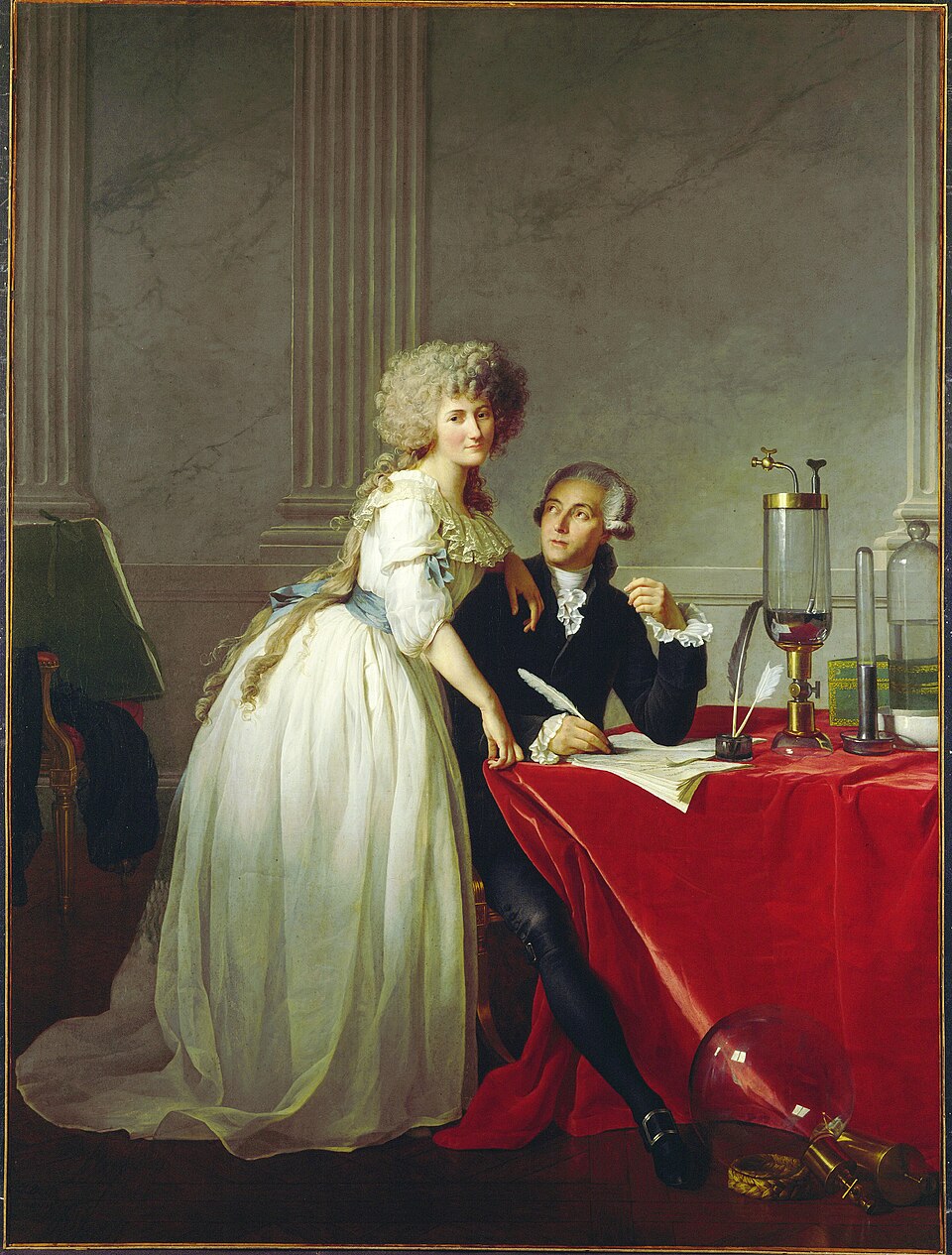
A physicist may be content with an eye; an exact chemist needs equipment. My gasometer is a heavy, expensive, capricious machine, but without it I could not say how much air a metal devours or how much a lung consumes. The pneumatic trough, filled with water or mercury, allows me to capture a fugitive gas without it mixing with the room air. See: ancient chemistry was done by nose and hand; mine is done by measurement and standard. It is costly, I admit, and I had to find the money somewhere. Every retort, every scale you see here has a price, and that price, my research could not pay alone.
Ancient chemistry was done by nose; mine is done by standard.
—How did you finance such expensive research?
Through a role that many reproach me for: I am a tax farmer. Understand this word well: the king entrusts me and my associates with collecting certain taxes — on salt, tobacco, customs — against an advance paid to the Treasury. It is lucrative, it is hated by the people, and I am not unaware of it. But it is this money that paid for the best collection of instruments in Europe, there, in those cabinets at the Arsenal. Without the Farm, no gasometer, no scale to the grain, no calorimeter. I also directed the Gunpowder Administration, improving the production of saltpeter for the kingdom's cannons. One day I will be told that I served two masters, science and the tax office. I will answer that one fed the other.
I will be told that I served two masters: science and the tax office.
—How do you experience the upheavals of the Revolution surrounding you?
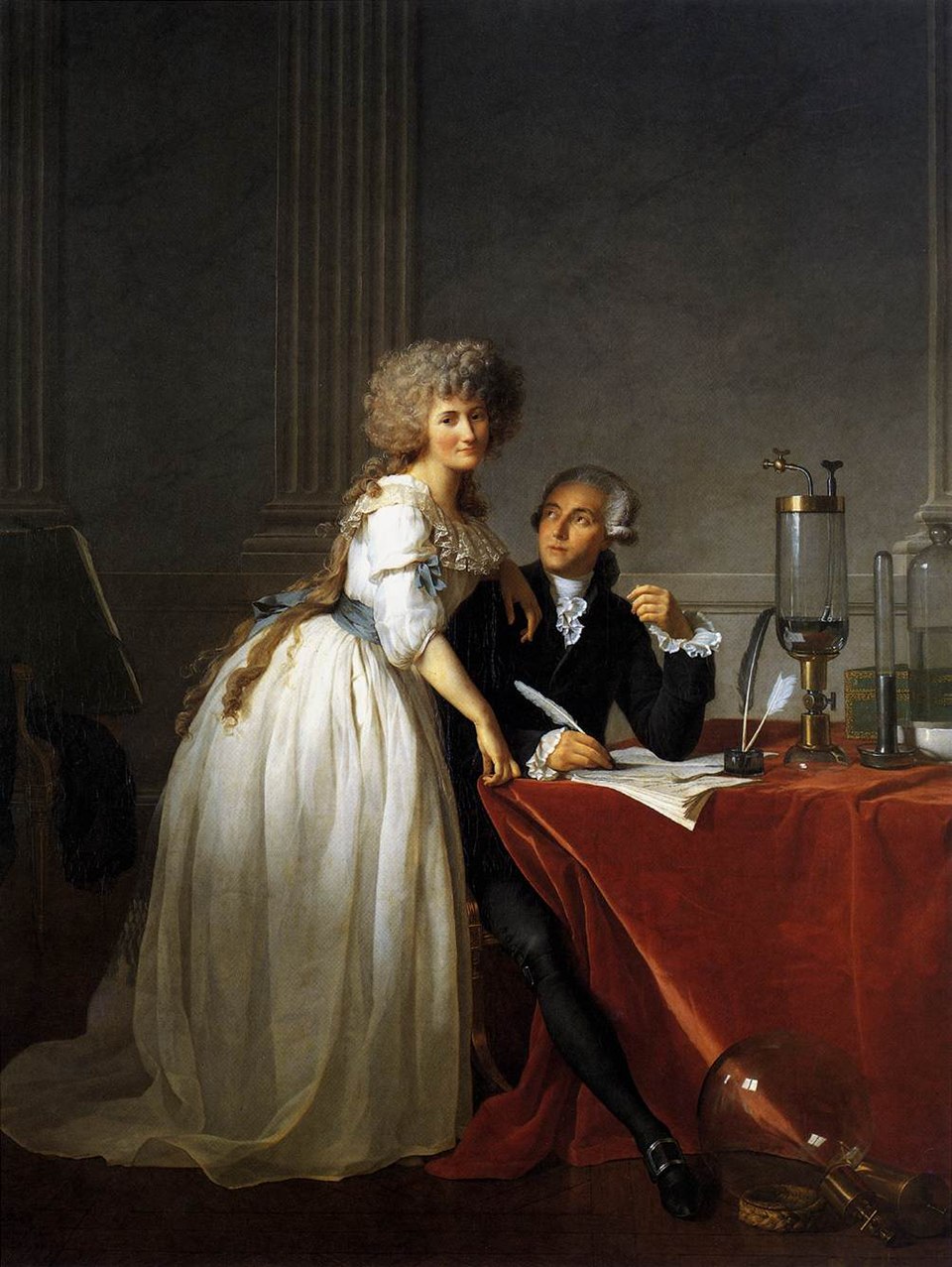
I experience them with the prudence of a man who weighs, and with the anxiety of a man who knows how to count. The Bastille fell the same year my Treatise appeared, in 1789; since then, the ground has moved beneath our feet. I thought I could serve the nation as I had served the king: in weights and measures, where we are working on a universal system, at the Bureau of Consultation for Arts and Crafts. But in 1791 the General Farm was abolished, and people are beginning to look askance at those who were part of it. A science should have neither cockade nor suspicion, but men decide otherwise. I continue my memoirs on respiration, convinced that a useful man has nothing to fear. Perhaps I am wrong to believe so calmly.
A science should have neither cockade nor suspicion.
—What role does your wife, Marie-Anne, play in the laboratory work?
Never say she assists me: she collaborates. Marie-Anne Paulze came into my life very young, and it is she who, in the evening, at this table at the Arsenal, takes notes while I handle the equipment. She learned Latin and especially English — which I know too little — to translate for me the memoirs of foreign scholars, those of Priestley, of Cavendish, which I would not read without her. And those fine engravings you admire in my works, showing every retort, every gasometer in detail? It is her hand that drew them, from our apparatus. Without these laboratory notebooks that she fills with regular handwriting, half of my experiments would have been lost in my memory. The new chemistry is written with two pens.
Never say she assists me: she collaborates.
—What would you say to those who will one day judge your work, perhaps in a century?
If I could imagine being read a hundred years from now, I would tell them: do not retain my opinions, retain my method. The facts I have gathered will one day be surpassed, corrected, perhaps mocked; such is the fate of any living science. But the way of weighing, of doubting, of verifying everything to the gram before affirming — that is what I would like to bequeath to them. I have recorded even the respiration of animals as a slow combustion, measuring oxygen consumed and heat released, because I believe that a breath can be quantified like a flame. Let my successors continue what Marie-Anne and I begin here, in this smell of mercury and wax. Let them keep their scales clean and their notebooks up to date. The rest, time and reason will take care of.
Do not retain my opinions, retain my method.
Read further
This imaginary interview was generated by artificial intelligence from sources documented in Antoine de Lavoisier's profile. It dramatises what the figure might have said based on what we know about them, but does not constitute attested historical testimony. For primary sources and factual documentation, refer to the full profile.