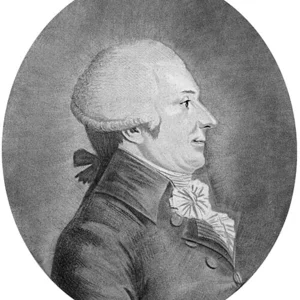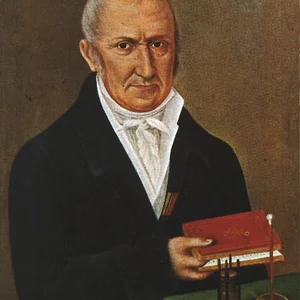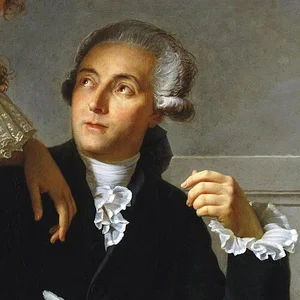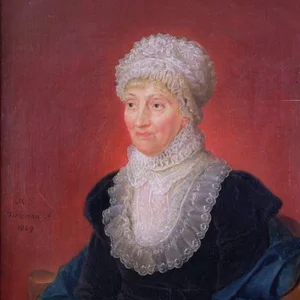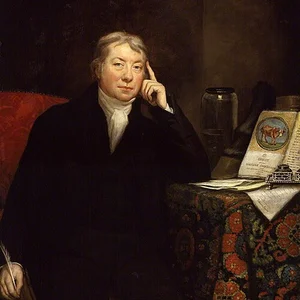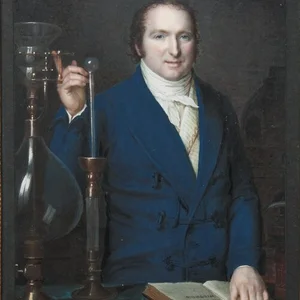

French chemist and statesman, a collaborator of Lavoisier in the reform of chemical nomenclature. A member of the National Convention, he played a major role in reorganizing scientific education during the Revolution.
Antoine François de Fourcroy(1755 — 1809)
Antoine-François Fourcroy
Royaume de France
6 min read
Frequently asked questions
Key Facts
- Born in 1755 in Paris, died in 1809
- Co-author in 1787 of the new chemical nomenclature with Lavoisier, Guyton de Morveau, and Berthollet
- Elected deputy to the National Convention in 1793
- Contributed to the founding of the École Polytechnique and the central schools (1794-1795)
- Author of the Système des connaissances chimiques (1801-1802), a vast synthesis of the chemistry of his time
Works & Achievements
A foundational collective work that rationalised the names of chemical substances. It established the language still used by modern chemistry today.
A clear and accessible chemistry textbook, reprinted and translated many times, which spread the new ideas of the discipline far and wide.
A vast eleven-volume synthesis bringing together all the chemical knowledge of his time.
A scientific and logistical effort to supply the armies of the Republic with the gunpowder they so desperately lacked.
A contribution to the founding of the prestigious school intended to train the nation's engineers and scholars.
As a councillor of state, Fourcroy was one of the main architects of the reorganisation of French secondary education.
Research on animal substances (fats, bodily fluids) that paved the way for organic and biological chemistry.
Anecdotes
Fourcroy was such an eloquent speaker that his chemistry lectures at the Jardin du roi drew enormous crowds: it is said you had to arrive very early to find a seat, for even high-society figures and ladies came to hear him explain chemical reactions as if it were a show.
Together with Lavoisier, Guyton de Morveau and Berthollet, Fourcroy took part in a genuine revolution of language in 1787: they devised a new chemical nomenclature that replaced the poetic, confusing names of alchemy (such as “oil of vitriol”) with logical terms (sulfuric acid) still used today.
During the Revolution, when France was running short of gunpowder, Fourcroy and other scientists organized the rapid production of saltpeter: throughout the country, the soil of cellars and stables was scraped to extract the precious nitre needed by the armies.
Fourcroy was one of the great architects of the new school system after the Revolution: he helped create the lycées in 1802 and the School of Medicine, playing a key role in reorganizing all of French scientific education.
Although he was a member of the Convention during the Terror, Fourcroy could not — or dared not — save his mentor Lavoisier from the guillotine in 1794, something long held against him; he did, however, later defend the memory and work of the great chemist.
Primary Sources
A well-made language, that is to say, a language in which one has succeeded in presenting ideas in a natural and consistent order, will bring about a necessary and even swift revolution in the way of teaching.
Chemistry is the science of the internal changes and changes of composition that bodies undergo upon one another through the effect of their reciprocal attractions.
The whole art of the chemist consists in separating the principles of bodies, then recombining them to recognize their true nature.
Education must be spread throughout all classes of society, for upon it depends the formation of enlightened citizens, useful to the Republic.
Key Places
Fourcroy's birthplace, where he lived, taught, and carried out his political duties until his death.
A Parisian scientific institution where Fourcroy taught chemistry from 1784 onward before large audiences.
The revolutionary assembly where Fourcroy sat as a deputy and contributed to education reforms and the war effort.
A leading scientific school founded in 1794, in whose creation Fourcroy took part to train the engineers of the Republic.
The institution where Fourcroy earned his doctorate in medicine in 1780 and which he later helped to reorganize.
Typical Objects

Glass vessel with a long, curved neck used to distill substances and collect the vapors of heated materials. A fundamental tool of the 18th-century chemistry laboratory.

An instrument for weighing substances very precisely before and after a reaction. A symbol of the new chemistry founded on measurement, inherited from the work of Lavoisier.

A document presenting the new rational names of substances, classified according to their composition. It established the vocabulary of modern chemistry.

A hearth used to heat substances intensely in order to bring about fusions and calcinations. The centerpiece of every chemistry cabinet of the period.

An insignia worn by members of the National Convention during the Revolution. It marks Fourcroy's political commitment in the service of the Republic.

Niter extracted from the soil of cellars and stables, an essential ingredient of gunpowder. Fourcroy organized its mass production for the armies of the Republic.
School Curriculum
Vocabulary & Tags
Key Vocabulary
Daily Life
Morning
Fourcroy rose early to prepare his lectures and his experiments. The morning was often devoted to reading, to writing his books and to corresponding with other scholars.
Afternoon
The afternoon was spent in the laboratory or in the amphitheatre of the King's Garden, where he gave his famous chemistry lessons before a large and attentive audience. During the Revolution, he added his political and administrative duties to it.
Evening
In the evening, he frequented the salons and gatherings of scholars where the latest discoveries were discussed. He also continued his reading and the refinement of his scientific publications.
Food
The diet of a well-off Parisian bourgeois of the late 18th century included bread, meats, vegetables, wine and coffee, a beverage then very much in fashion within intellectual circles. Meals could be an occasion for learned exchanges.
Clothing
Before the Revolution, Fourcroy wore the coat, breeches and powdered wig of the educated men of his time. After 1789, fashion grew simpler: the wig was set aside in favour of plainer attire, and he donned the tricolour sash when carrying out his duties as a member of the Convention.
Housing
He lived in Paris, in lodgings suited to his standing first as a professor and then as a senior official, close to the places where he taught and worked. His surroundings reflected the rise of a man who had come from a modest background.
Historical Timeline
Period Vocabulary
Liens externes & ressources
Références
Œuvres
Méthode de nomenclature chimique
1787
Éléments d'histoire naturelle et de chimie
1782
Système des connaissances chimiques
1801-1802
Organisation de la fabrication du salpêtre et de la poudre
1794
Participation à la création de l'École polytechnique
1794
Loi sur l'instruction publique et création des lycées
1802
Travaux de chimie et de physiologie animale
vers 1790