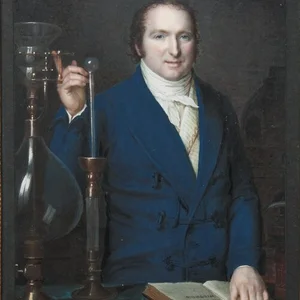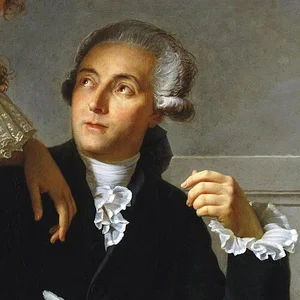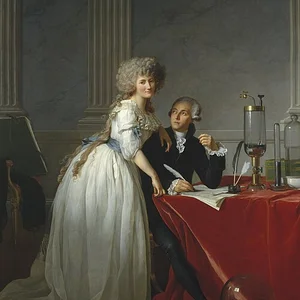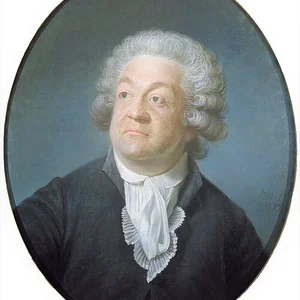

A French chemist, jurist and statesman, Guyton de Morveau was one of the architects of the reform of chemical nomenclature alongside Lavoisier in 1787. As a member of the National Convention, he also took part in the Revolution and contributed to the founding of the École Polytechnique.
Louis-Bernard Guyton de Morveau(1737 — 1816)
Louis-Bernard Guyton-Morveau
France
6 min read
Frequently asked questions
Key Facts
- Born in 1737 in Dijon, died in 1816 in Paris
- Published his first work on a systematic chemical nomenclature in 1782
- Co-author, with Lavoisier, Berthollet and Fourcroy, of the “Method of Chemical Nomenclature” (1787)
- Member of the National Convention and the Committee of Public Safety during the Revolution
- Took part in the creation of the École Polytechnique (1794), of which he was director
Works & Achievements
A collection of scientific memoirs in which Guyton sets out his earliest ideas in chemistry, notably on phlogiston and affinities.
A method for purifying the air in infected places, adopted throughout Europe to fight epidemics.
A major work, written with Lavoisier, Berthollet and Fourcroy, that established the modern language of chemistry still used today.
A vast synthesis of the chemical knowledge of the time, in which he proposed a rational reform of naming conventions.
The use of balloons for observing battlefields, notably at Fleurus, a first in military history.
Contribution to the creation and leadership of a leading school meant to train the scientists and engineers of the Republic.
A synthesizing work on his disinfection methods, which served as an authority in public hygiene throughout the 19th century.
Anecdotes
Before reforming chemistry, Guyton de Morveau was advocate-general at the Parliament of Burgundy in Dijon. Passionate about science, he gradually traded the lawyer's robe for the laboratory bench, becoming one of the most respected chemists of his time.
In 1773, to combat epidemics, he came up with the idea of disinfecting the air by spreading hydrochloric acid vapors: he is said to have purified Dijon Cathedral, whose foul stench was a cause for concern. These “Guytonian fumigations” were used throughout Europe for decades.
In 1784, he was one of the first Frenchmen to rise into the skies: he made a balloon ascent in Dijon, fascinated by this new scientific conquest born just a few months earlier with the Montgolfier brothers.
It was he who proposed, together with Lavoisier, Berthollet, and Fourcroy, to rename the substances bearing the mysterious names of the alchemists (such as “oil of vitriol”) and replace them with logical names describing their composition, such as “sulfuric acid.” This 1787 nomenclature still underlies today's chemical language.
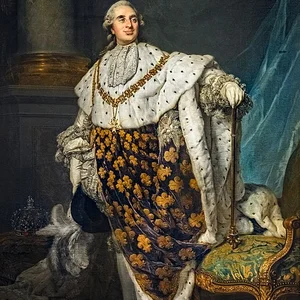
As a deputy to the Convention, he voted for the death of Louis XVI in 1793, then presided over the fearsome Committee of Public Safety. He also put his knowledge at the service of war, organizing the use of military observation balloons at the Battle of Fleurus in 1794.
Primary Sources
A well-constructed language, a language in which one has grasped the successive and natural order of ideas, will bring about a necessary and even swift revolution in the manner of teaching.
Names should, as far as possible, make known the nature of the substances they designate, and one must avoid giving to bodies of different natures denominations that seem to bring them together.
Public instruction must be within the reach of all citizens, and the study of the exact sciences holds first rank in it for forming sound minds useful to the homeland.
The vapors of marine acid decompose and destroy the miasmas spread through the air of infected places, and restore to the atmosphere its salubrity.
Key Places
Guyton's birthplace, where he served as advocate general at the Parliament of Burgundy and founded a public course in chemistry.
The center of his revolutionary and scientific activity; he sat in the National Convention there and headed the École Polytechnique. He died there in 1816.
A school founded in 1794 that Guyton helped organize, later becoming its administrator and director. There he trained generations of engineers.
A learned society in Burgundy where Guyton presented his first work on chemistry and the disinfection of air.
The revolutionary assembly where he sat as a deputy for the Côte-d'Or, voted for the king's death, and joined the Committee of Public Safety.
Typical Objects

A vessel with a long curved neck used for distilling and heating substances. A central tool in eighteenth-century chemistry experiments.

A highly sensitive beam balance used to weigh substances before and after a reaction. It embodies the new chemistry founded on the exact measurement of masses.

A device devised by Guyton to release hydrochloric acid vapors and disinfect the air of unhealthy places. A forerunner of modern disinfectants.

A tethered aerostat used by the revolutionary armies to observe enemy positions. Guyton helped organize its use at the Battle of Fleurus.

A magistrate's garment worn by Guyton at the Parlement of Burgundy before he devoted himself to science. A symbol of his first career in the law.

A 1787 work establishing the rules of the new language of chemistry. It replaced the obscure names of the alchemists with terms describing the composition of substances.
School Curriculum
Vocabulary & Tags
Key Vocabulary
Daily Life
Morning
In his youth in Dijon, Guyton often devoted his mornings to the affairs of the Parlement, dressed in his advocate-general's robe. Later, his mornings began in the laboratory, preparing experiments and weighings.
Afternoon
In the afternoon, he gave his public chemistry course or corresponded with the scholars of Europe. Once he became a member of the Convention, he spent his days in assembly sessions and committee meetings.
Evening
In the evening, he read and wrote his papers by candlelight, poring over the works of foreign chemists, which he sometimes translated himself.
Food
A well-to-do bourgeois and later a Baron of the Empire, he ate refined Burgundian cuisine: meats in sauce, poultry, wheat bread, and the renowned wines of Burgundy. Meals were occasions for scholarly conversation.
Clothing
He first wore the black coat and robe of the magistracy, then the 18th-century French-style dress — coat, waistcoat, breeches, and stockings. Under the Empire, he donned the embroidered uniform of a baron and member of the learned institutions.
Housing
He lived in a private mansion in Dijon, where he set up his chemistry laboratory, before moving to Paris, near the École Polytechnique, which he directed.
Historical Timeline
Period Vocabulary
Liens externes & ressources
Références
Œuvres
Digressions académiques
1772
Fumigations désinfectantes à l'acide chlorhydrique
1773
Méthode de nomenclature chimique
1787
Articles de chimie de l'Encyclopédie méthodique
1786-1789
Organisation des ballons militaires d'observation
1794
Participation à la fondation de l'École polytechnique
1794
Traité des moyens de désinfecter l'air
1801