
French chemist and illustrator (1758–1836), essential collaborator of Antoine Lavoisier. She translated English scientific treatises and created the engravings for the landmark "Elementary Treatise on Chemistry" (1789), contributing to the chemical revolution.
Marie-Anne Paulze
Marie-Anne Pierrette Paulze-Lavoisier
France
7 min read
Frequently asked questions
Key Facts
- 1758: Born in Montbrison (Loire), daughter of a tax farmer
- 1771: Married at age 13 to Antoine Lavoisier, chemist and tax farmer
- 1789: Publication of Lavoisier's "Elementary Treatise on Chemistry", for which she created the 13 engraved plates
- 1794: Arrest and execution of Lavoisier during the Terror; she preserves his manuscripts and archives
- 1805: Posthumous publication of Lavoisier's "Mémoires de chimie", which she edited and prefaced
Works & Achievements
Marie-Anne herself engraved the illustrations depicting the chemical apparatus in her husband's foundational work. Remarkable for their scientific precision and artistic quality, these plates played an essential educational role in spreading the new chemistry.
By translating this essay from English, Marie-Anne added critical annotations refuting the phlogiston theory, directly contributing to the triumph of Lavoisian chemistry over the old theory.
After her husband's execution, Marie-Anne gathered, organized, and published his unfinished manuscripts. This edition preserved for posterity research that might otherwise have been lost forever.
For nearly twenty years, Marie-Anne recorded the accounts of experiments conducted at the Arsenal laboratory, building a valuable scientific record of the chemical revolution.
Marie-Anne maintained an active correspondence with leading European scientists (Priestley, Black, Volta), serving as a bridge between French and foreign scientific circles thanks to her command of languages.
Anecdotes
At just 13 years old, Marie-Anne Paulze categorically refused to marry the Comte d'Amerval, a man much older than herself. Her father, a partner in the Ferme Générale, found an elegant solution: asking his colleague Antoine Lavoisier, aged 28, to marry her instead. The wedding took place in 1771, when she was only 14 years old.
Determined to make herself useful to her husband's work, Marie-Anne taught herself English and Latin. Her critical translation of the Irishman Richard Kirwan's *Essay on Phlogiston* (1787) was a major scientific act: she refuted Kirwan's arguments in favor of phlogiston point by point, directly contributing to the abandonment of this erroneous theory.
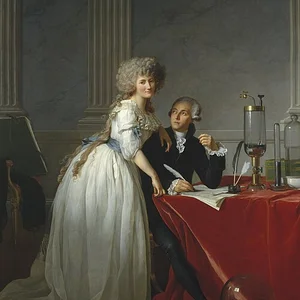
Marie-Anne took drawing lessons from the neoclassical painter Jacques-Louis David, one of the greatest artists of the era. It was he who painted, in 1788, the famous double portrait of the Lavoisier couple, now held at the Metropolitan Museum of Art in New York. The fourteen engraved plates she produced for the *Traité élémentaire de chimie* attest to her technical mastery.
After her husband's execution on 8 May 1794 — the chemist Coffinhal reportedly declared “The Republic has no need of scientists” — Marie-Anne showed remarkable tenacity. She recovered Lavoisier's notebooks, manuscripts, and instruments that had been confiscated by the revolutionary authorities, and oversaw the posthumous publication of his *Mémoires de chimie* in 1805.
Marie-Anne organized renowned scientific dinners in their apartment at the Arsenal, where European scholars such as Benjamin Franklin, James Watt, and Alessandro Volta would gather. She served as interpreter and secretary, taking notes in several languages. These evenings made their salon one of the great centers of the European chemical revolution.
Primary Sources
I have imposed upon myself the law of never proceeding but from the known to the unknown, of drawing only rigorous conclusions from facts and observations.
We felt it necessary to accompany this translation with some remarks intended to counter the main objections raised by the author against the new chemical theory.
These memoirs have been carefully gathered: they contain the results of his research and experiments on several important branches of chemistry.
I carefully preserve everything that can keep alive the memory of him whose loss has been so cruel to me, and whose work belongs to all of humanity.
Key Places
It was in this official residence that Marie-Anne and Antoine Lavoisier lived and worked from 1775 to 1793. The laboratory, considered the most modern in Europe, was the setting for the chemical revolution.
The institution where Lavoisier presented his work, to which Marie-Anne actively contributed. She accompanied her husband there and met the leading European scientists who passed through.
The site where Antoine Lavoisier and Marie-Anne's father were guillotined on 8 May 1794. This tragedy deeply marked Marie-Anne's life; she devoted the rest of her years to preserving her husband's legacy.
The birthplace of Marie-Anne Paulze, born here in 1758 into a family of administrative bourgeoisie connected to the Ferme générale.
The country estate where the Lavoisiers would retreat and continue their scientific work. Marie-Anne pursued her translations and correspondence with European scholars there.
Typical Objects

Engraving tools that Marie-Anne had mastered after her lessons with David. She used them to produce the fourteen plates illustrating the chemical apparatus in the *Traité élémentaire de chimie*.

The central instrument of the Lavoisier laboratory and a symbol of quantitative chemistry. Marie-Anne meticulously recorded mass measurements in the experimental notebooks.

Laboratory glassware used to distil, collect, and analyse gases. Marie-Anne depicted them with remarkable accuracy in her scientific engravings.

Works by Priestley, Kirwan, and Black that Marie-Anne translated to make them accessible to French scholars who did not read English.

Marie-Anne wrote up experiment reports in real time, acting as scientific secretary during the experiments in which she actively took part.

Her everyday writing tools, used for international scientific correspondence, translations, and critical annotations of foreign texts.

A large apparatus for collecting and measuring gases, designed in the Arsenal laboratory and faithfully reproduced in Marie-Anne's engravings for the *Traité élémentaire de chimie*.
School Curriculum
Vocabulary & Tags
Key Vocabulary
Tags
Daily Life
Morning
Marie-Anne rises early and begins her day by reading the scientific correspondence that arrived the previous evening, often in English. She notes down points to translate or discuss with her husband over a frugal breakfast of café au lait and bread.
Afternoon
Afternoons are devoted to the laboratory at the Arsenal: she observes and records experiments, takes measurements on the balance, or works alone on her burin engravings. She sometimes pauses to translate a difficult passage from an English treatise or to prepare her critical annotations.
Evening
The scientific dinners the Lavoisiers host regularly bring together French and foreign scholars. Marie-Anne leads the conversation, translates, discusses chemical theories, and takes notes. The evenings often stretch on into lively debates around the theory of combustion.
Food
The Lavoisiers' table is that of the Parisian upper bourgeoisie: soups, roasted meats, market vegetables, cheeses, and pastries. The scientific dinners call for carefully prepared cuisine to give visiting foreign scholars a worthy welcome.
Clothing
Marie-Anne wears the fashionable dress of the Enlightenment upper bourgeoisie: a *robe à la polonaise* in silk or taffeta, a fitted bodice, pannier petticoats, and a lace *fichu*. In the laboratory she puts on a protective apron over her everyday dress. Her hair is powdered in keeping with the fashion of the time.
Housing
The Lavoisiers' apartment within the Arsenal complex is spacious and luxurious: a library stocked with scientific treatises, a reception room for learned dinners, and the adjoining laboratory — considered the best-equipped in Europe — with its glassware and precision balances.
Historical Timeline
Period Vocabulary
Visual Style
Style néoclassique inspiré de David, associant l'élégance de la bourgeoisie éclairée du XVIIIe siècle à la rigueur d'un laboratoire scientifique de pointe, avec des teintes ivoire, bleu de Prusse et or.
Sound Ambience
Ambiance feutrée d'un laboratoire de chimie du XVIIIe siècle, mêlant les sons délicats de la verrerie, du burin sur le cuivre et du brouhaha savant d'un salon scientifique parisien.
Liens externes & ressources
Références
Œuvres
Quatorze planches gravées du Traité élémentaire de chimie
1789
Traduction de l'Essay on Phlogiston de Richard Kirwan
1787
Mémoires de chimie de M. Lavoisier (édition posthume)
1805
Notes et comptes rendus de laboratoire
1775-1793
Correspondance scientifique internationale
1775-1836