Imaginary dialogue between Marie-Anne Paulze Lavoisier and Antoine de Lavoisier
by Charactorium · Antoine de Lavoisier (1743 — 1794) · Sciences · 5 min read
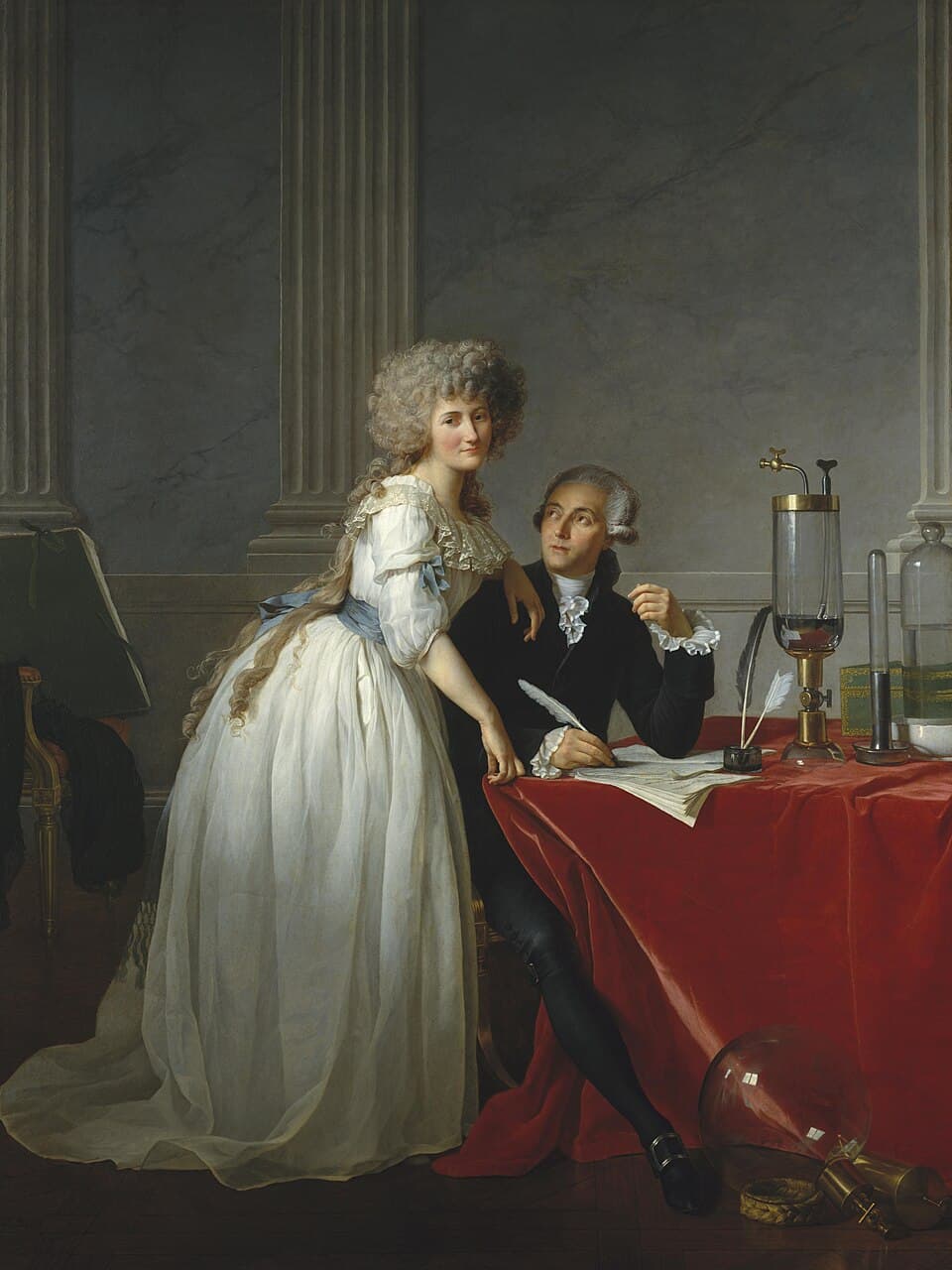
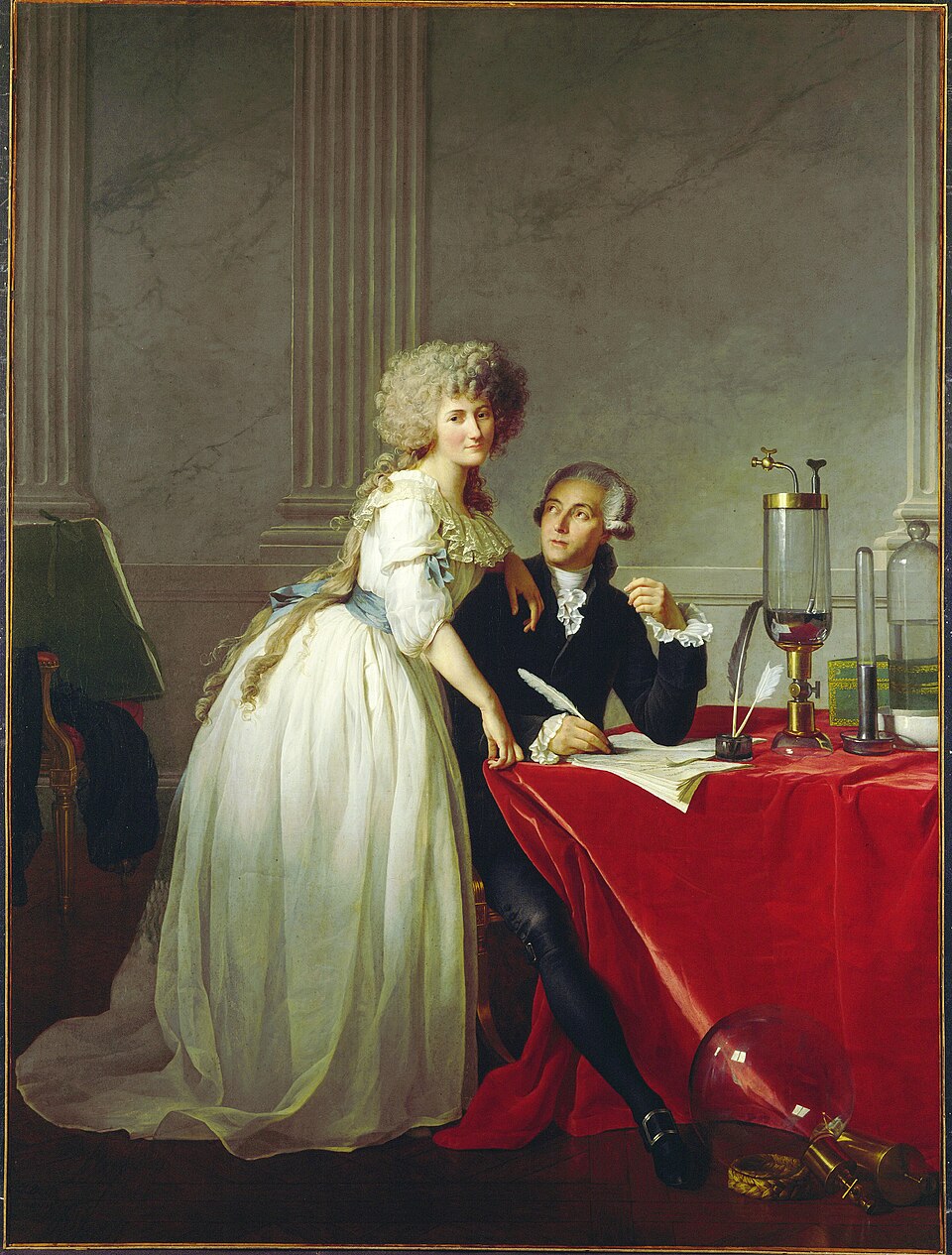
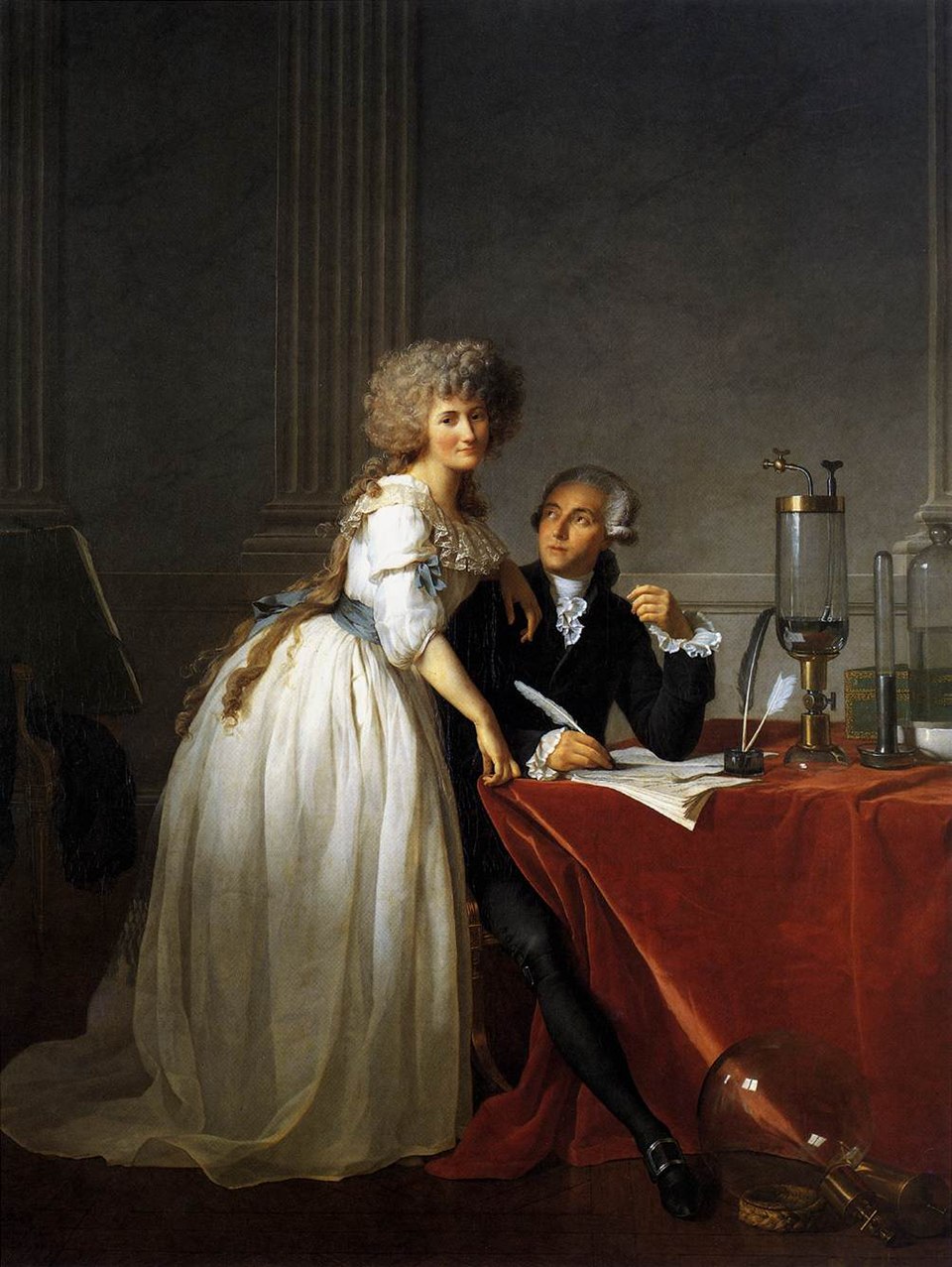
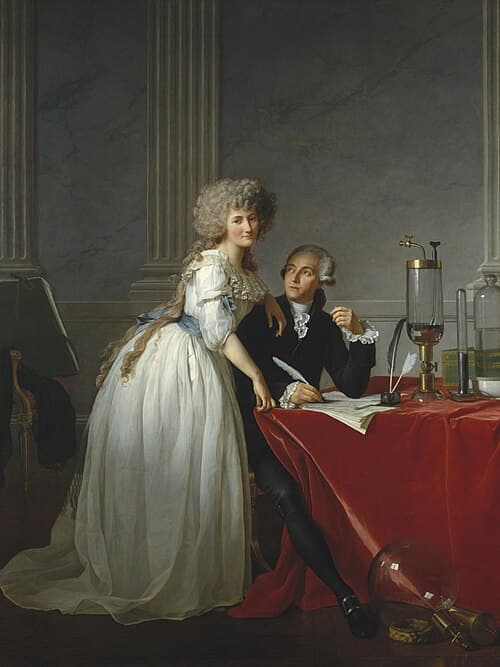
Evening falls on the Arsenal, in this winter of 1788. The furnaces are still warm, a mercury bellows gleams in the last light from the window, and the smell of calcined metal floats above the workbenches. Marie-Anne puts down her drawing pencil, closes the experiment notebook she has kept for so many years, and turns her chair toward her husband. She who translates his English readings and draws his apparatus wants, tonight, for him to say aloud the approach she sees taking shape every day at his side.
—Antoine, I've recorded your weighings all day. Why do you insist so on this balance that measures to the grain?
You know better than anyone, Marie-Anne, since it's you who records every figure. Without exact weighing, chemistry remains mere chatter: you see a flame, some smoke, and imagine anything. My balance, it doesn't lie — it captures the fiftieth part of a grain. It's through it that I was able to establish the principle you copied in the Treatise: in every operation, there is an equal quantity of matter before and after. Nothing is lost, nothing is created. When a calcined metal gains weight, that weight doesn't come from nowhere: it comes from the air. The balance turns opinion into proof.
Without exact weighing, chemistry remains mere chatter.
—Do you remember, in 1777, when you presented your memoir on combustion: why were you so set against phlogiston?
I remember all the more because you helped me proofread the English pages of Priestley. You see, for a century people claimed that a burning body releases a substance, phlogiston. But then how could a calcined metal gain weight while losing something? The absurdity was obvious. My weighings showed it: calcination and combustion are due only to pure air, and the weight increase exactly equals the amount of air absorbed. What Priestley called dephlogisticated air, I recognized for what it is: a new principle, which I named oxygen. Overturning a century-old theory is not done by eloquence, but by the balance and patience.
Overturning a century-old theory is not done by eloquence, but by the balance.
—Do you recall that session at the Academy where you decomposed water? The silence in the room, I can still hear it.
How could I forget? You were there, and you drew the apparatus better than I could have described it. Since Aristotle, water was held to be a simple element, one of the four principles of the world. I passed water vapor over red-hot iron: the water broke down, releasing its hydrogen, the iron fixing the oxygen. Then I reversed the process, recomposing water from the two gases. Before the assembly, the reputedly indivisible element revealed itself as a compound. You know the emotion it caused me: not the pride of being right, but the vertigo of seeing a two-thousand-year-old belief dissolve in a vat. Nature respects no authority except experiment.
Nature respects no authority except experiment.
—When you state that nothing is lost nor created, is it a scientist's certainty or an act of faith?
Neither, my dear: it is a finding that the balance imposes. I did not decree this principle, I measured it, operation after operation, in the vats you have seen on these workbenches. Matter changes form, hides in a gas, fixes into a calx, but its quantity remains. That is why I keep our notebooks with such rigor: each weighing before must find its equal after. If one day the accounts didn't balance, it wouldn't be the principle that failed, but our attention. Chemistry becomes a science the day it learns to count what seems to vanish.
Matter changes form, but its quantity remains.
—You made me learn Latin, English, drawing for your work. Tell me frankly: what do I truly serve you for?
Don't ask as if you doubted the answer, Marie-Anne. Without you, half of learned Europe would remain closed to me: it's through your translations that I read Priestley, Cavendish, Kirwan, and that I guess where they are wrong. Your drawings capture my apparatus better than my words ever could; when people look at our plates, they will understand at a glance what a whole page would not explain. And our notebooks, you keep them with a steadier hand than mine. Visitors see the man of the Arsenal; they ignore that my entire days rest on what you do beside me. You are not my assistant: you are the other half of the laboratory.
You are not my assistant: you are the other half of the laboratory.
—You chose new words — oxygen, hydrogen, nitrogen. Why change the very language of your science?
Because a poorly named science thinks poorly. When one said dephlogisticated air, the word carried an error, it assumed a false theory to be true. With Guyton de Morveau, Berthollet, and Fourcroy, we wanted a nomenclature where the name tells the nature of the body. I coined oxygen, from that which generates acid. Languages, you see, not only express ideas: they are true methods to go from the known to the unknown. Reforming words was reforming reasoning. You have often heard me say that a clear mind begins with a clear vocabulary — it is as true in chemistry as in philosophy.
A poorly named science thinks poorly.
—In the laboratory, you even measure the heat of animals. Why push weighing to the breath of a guinea pig?
Because I suspect that life itself obeys the same laws as my furnaces. With Laplace, we placed an animal in that ice calorimeter you know: its respiration melts the ice, exactly like a slow combustion. The animal consumes oxygen, releases fixed air, produces heat — like a candle burning softly. To breathe is to burn. If the balance and thermometer work for metal, why would they stop at the threshold of the living? I believe nature has only one chemistry, and the breath of a being is a chapter of it. Measuring breath is measuring life.
To breathe is to burn.
—Antoine, what funds your instruments is the Ferme générale. Aren't you afraid that one day you'll be reproached for it?
The question is fair, and I ask it more often than you think. This balance, these gasometers, this laboratory said to be the best-equipped in Europe — none of it would exist without the revenues of the Ferme. No king would pay to decompose water; so chemistry must find its means elsewhere. But I know the people's resentment toward those who levy the salt and tobacco tax. We are not loved, and one hardly distinguishes the scientist from the financier. I tell myself that my work will serve all men, whereas my office serves only the Treasury. Let us hope they will remember that.
No king would pay to decompose water.
—In the evening, when the visitors have left and we remain alone here, what still keeps you in the laboratory?
Those hours are mine, Marie-Anne — ours. The day belongs to the Ferme, to the Academy, to the king's commissions; but in the evening, when you take up your pen and I relight a furnace, I become entirely a chemist again. I love this silence where we hear only the simmering of a retort and your pencil on paper. It is in these stolen hours that true ideas are born, those that no official session brings forth. We resume a weighing, we discuss a result, and the outside world fades. All the rest of my life is but a detour to return to this table.
All the rest of my life is but a detour to return to this table.
—Many scientists remain loyal to phlogiston. How do you bear being contradicted by men you respect?
With patience, for I know what it costs to abandon an idea long held as true. Men I admire, like Priestley himself, still refuse to follow me. I do not resent them: it is not to me they must yield, but to experiment. That is why I repeat my demonstrations before witnesses, publish my weighings, invite everyone to verify. It is time to bring chemistry to a more rigorous way of reasoning, to strip facts of what prejudice adds to them. Phlogiston will fall not because I shout it, but because the balance condemns it. Truth does not need to be defended, only to be shown.
It is not to me they must yield, but to experiment.
Read further
This imaginary interview was generated by artificial intelligence from sources documented in Antoine de Lavoisier's profile. It dramatises what the figure might have said based on what we know about them, but does not constitute attested historical testimony. For primary sources and factual documentation, refer to the full profile.