Imaginary dialogue between Osiris and Anubis
by Charactorium · Anubis · Mythology · 7 min read
It is in the deep colonnades of Abydos, amid the smell of cedar resin and natron drifting from the preparation chambers, that Osiris — lord of Amenti, the first among all the embalmed — seeks out Anubis, the god who first laid hands upon him in death. A single oil lamp throws the painted jackal on the limestone wall into amber relief; the scales hang motionless in the shadows behind. Between these two there is no ceremony to observe: one is the father, the other is the god who made him immortal. Osiris has come with questions that only a father — or the first mummy — would dare to ask.
—Anubis — when I lay before you, the first body you had ever prepared — what passed through you in that moment?
You know, Osiris, that there was no tradition before you — no teacher who had done it, no text to consult. When I first held your body in my hands, I understood in my very being what needed to be done: the organs removed and preserved, the flesh dried with natron and cedar oil, the limbs bound in fine linen so that nothing of you would dissolve into the earth. The black soil of Egypt teaches its own lesson — what appears to rot will bloom again. Your body was my first teaching and my first gift to the living. Every embalmer who has since bent over a pharaoh and spoken the words, every priest who has wrapped the linen from foot to crown, follows the path I discovered over you. You gave me my purpose before I fully understood what that purpose was.
You gave me my purpose before I fully understood what that purpose was.
—The natron, the canopic jars, the linen — how did you know what each element was meant to achieve?
Each element answers a need that the body announces to those who know how to listen. Natron draws out the moisture that decay feeds upon; cedar oil purifies what natron leaves behind. The canopes hold what the body cannot carry into the Duat as a single burden — the liver, the lungs, the stomach, the intestines, each placed under a divine guardian, each preserved so that the whole self may be reassembled in eternity. The linen binds and protects, yes, but it also transforms: a body wrapped is no longer simply flesh. It has become something prepared, something ready. I learned all of this in the act of doing it, with you as my first subject. What the craft revealed to me, I passed to the embalmers of Memphis and Abydos, and they have carried it forward to every corner of Egypt ever since.
—They name you Inpu — some say it means he who is in putrefaction. Does such a name sit lightly with you?
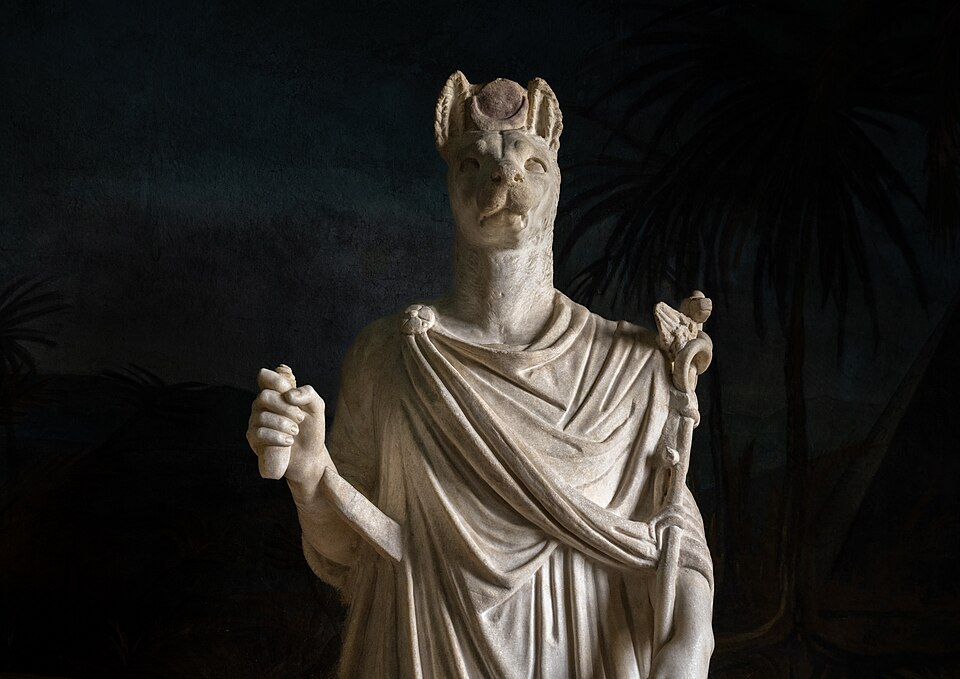
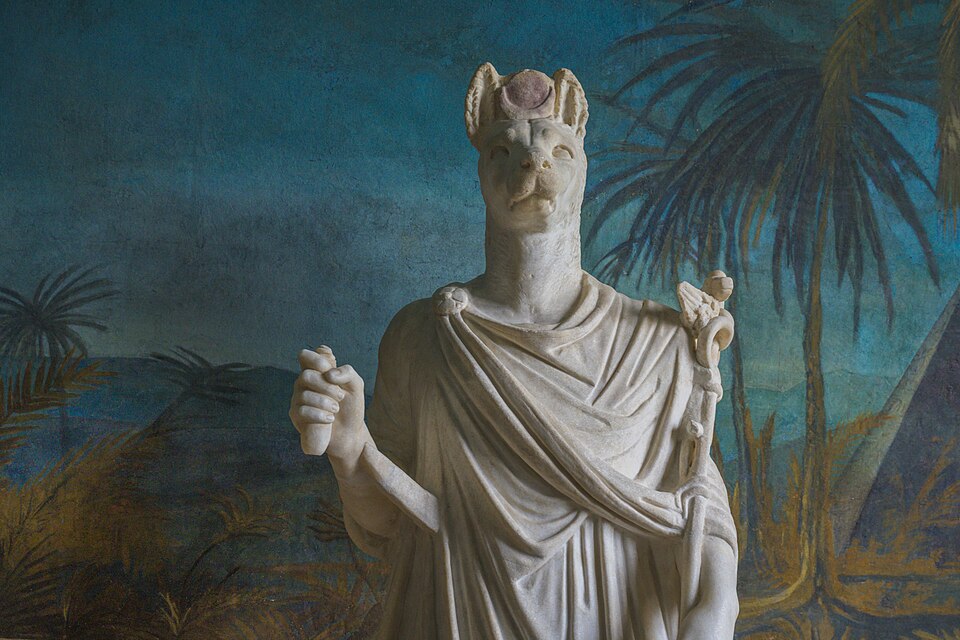
The name is honest, and I have never sought one that flatters. The jackals who prowled the edges of Egypt's cemeteries — who circled what the living had buried — could have been seen as a threat, as desecrators. The people of the Nile, wiser than that, saw something else: that the jackal was drawn to what was sacred, that he kept vigil where others would not go. I am the god that arose from that recognition. My name holds what I do not conceal: I am present where flesh returns to earth, where the body begins its great transformation. But putrefaction is not an ending — it is the condition of renewal. The black of my form is not the black of oblivion; it is the black of the fertile kemet, the dark rich soil the Nile's flood leaves behind, from which all life returns.
Putrefaction is not an ending — it is the condition of renewal.
—Your form is always black, yet the jackal in the desert is brown and grey. Explain that choice to me.
The color is not a description of the animal — it is a declaration about what I represent. The jackal of the desert is indeed grey and brown, and I know it well, for I chose it for my own reasons. The black I carry is the black of the kemet, the dark fertile earth the Nile's flood deposits when the waters recede: the color of what gives life back to the land each year, of seeds buried in soil, of a night sky where stars do not die but continue their journeys unseen. For Egypt, black is not the color of death in the sense of ending — it is the color of transformation, of what vanishes only so that it may return renewed. My form carries that truth visibly: I stand at the place where the body appears to end, but the color of my body announces that endings in Egypt are never quite what they seem.
—In the Hall of Judgment, you hold the scales against the feather of Ma'at. What does a heart reveal to you?
A heart does not lie the way the living lie — with words carefully chosen, with gestures shaped for witnesses. Before the scales, it presents itself as it truly is: all the weight of acts committed, of injustices done or suffered without redress, of small cruelties the person may have forgotten but the heart never did. The feather of Ma'at is not a punishment — it is a measure. I do not judge in anger; I am not you, Osiris, standing as sovereign lord over the dead. I am the god of the threshold, the one who ensures that what passes into eternity carries only what is true. If the heart is lighter than the feather, the soul proceeds. If it is heavier, Ammit waits. I have presided over this ceremony since the first pharaoh was laid to rest, and I approach each weighing with the same attention: every heart deserves to be witnessed honestly.
—The scrolls placed in every tomb now prepare the dead for your judgment. Is that preparation truly enough?
The Book of the Dead speaks to those who have already crossed from the living world — it is guidance for the threshold, not a substitute for how one lived. I read what the heart holds, not what the papyrus declares. The formulas, the illustrations, the painted images of the scales and the weighing ceremony — these serve a real purpose: they give the soul language for a moment when language is difficult, and they remind it that the passage has an order, that it is not chaos. But I will not be deceived by a recitation alone. What the Book of the Dead truly gives to the dead is something almost more precious than the formulas: it gives them the understanding that I am present in the Duat, that there is a structure to what awaits, and that the weighing is not an act of malice but of absolute honesty. That knowledge alone is worth carrying into the dark.
—My son — you were the first among the funerary gods, long before I took that place. Did you choose to step aside?
I did not step aside so much as I found my truer form. For long ages — since the first pharaohs of the unified kingdom, from the time the two lands became one — I held the highest place among those who guard the dead. Then the stories of your death, your dismemberment, your resurrection began to carry a weight that moved all of Egypt: you became the proof that death could be overcome, not merely endured. It was right that you should stand as the supreme lord of Amenti. What I kept was perhaps the most intimate part of the work: the preparation of the body, the custody of the tomb, the weighing of each individual heart. You receive the souls, Osiris; I make them fit to stand before you. We were never in competition — you took the sovereignty of the western land, and I kept the craft.
You took the sovereignty of the western land; I kept the craft.
—At Cynopolis — Hardai, the city of the jackal — what do you truly ask of those who worship you there?
Cynopolis is one of the places where the devotion is oldest and most sincere, and what I ask there is not elaborate ceremony for its own sake — it is rigor, consistency, and respect for the dead. The priests who tend the necropolis must understand that their work is sacred in the most literal sense: they are custodians of the boundary between the living and the dead, and that boundary demands attention every day, not only on festival days. At Abydos and Saqqara as well, the rituals must be performed with precision, the offerings maintained, the tombs protected from those who would violate them. What I ask of my worshippers is not fear of me but seriousness about the task. The dead who lie in those cemeteries placed their eternal life in our hands, and I do not forgive negligence easily.
—When your priests wear the jackal mask during the rites, do you enter into them, or do they merely imitate you?
When a priest dons the mask of the black jackal and bends over the body to perform the rituals of preparation, he does not merely imitate — something passes into him that is larger than his own person. I do not claim that he becomes me entirely: he remains a man of Memphis or Abydos, trained in the craft, knowing the words and the gestures. But the mask opens a channel. The mourners who watch understand that what stands over their dead is not only a priest — it is the god's intention made visible. This matters enormously. A body must be prepared not only with skilled hands but with sacred intention, or the ritual remains incomplete. The mask is a threshold object, like the tomb door itself — it marks where one order ends and another begins. I have no objection to being present in this way. The work requires it.
—And my son — when my own heart was placed upon your scales — what did you find there?
You ask me to speak of something I hold in the strictest custody, Osiris — the weighing of a heart is the most sacred confidence I keep. But I will say this, because you stand before me now and are not merely a name in a text: your heart was not without its weight. You were a king, and kings carry the heaviness of decisions made and lives shaped by their power. But your heart also held what only a heart can hold — a genuine love for the land, for the living, for the idea that death should not be the end of meaning. The scales did not consume you. The feather held you, and you passed. Everything that came after — your lordship over Amenti, the hope you give to all who die and wish to live again — began at that moment, at those scales, in my hands. I am glad the weighing went as it did.
This imaginary interview was generated by artificial intelligence from sources documented in Anubis's profile. It dramatises what the figure might have said based on what we know about them, but does not constitute attested historical testimony. For primary sources and factual documentation, refer to the full profile.