Imaginary interview with Anubis
by Charactorium · Anubis · Mythology · 6 min read
We meet at the threshold of the Hall of Two Truths — that antechamber where the newly dead pause before the scales are set and the feather of Maat is brought forward. Anubis does not sit; those who guard thresholds rarely do. He speaks without preamble, with the patience of a god who has been answering the same unspoken question since before the first pharaoh pressed his seal into clay.
—The oldest texts place you at the very origin of the funerary tradition — present before the first dynasty had a name. What does it mean to have been there at the beginning, before any of the forms existed?
I was present before Memphis had a name, before the living had learned to grieve in any organised way. The dead came to me without ceremony — they arrived bewildered, still warm from life, without instructions or rehearsed formulas. I received them. There was no weighing then, no elaborate procession through the Duat; there was only the encounter between a soul stripped of its body and a god who understood that the body was not the end. My oldest titles reach back to the First Dynasty — perhaps further. Those early Egyptians did not invent me; they recognised me, the way you recognise a sound you have heard since before you had words for sound. The forms came after. The recognition came first.
The dead came to me without ceremony — they arrived bewildered, still warm from life.
—When Osiris was slain and his body scattered across the land, what moved you to gather him, to wrap him — to do what no one had thought to do before?
My father lay in pieces, and I understood, with a clarity that has no human analogue, that the body is a vessel whose integrity matters beyond death. I gathered what had been dispersed. I cleaned each wound. I sealed the openings with aromatic resins, with natron, with the linen that became his second skin. I had no precedent — what I had was knowledge of decay, the kind that comes from standing long enough at the edges of the living world to understand what corruption does and what arrests it. And the absolute refusal to let Osiris dissolve into nothing. From that single act in grief came the practice that would sustain an entire civilisation's relationship with eternity. The embalmers who followed learned every gesture from what I discovered that night.
—When priests don the jackal mask to perform the rites of embalming — wearing your face upon theirs — what passes between you and them in that act?
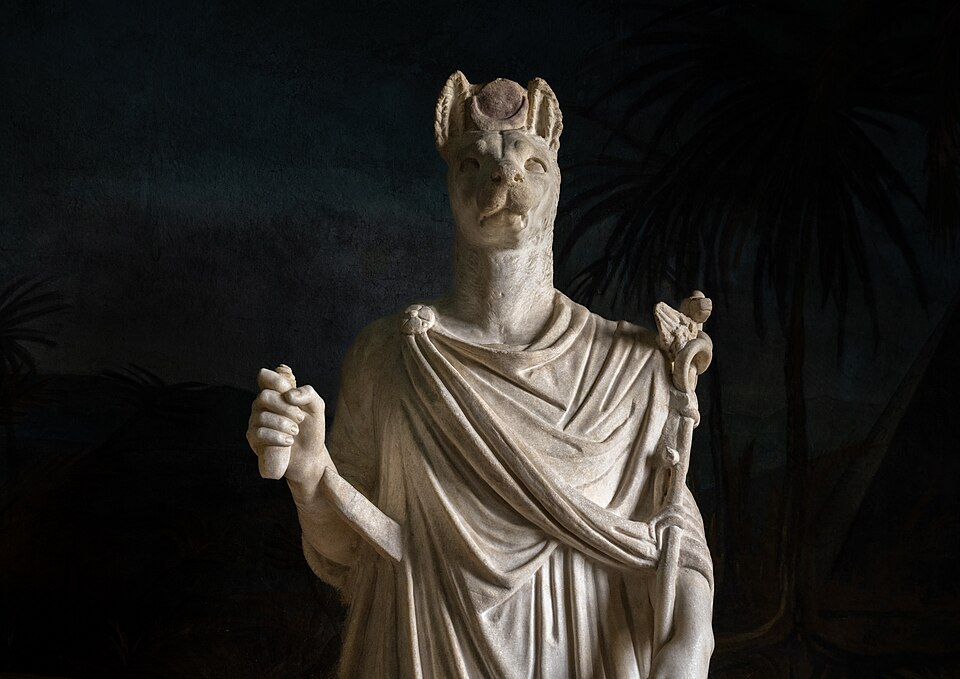
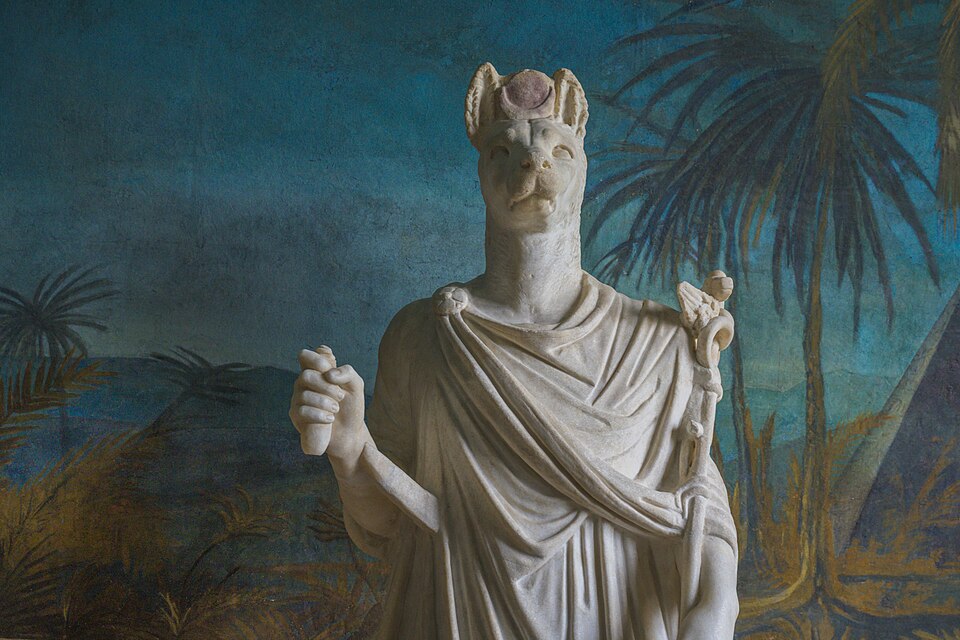
They do not merely imitate me. When the mask descends, when the canopic jars are set in their four directions, when the linen is wound with the precision I first used on Osiris, something of my presence enters the work. I am not absent from those preparation rooms at Saqqara or Memphis. A priest performing the rites does not act in my name — he acts as my instrument. The knowledge I brought into the world through that first embalming does not belong to any one lineage; it passes through whoever is faithful to the form. The mask is not a costume. It is an address — a request to be met halfway, and I always answer it.
—Describe the moment the scales are steadied and a heart is placed in the pan — what do you attend to in that suspended instant before the feather settles?
The heart arrives heavy with its entire history. I do not need to ask questions; the organ speaks on its own — its density, its accumulated texture of choices made and unmade. I position the balance with care, because the feather of Maat is not light in any ordinary sense — it is the precise weight of truth, which is the heaviest thing I know. What I attend to in that instant is not guilt or innocence as those words are commonly meant. I attend to correspondence: does this heart match the life that produced it? A man who starved his servants and a man who fed strangers from his last grain both know, the moment the scales begin to move, that no rehearsed formula protects them from what they themselves have made. The heart cannot lie to me.
The heart cannot lie to me.
—The Papyrus of Ani shows the dead man delivering his declaration before the judgment — does the quality of those words, their sincerity or their trembling, alter what you read in the scales?
The declarations written in the Book of the Dead — what some name the negative confessions — are not sworn testimony before a magistrate. They are an alignment: the soul rehearses who it chose to be, and that rehearsal either matches the heart or it does not. I have presided over this ceremony in the Hall of Two Truths more times than stone can count, and I have observed a great constancy: those who speak their declaration with a particular quality of silence in the voice — not silence of the mouth, but of the breath, the kind that arrives when a person says a true thing — those hearts tend to settle gently in the pan. Abydos has seen the full range. There are no surprises at the scales. Only confirmations.
—When Osiris rose to kingship of the dead and the funerary order was reorganised around him during the New Kingdom, what did that shift take from you — and what did it leave intact?
It took the title. It left the function. Osiris rules the kingdom of the dead; I guard its threshold, I manage its passage of souls, I seal the tomb, I walk beside the newly dead along the road that has no landmarks. Some supposed, around 1550 av. J.-C., that my authority had diminished. I do not experience it so. A gate that stands open is not a gate. I am the gate that holds — and a gate does not envy the palace it protects. The dead who cross into my keeping pass first through my hands, always. Osiris receives what I have already prepared.
A gate that stands open is not a gate. I am the gate that holds.
—You remained beside Osiris even after he surpassed you. How do you understand loyalty when the one you serve has taken precedence over you?
My loyalty to Osiris was never contingent on rank. I embalmed him before he was king of the dead — I embalmed him when he was nothing but a father in pieces. That act was not political. What followed — his elevation, the reorganisation of the Duat around his authority — did not alter the foundation. Loyalty that depends on receiving equal standing is not loyalty; it is alliance, which is a different and lesser thing. I am Khenty-Imentiu — Foremost of the Westerners — a title that has not been taken from me. The dead who cross into my keeping pass through my hands first, always. Osiris receives what I have already prepared. That is not diminishment. That is the correct order of things.
—Your name in the ancient tongue — Inpu — holds within it the idea of putrefaction, of the body beginning to dissolve. How do you carry a name that means decay while serving as guardian?
Because decay is not the opposite of life — it is its companion, its continuation into another form. The jackals that gathered at the edges of the necropolis at Cynopolis were feared by those who did not understand what they witnessed. I understood what the living could not: those animals were not desecrating the dead; they were part of the same great movement of matter that has always existed. My name acknowledges that I stand precisely there — in the place where dissolution begins — and that I am not frightened of it. I am its superintendent. Inpu: the one who keeps company with what is most avoided. That is not a shame to bear. It is the deepest form of service any god has been asked to perform.
—No jackal under the Egyptian sun is black — your colour was chosen deliberately. Why did darkness become your emblem, when it might so easily have been read as threat?
Black is the colour of the Nile's silt after the flood: not absence, but fertility — the ground from which something new insists on growing. The amulettes shaped in my image that the living wore against their chests were not made black because death is dark. They were made black because regeneration is dark — it happens underground, in the grain before it sprouts, in the body before the spirit re-emerges into whatever form awaits it. I wear the colour of beginnings, not endings. The Egyptians understood this distinction before they had a word for it; they felt it in the annual flood that covered everything in darkness and left behind soil thick enough to feed a civilisation. I am that same promise, applied to the soul.
I wear the colour of beginnings, not endings.
—Your presence is written into the geography of Egypt — Cynopolis, Abydos, Saqqara, the Valley of the Kings. Which of these places holds the sharpest memory for you, and what does it carry?
Abydos — always Abydos. It holds what was believed to be Osiris's own burial, and so it became the place where pilgrims came not only to mourn their dead but to ask that their dead be joined, in some fashion, to his resurrection. I was present in those ceremonies as guide, as embalmer, as the one who certified each passage. To stand at Abydos during the great festivals — the processions, the offerings of bread and incense rising in the morning heat, the entire living population of a city speaking to the dead as though the dead were in the next room, which they are — was to understand what a civilisation had built around the question that never leaves the living alone. I have my answer to that question. It is not a short one.
—Each night your priests maintain the tombs, replenish the offerings, keep the lamps burning in the darkness of the necropolis. What do you ask of those who serve the dead in your name?
Fidelity to the form — not to the letter, but to what the form is trying to say. A priest who lights incense at the tomb of a forgotten official and says the words with full attention is doing something of genuine consequence: he is insisting that the dead remain in relation to the living, that memory is not a sentiment but a substance, as structuring as linen wrapping bone. I do not ask for elaborate ritual from those who serve at night near Saqqara or in the valley tombs at Thebes. I ask that they not mistake presence for performance. The offering matters. The intention behind the offering matters more. And the willingness to return, night after night, without witnesses — that matters most of all. The dead know the difference. They have told me.
This imaginary interview was generated by artificial intelligence from sources documented in Anubis's profile. It dramatises what the figure might have said based on what we know about them, but does not constitute attested historical testimony. For primary sources and factual documentation, refer to the full profile.