Imaginary interview with Archimedes
by Charactorium · Archimedes (286 av. J.-C. — 211 av. J.-C.) · Sciences · 5 min read
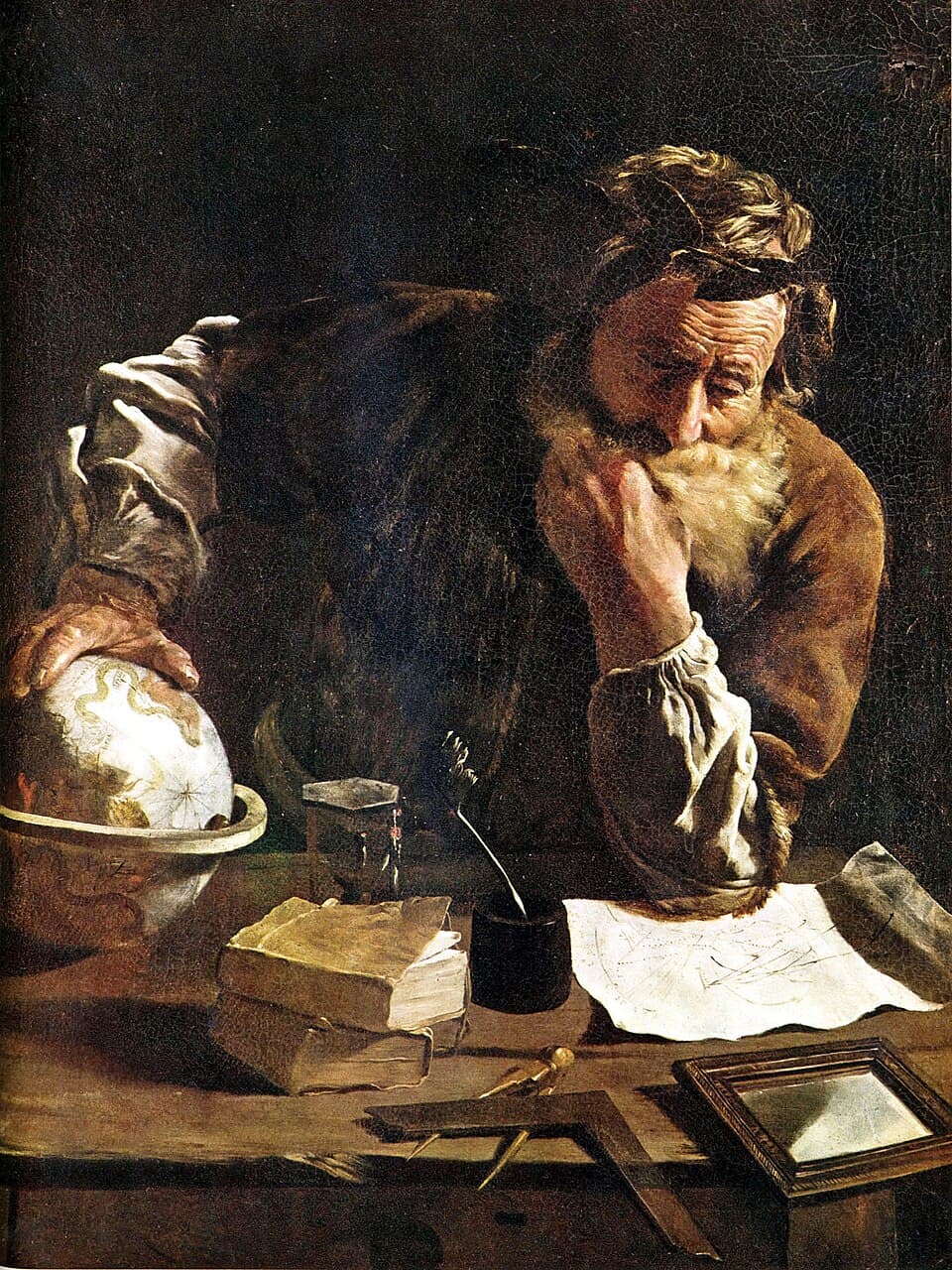
Syracuse, late summer afternoon. The oblique light strikes the limestone walls of the island of Ortygia, and on the floor of a workshop cluttered with pulleys, tablets, and figures traced in the ash, an old man with chalk-stained hands looks up. In the distance, Roman masts can be seen in the harbor. Archimedes agrees to set down his stylus for a moment to talk about numbers, overflowing baths, and lifted ships.
—Among all your demonstrations, which one is dearest to you?
Without hesitation, the one I recorded in On the Sphere and the Cylinder. Imagine a perfect sphere nested in the cylinder that encloses it, just wide enough to contain it. I proved that the sphere occupies exactly two thirds of the cylinder, and that its surface area is four times that of its great circle. Others find this dry; I see in it a harmony that owes nothing to the whim of the gods, everything to the rigor of measurement. When my time comes, I want that sphere within its cylinder to be engraved on the stone that covers me. Not my name, not my war machines: that ratio. A geometer is known by what he loved to demonstrate, not by what he built.
On my stone, I want the sphere in its cylinder. Not my name: that ratio.
—How did you come to that famous discovery of the king's crown?
Hieron II had entrusted me with a thorny puzzle: had his goldsmith mixed silver into the gold of his votive crown? I could not melt it or break it. I was thinking about it as I entered my bath, distracted, and the water overflowed onto the tiles as I sank in. Then it all clicked: a submerged body displaces a volume of water equal to its own. A pure gold crown and a adulterated crown, of equal weight, do not displace the same amount of liquid. They say I ran through the streets shouting Eureka, half-dressed. I will not deny it. I later laid down this principle of buoyancy in On Floating Bodies: what amused me in a tub became a law of nature.
A submerged body displaces a volume of water equal to its own: that is what my bath taught me.
—Why attach so much importance to something as trivial as an overflowing bath?
Because nature only whispers its laws to those who observe it in the humblest detail. A symposion among the notables of Syracuse never taught me anything; a tub emptying over my feet did. The scholar who scorns the trivial misses everything. The buoyancy I measured applies to Hieron's crown as to the heaviest ship: it is the same water, the same rule, whether for a jewel or a hull laden with grain. I devoted my life to uncovering the hidden order beneath ordinary things. The rest—glory, running through the streets—is only foam around the truth.
Nature only whispers its laws to those who observe the humblest detail.
—Do you remember the day you proved that a single man could move a ship?
Hieron doubted that mechanics could work wonders. To convince him, I had one of his largest vessels loaded with men and cargo, then I connected its hull to an assembly of pulleys—a méchanè of my invention, what sailors call a block and tackle. Seated, without apparent effort, gently pulling the rope, I drew the ship out of the water as one slides a boat onto the sand. The court was speechless. It was that day, they say, that I declared: “Give me a place to stand, and I will move the world.” The lever does not cheat: it trades force for distance. What the arm loses, the mechanism returns.
The lever does not cheat: it trades force for distance.
—What would you say about the machines you set against Marcellus' fleet?
When Marcellus launched his ships against our walls in 214 BC, I had only geometry to arm Syracuse. I had long-armed cranes mounted above the Port of Syracuse: their claws seized the Roman prows, hoisted them vertically, then dropped them to smash or sink them. Other calibrated engines struck at any distance, far and near. They say Marcellus, disheartened, said he was fighting a geometer-Briareus, that hundred-armed giant of old legends. Yet I did not like war; these machines were only levers and pulleys pushed to their extreme, my principles turned against men. Poliorcetics is but a grim mechanics.
My war machines were only levers and pulleys turned against men.
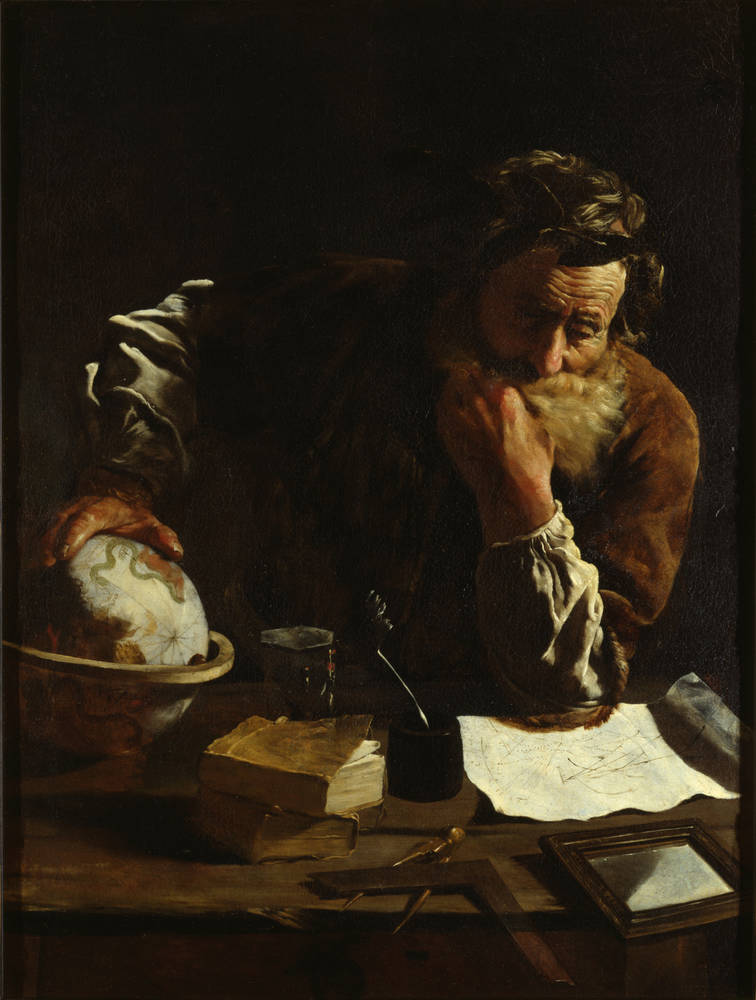
—How did you work with the scholars of Alexandria, so far from Sicily?
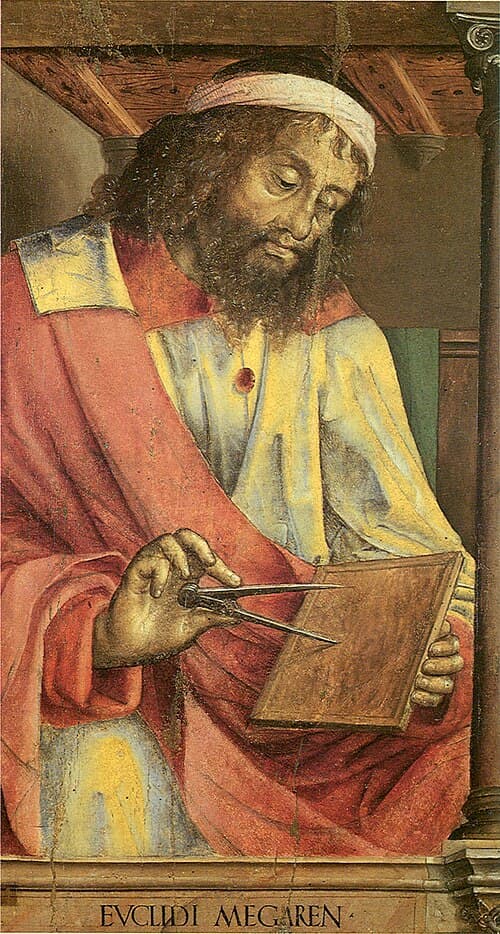
By letters, always by letters. In the evening, when the day's figures fade in the hearth's ash, I write my treatises as missives addressed to Eratosthenes or my friend Conon of Samos. Alexandria has been the great hearth of knowledge since Euclid composed his Elements there, and I stayed there as a youth to study under his successors. We exchange problems as others exchange gifts. I have even slipped in false propositions to confound the braggarts who claim others' discoveries without understanding them. A theorem travels better than a man: it crosses the sea in a scroll and arrives intact on the banks of the Nile.
A theorem travels better than a man: it crosses the sea in a scroll.
—They say you wanted to count the grains of sand in the universe. What idea drove you to that?
Many repeat that sand is countless, that no number can exhaust it. That annoyed me: people confuse the immense with the infinite out of linguistic laziness. In The Sand Reckoner, I therefore forged a numbering system capable of naming numbers so vast that no Greek word designated them, then I calculated how many grains would fill the world as our astronomers conceived it, measured in stadia. The result is colossal, but finite, and perfectly written. That is what I wanted to show my correspondents in Alexandria: the mind can tame what the mouth declares unspeakable. Naming a number is already conquering it.
People confuse the immense with the infinite out of linguistic laziness.
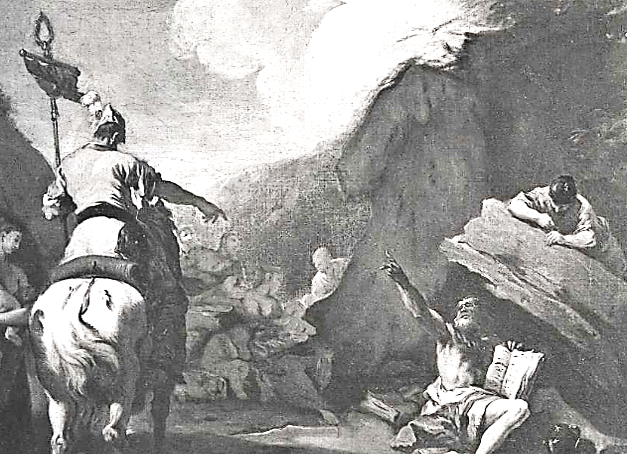
—You entrusted some of your writings with a secret method. What is it?
In the treatise I call The Method, again addressed to Eratosthenes, I reveal not my finished demonstrations, but the way I sniff them out before proving them. I imagine an area, a volume, as composed of an infinity of slices that I weigh in thought on a balance, in the way I determine centers of gravity in On the Equilibrium of Planes. That gives me the result; only afterward do I lock it down with the rigor of the Ancients. I wanted to pass on this procedure, because it is more valuable to learn how to search than to receive a ready-made truth. How many theorems remain to be discovered for those who know how to weigh the invisible in this way?
It is more valuable to learn how to search than to receive a ready-made truth.
—The Romans are at the gates of Syracuse. What do you feel as you trace your circles while the city falls?
They tell me the walls are giving way, that Marcellus' soldiers are spreading through the alleys of Ortygia. And yet, this morning, I smoothed a square of sand before me to inscribe a figure that has occupied me for days. You find that insane? A geometer does not abandon a half-finished demonstration, even to save his skin. The tumult outside reaches me as through thick water. My circles, however, do not tremble; they are the only thing, in these hours, that still obeys a law. If an armed man comes to disturb this drawing, I will only ask him to wait until I finish my line.
My circles do not tremble; they are the only thing that still obeys a law.
—What would you like people to remember about you, when all this is over?
Neither the cranes that shattered the ships, nor the pulley that pulled Hieron's vessel. Those feats amuse kings and die with them. Instead, let them remember a man bent over his wax tablet and compass, who knew that the sphere holds two thirds of its cylinder, and proved it without recourse to the gods. The stone of my tomb will bear that figure, and if some traveler, in a century or two, sees it under the brambles and understands what it means, then I will not have entirely vanished. A true theorem does not age. That is the only immortality I covet, and the only one, perhaps, that does not lie.
A true theorem does not age. That is the only immortality that does not lie.
Read further
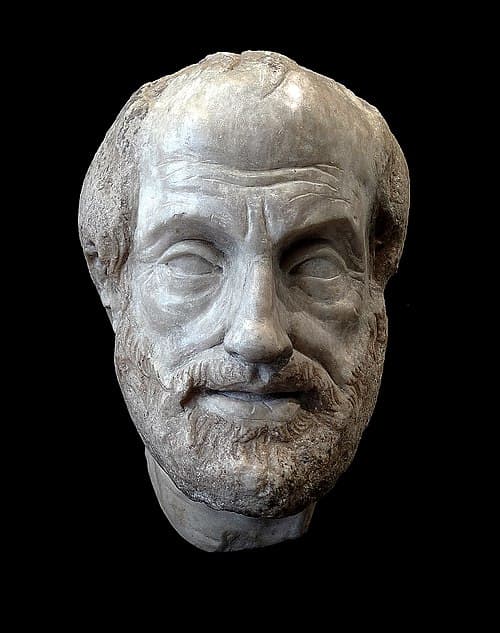
This imaginary interview was generated by artificial intelligence from sources documented in Archimedes's profile. It dramatises what the figure might have said based on what we know about them, but does not constitute attested historical testimony. For primary sources and factual documentation, refer to the full profile.