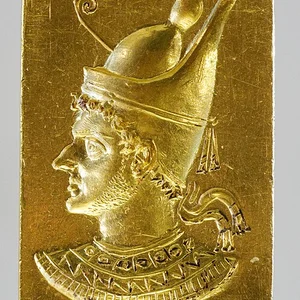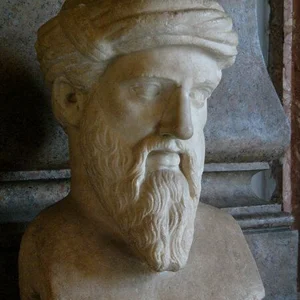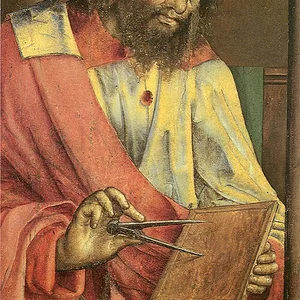
Portrait de Euclid

Euclid

Euclid

333 av. J.-C. — 284 av. J.-C.

Athènes

SciencesMathématicien(ne)ScientifiqueAntiquity3rd century BC, Hellenistic period

A Greek mathematician of Antiquity, Euclid lived in Alexandria in the 3rd century BC. He is the author of the Elements, the most influential mathematical work in history, which dominated the teaching of geometry for over 2,000 years.

Émotions disponibles (6)

N

Neutre

par défaut

I

Inspiré

P

Pensif

S

Surpris

T

Triste

F

Fier

Key Facts

  • Composition of the Elements around 300 BC, the founding work of systematic geometry
  • Teaching in Alexandria under the reign of Ptolemy I, a golden age of Greek knowledge
  • Establishment of Euclid's five postulates, the axiomatic foundation of plane geometry
  • Systematic proof of the Pythagorean theorem and numerous geometric theorems
  • Major influence on European mathematics from the Middle Ages and the Renaissance through the 19th century

Works & Achievements

Elements (Στοιχεῖα) (c. 300 BC)

A treatise in 13 books covering plane geometry, the theory of proportions, arithmetic, and solid geometry. It is the most influential mathematical work in history, serving as the foundation of geometry education for over 2,000 years.

Data (Δεδομένα) (c. 300 BC)

A companion to the Elements dealing with what can be deduced as 'given' from hypotheses. This work is essential for solving geometric problems.

Optics (Ὀπτικά) (c. 300 BC)

The earliest known treatise on perspective and geometric optics. Euclid studies vision by modeling light rays as straight lines emanating from the eye.

Phenomena (Φαινόμενα) (c. 300 BC)

An astronomy treatise applying spherical geometry to the study of the celestial vault. It addresses the rising and setting of stars.

On Divisions of Figures (Περὶ διαιρέσεων) (c. 300 BC)

A work on dividing geometric figures into equal parts or according to given ratios. The original Greek text is lost, but a partial Arabic translation survives.

Conics (Κωνικά) (c. 300 BC)

A treatise on conic sections (ellipse, parabola, hyperbola), now lost. It was superseded by the more comprehensive treatise on the same subject by Apollonius of Perga.

Anecdotes

According to a tradition reported by Proclus, King Ptolemy I once asked Euclid whether there was a shorter path than the Elements for learning geometry. Euclid is said to have replied: "There is no royal road to geometry." This famous retort illustrates the mathematician's intellectual rigor.

Euclid is said to have once asked a slave to give a coin to a student who complained of seeing no practical use in geometry, saying: "Give him an obol, since he must profit from what he learns." The anecdote, reported by Stobaeus, highlights Euclid's contempt for a purely utilitarian view of knowledge.

Euclid's Elements was the second most printed book in the world after the Bible. For more than two millennia, this work served as the reference textbook for the teaching of geometry, from Antiquity through the 19th century. Abraham Lincoln himself studied the first six books of the Elements to sharpen his logical mind.

Very little is known about Euclid's personal life. Even his exact place of birth is unknown. Some historians long confused Euclid of Alexandria with Euclid of Megara, a philosopher who lived a century earlier, creating a persistent confusion that lasted for centuries.

Euclid founded a true mathematical school in Alexandria, most likely linked to the Mouseion, the great cultural institution created by Ptolemy I. His students carried on his work and helped make Alexandria the intellectual center of the Mediterranean world for several centuries.

Primary Sources

Elements (Στοιχεῖα) (c. 300 BC)
Let it be required to draw a straight line from any point to any point. That a point is that of which there is no part. That a line is a length without breadth.
Commentary on the First Book of Euclid's Elements, Proclus (5th century AD)
This scholar lived under the first Ptolemy, for Archimedes, who came immediately after the first Ptolemy, mentions Euclid. It is also reported that Ptolemy asked him whether there was not a shorter way than the Elements, and that he replied that there is no royal road to geometry.
Data (Δεδομένα) (c. 300 BC)
If given magnitudes are added to given magnitudes, the wholes are also given in magnitude.
Anthology of Stobaeus (5th century AD)
Someone who had begun to study geometry with Euclid, after learning the first proposition, asked: 'What profit shall I gain from these things?' Euclid called his slave and said: 'Give him three obols, since he must profit from what he learns.'

Key Places

Alexandria

City where Euclid lived and taught, intellectual capital of the Hellenistic world. He wrote the Elements there, most likely within the Mouseion founded by Ptolemy I.

Mouseion and Library of Alexandria

Major cultural and scientific institution where Euclid most likely taught. It housed hundreds of thousands of papyrus scrolls.

Athens – Plato's Academy

Euclid is said to have studied at Plato's Academy in Athens before settling in Alexandria. The Elements belong to the Platonic mathematical tradition.

Syracuse

Greek city in Sicily where Archimedes lived, the most celebrated heir of the Euclidean tradition. Syracuse maintained close intellectual ties with Alexandria.

Typical Objects

Stylus and wax tablet

A everyday writing instrument used by Euclid and his students to draw geometric figures and take notes during lessons.

Straightedge and compass

The two fundamental instruments of Euclidean geometry, the only tools permitted for the constructions described in the Elements.

Papyrus scroll

The writing medium on which the Elements were composed and disseminated. Papyrus, manufactured in Egypt, was the primary carrier of knowledge in Alexandria.

Gnomon

A vertical rod whose cast shadow allowed the height of the sun to be measured. Euclid refers to it in his treatise on optics.

Armillary sphere

An astronomical model representing the celestial circles. Euclid took an interest in astronomy in his Phaenomena, where he studies the geometry of the celestial sphere.

Abacus

A counting board used in the Greek world to perform arithmetic operations, as a complement to geometric reasoning.

School Curriculum

Cycle 4 (5e-3e)MathématiquesHistoire des mathématiques et origines de la géométrie
LycéeMathématiquesHistoire des mathématiques et origines de la géométrie
LycéeMathématiquesGéométrie plane : points, droites, angles, triangles
LycéeMathématiquesThéorème de Pythagore et ses applications
LycéeMathématiquesPostulats et axiomes en géométrie
LycéeMathématiquesDémonstration mathématique et raisonnement déductif
LycéeMathématiquesGéométrie euclidienne vs géométries non-euclidiennes (lycée)

Vocabulary & Tags

Key Vocabulary

postulateaxiomtheoremproofEuclidean geometrypropositiongeometric constructionparallel line

Tags

Euclidegrece-antiqueGrèce antiquepostulataxiomethéorèmedémonstrationgéométrie euclidiennepropositionconstruction géométriquedroite parallèleIIIe siècle av. J.-C., époque hellénistique

Daily Life

Morning

Euclid rises at dawn in his dwelling in the royal district of Alexandria. After a frugal meal of barley bread, olives, and goat cheese, he makes his way to the Mouseion where he meets his students and colleagues for teaching sessions.

Afternoon

The afternoon is devoted to research and writing. Euclid works on his proofs, tracing geometric figures on wax tablets or dictating to scribes on papyrus scrolls. He exchanges ideas with other scholars at the Mouseion on mathematical problems.

Evening

In the evening, Euclid sometimes takes part in learned banquets (symposia) with other members of the Mouseion. Discussions revolve around philosophy, mathematics, and astronomy. He then retires to review and correct his manuscripts by the light of an oil lamp.

Food

Euclid's diet follows the Greek Mediterranean regime: barley or wheat bread, olives, figs, grapes, cheese, fresh fish from the port of Alexandria, vegetables, and wine diluted with water. Meat is consumed mainly during religious festivals and sacrifices.

Clothing

Euclid wears the chiton, a light linen tunic suited to Alexandria's warm climate, and the himation, a draped cloak worn over it. His leather sandals are typical of the Greek world. The beard, a sign of wisdom, is worn long by philosophers and mathematicians.

Housing

Euclid most likely resides in the Brucheion district, the royal quarter of Alexandria, close to the Mouseion. His house is built of stone with a flat roof terrace, organised around an inner courtyard. The rooms are simple, furnished with beds, chests, and shelves for his papyrus scrolls.

Historical Timeline

-356Naissance d'Alexandre le Grand en Macédoine
-338Bataille de Chéronée : Philippe II de Macédoine domine la Grèce
-336Assassinat de Philippe II, Alexandre le Grand monte sur le trône
-335Aristote fonde le Lycée à Athènes
-334Début des conquêtes d'Alexandre le Grand vers l'Orient
-332Alexandre le Grand fonde la ville d'Alexandrie en Égypte
-323Mort d'Alexandre le Grand à Babylone, début de l'époque hellénistique
-305Ptolémée Ier Sôter se proclame pharaon et fonde la dynastie lagide en Égypte
-300Fondation du Mouseîon et de la Bibliothèque d'Alexandrie par Ptolémée Ier
-300Euclide rédige les Éléments à Alexandrie
-295Construction du Phare d'Alexandrie, l'une des sept merveilles du monde, débute
-287Naissance d'Archimède à Syracuse, futur héritier de la tradition euclidienne
-283Mort de Ptolémée Ier Sôter, Ptolémée II Philadelphe lui succède

Period Vocabulary

Στοιχεῖα (Stoicheia)"Elements" in ancient Greek. Refers to fundamental principles, the foundations of a science. Title of Euclid's major work.
Mouseîon (Μουσεῖον)"Temple of the Muses": scholarly institution in Alexandria founded by Ptolemy I, bringing together a library, lecture halls, and lodgings for scholars. Ancestor of the word "museum".
Axiom (ἀξίωμα)A proposition accepted as self-evident without proof. Euclid distinguishes axioms (common notions) from postulates in his Elements.
Postulate (αἴτημα)A starting assumption or hypothesis specific to a science. Euclid's fifth postulate, on parallel lines, has fascinated mathematicians for two millennia.
Theorem (θεώρημα)A proposition proved by logical reasoning from axioms and previously established propositions. From the Greek "theorein", to contemplate.
Q.E.D. / ὅπερ ἔδει δεῖξαι"Which was to be demonstrated": formula placed at the end of each proof in the Elements, marking the completion of the reasoning.
Papyrus (πάπυρος)A plant of the Nile delta whose stems, cut and pressed, served as a writing surface in ancient Egypt. The main medium for Euclid's works.
Diadoch (Διάδοχος)"Successor": refers to the generals who divided Alexander the Great's empire among themselves. Ptolemy I, Euclid's patron, was one of them.
Logos (λόγος)Greek word meaning "reason", "ratio", and "discourse" at once. In Euclidean mathematics, it denotes the ratio between two magnitudes.
Agora (ἀγορά)The central public square of a Greek city, a place of commerce and debate. Alexandria had a large agora where scholars, merchants, and citizens crossed paths.

Gallery

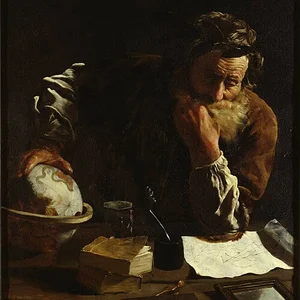
Euklid2

Euklid2

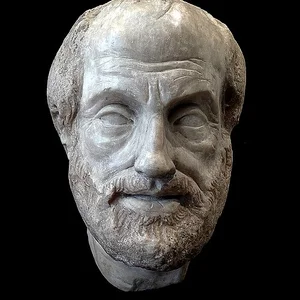
Euklid

Euklid


itlabel QS:Len,"Euclid"label QS:Lde,"Euklid"

itlabel QS:Len,"Euclid"label QS:Lde,"Euklid"


Euclidtitle QS:P1476,en:"Euclid"label QS:Len,"Euclid"

Euclidtitle QS:P1476,en:"Euclid"label QS:Len,"Euclid"


Euclidi Megaren

Euclidi Megaren

Woman teaching geometry

Woman teaching geometry

Formella 23, euclide e pitagora o la geometria e l'aritmetica, luca della robbia, 1437-1439

Formella 23, euclide e pitagora o la geometria e l'aritmetica, luca della robbia, 1437-1439

Triangle-right-abchpq

Triangle-right-abchpq

Euclid Goujon Cour Carrée Louvre

Euclid Goujon Cour Carrée Louvre


Storia di Alesa, antica città di Sicilia : col rapporto de'suoi più insigni monumenti statue, medaglie, iscrizioni, &c.

Storia di Alesa, antica città di Sicilia : col rapporto de'suoi più insigni monumenti statue, medaglie, iscrizioni, &c.

Visual Style

Style visuel inspiré de l'Alexandrie hellénistique : compositions géométriques épurées, lignes précises évoquant les constructions à la règle et au compas, lumière méditerranéenne dorée sur fond de marbre blanc et de papyrus.

#D4A843
#1E3A5F
#F5ECD7
#C2572B
#8FA89E
AI Prompt
Hellenistic Alexandria aesthetic with warm Mediterranean light. Clean geometric compositions inspired by Euclidean constructions: precise circles, triangles, and parallel lines as subtle background patterns. Architecture of white marble columns, open courtyards with papyrus plants, and scrolled manuscripts. Color palette of sun-bleached stone, deep Ptolemaic blue, papyrus gold, and terracotta. Flat illustration style with fine ink-like linework reminiscent of ancient geometric diagrams. Decorative Greek key patterns and meander borders. Scholarly atmosphere with stacked scrolls, compass-drawn arcs, and geometric solids rendered in clean vector style.

Sound Ambience

L'atmosphère sonore du quartier savant d'Alexandrie au IIIe siècle av. J.-C. : discussions entre érudits, grattement des calames sur le papyrus, bruits lointains du port méditerranéen et rumeur d'une grande cité hellénistique.

AI Prompt
Ambient sounds of ancient Alexandria's scholarly quarter. Gentle scratching of reed pens on papyrus scrolls. Murmured discussions in Greek between scholars debating geometric propositions. Distant sounds of the Mediterranean harbor: seagulls crying, wooden ships creaking, waves lapping against stone quays. Occasional footsteps on marble floors echoing through columned halls of the Mouseion. A teacher's clear voice explaining a theorem, followed by the quiet tapping of a stylus on a wax tablet. Wind rustling through palm trees in an inner courtyard. Far-off sounds of a bustling Hellenistic city: merchants calling, donkeys braying, bronze tools clinking.

Portrait Source

Wikimedia Commons — domaine public — Justus van Gent — 1474

Aller plus loin

Œuvres

Les Éléments (Στοιχεῖα)

vers 300 av. J.-C.

Les Données (Δεδομένα)

vers 300 av. J.-C.

L'Optique (Ὀπτικά)

vers 300 av. J.-C.

Les Phénomènes (Φαινόμενα)

vers 300 av. J.-C.

Division des figures (Περὶ διαιρέσεων)

vers 300 av. J.-C.

Les Coniques (Κωνικά)

vers 300 av. J.-C.