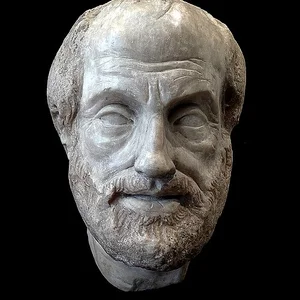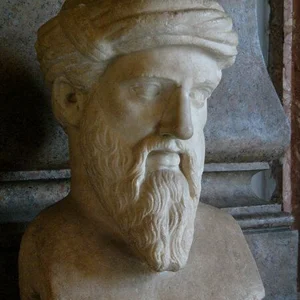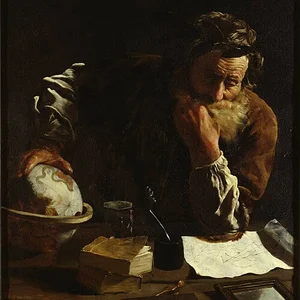

Greek mathematician and physicist from Sicily (c. 287–212 BC), Archimedes is one of the greatest scholars of Antiquity. He revolutionized mathematics and physics by developing innovative methods for calculating areas and volumes, and by formulating the principles of levers and buoyancy.
Archimedes(286 av. J.-C. — 211 av. J.-C.)
Archimedes
Syracuse ancienne
7 min read
Frequently asked questions
Famous Quotes
« Give me a place to stand, and I shall move the Earth»
Key Facts
- c. 250 BC: calculated an approximation of the number π (pi) using the method of exhaustion
- Stated the principle of buoyancy (Archimedes' principle) and discovered hydrostatic thrust
- Developed the mathematical theory of levers and simple machines
- 212 BC: died during the Roman siege of Syracuse
- Invented innovative mechanical devices including the Archimedes screw and pulley systems
Works & Achievements
A major treatise in which Archimedes proves that the volume of a sphere is two-thirds that of the cylinder enclosing it. He considered this discovery his greatest achievement.
The founding work of hydrostatics in which Archimedes states the principle of buoyancy (Archimedes' principle), the basis of fluid physics.
A treatise in which Archimedes bounds the value of pi between 3+10/71 and 3+1/7 by inscribing and circumscribing regular 96-sided polygons in a circle.
A work in which Archimedes invents a numeration system to express very large numbers and calculates how many grains of sand would fill the universe.
A treatise on static mechanics in which Archimedes establishes the law of the lever and the theory of centers of gravity, foundations of rational mechanics.
A treatise rediscovered in 1906 in the Archimedes Palimpsest. In it he reveals his heuristic method using concepts close to infinitesimal calculus, two millennia before Newton and Leibniz.
A treatise defining the curve known as the Archimedean spiral and demonstrating the properties of this curve, still studied in mathematics today.
Anecdotes
According to Vitruvius, Archimedes discovered the principle of buoyancy while taking a bath. King Hieron II had asked him to verify whether his crown was made of pure gold without destroying it. Seeing water overflow from the bathtub, Archimedes understood that a body submerged in water displaces a volume equal to its own, and allegedly cried out "Eureka!" while running naked through the streets of Syracuse.
Archimedes is said to have declared: "Give me a place to stand and I shall move the world." To demonstrate the power of levers and pulleys, he reportedly pulled, single-handedly, a heavily laden ship out of the water before King Hieron II using a system of compound pulleys. This demonstration astonished the court of Syracuse.
During the Roman siege of Syracuse in 214–212 BC, Archimedes designed formidable war machines to defend his city. Among them, giant cranes lifted Roman ships out of the water and let them drop, while precisely calibrated catapults struck the enemy at varying distances. The Roman general Marcellus reportedly said he was fighting against a "geometrical Briareus".
Archimedes died in 212 BC during the Roman capture of Syracuse. According to Plutarch, a Roman soldier came to fetch him, but Archimedes, absorbed in a geometry problem he was tracing in the sand, said: "Do not disturb my circles." The soldier, enraged, killed him. General Marcellus, who had ordered that Archimedes be spared, was deeply grieved by his death.
Cicero recounts having found Archimedes' tomb in Syracuse in 75 BC, at the time neglected and overgrown with brambles. He recognised it by the sphere inscribed within a cylinder decorating the stele — the symbol of the discovery Archimedes was most proud of: the 2/3 ratio between the volume of a sphere and that of the cylinder containing it.
Primary Sources
Archimedes demonstrates that the surface area of a sphere equals four times that of its great circle, and that the volume of the sphere is two thirds of that of the circumscribed cylinder.
Any body immersed in a fluid at rest experiences a vertical upward force equal to the weight of the fluid displaced by that body.
Archimedes proposes a numeration system capable of expressing immensely large numbers, and calculates the number of grains of sand needed to fill the universe as it was conceived in his time.
Marcellus was grieved by the death of Archimedes; he turned his eyes away from his killer as from a sacrilegious act and had the scholar's relatives sought out in order to honor them.
Archimedes, upon stepping into the bath and observing that water overflowed as he sank into it, understood the method to solve the problem of the crown, and ran out crying Eureka.
Key Places
Greek city in Sicily where Archimedes was born, lived, and died. It was here that he carried out the bulk of his scientific work in the service of King Hiero II.
Great intellectual center of the Hellenistic world. Archimedes likely stayed there in his youth to study under the successors of Euclid, and forged connections with Eratosthenes.
Natural harbor of Syracuse where Archimedes deployed his war machines against the Roman fleet of Marcellus during the siege of 214–212 BC.
Peninsula forming the historic heart of ancient Syracuse, home to its temples, the royal palace of Hiero II, and likely the residence of Archimedes.
The tomb of Archimedes was located on the outskirts of Syracuse. Cicero rediscovered it in 75 BC by recognizing the cylinder and sphere engraved on the stele, in accordance with the scholar's own wish.
Typical Objects

Common writing instruments in ancient Greece, used by Archimedes to record his calculations and geometric proofs in his daily work.

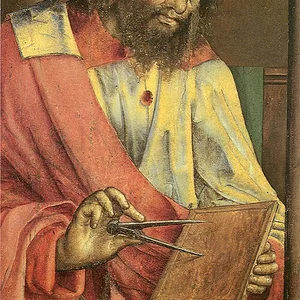
Fundamental tools of the Greek geometer, essential for drawing the complex figures Archimedes studied, such as spirals, parabolas, and conic sections.

Archimedes is said to have built a mechanical planetarium reproducing the movements of celestial bodies. Cicero mentions this object as a marvel of ingenuity brought to Rome after the fall of Syracuse.

A mechanical system perfected by Archimedes to multiply forces. He used it to demonstrate to King Hiero II that a single man could move a ship.

A helical device attributed to Archimedes, used to raise water for irrigation. It is still used today in certain hydraulic systems.

Archimedes would often draw his geometric figures in sand or ash on the ground. It was while drawing in the sand that he is said to have spoken his last words, according to tradition.
School Curriculum
Vocabulary & Tags
Key Vocabulary
Daily Life
Morning
Archimedes likely rose at dawn, as most Greeks did. After a quick wash and a frugal meal, he would immerse himself in geometric reflections, tracing figures in the hearth ashes or on wax tablets. According to Plutarch, he was so absorbed in his research that he sometimes forgot to eat.
Afternoon
The afternoon could be devoted to practical experiments in his workshop, where he designed machines and tested his principles of mechanics. He also visited the palace of Hieron II to present his inventions or discuss concrete problems, such as verifying the purity of gold or the defense of the city.
Evening
In the evening, Archimedes might attend a symposium (banquet) at the king's court or at a notable's home, where guests debated philosophy and science. He also wrote his treatises in the form of letters addressed to other scholars, such as Eratosthenes in Alexandria or Conon of Samos.
Food
The diet in Greek Sicily was built around the Mediterranean triad: wheat bread, olive oil, and water-diluted wine. Figs, goat cheese, fresh fish, and vegetables were also common. Syracuse was renowned for its refined cuisine, considered among the finest in the Greek world.
Clothing
Archimedes most likely wore a chiton (a light linen or wool tunic) suited to the Sicilian climate, and a himation (draped cloak) for more formal occasions. Greek scholars dressed simply, and Plutarch describes him as neglecting his appearance in favor of his research.
Housing
As a close associate of King Hieron II, Archimedes probably lived in a comfortable house in Syracuse, perhaps on the island of Ortygia. Prosperous Greek homes featured a central atrium, rooms opening onto an inner courtyard, a workshop, and were built from limestone with terracotta-tiled roofs.
Historical Timeline
Period Vocabulary
Visual Style
Un style visuel inspiré de l'art hellénistique et de la lumière dorée de la Sicile antique, mettant en valeur la géométrie, le marbre blanc et les teintes chaudes méditerranéennes.
Sound Ambience
L'ambiance sonore de Syracuse au IIIe siècle av. J.-C. : un port méditerranéen animé, le son des vagues et des navires, mêlé aux bruits d'un atelier de mécanicien-inventeur et au chant des cigales siciliennes.
Liens externes & ressources
Références
Œuvres
De la sphère et du cylindre
vers 250 av. J.-C.
Des corps flottants
vers 250 av. J.-C.
De la mesure du cercle
vers 250 av. J.-C.
L'Arénaire (Psammitès)
vers 250 av. J.-C.
De l'équilibre des plans
vers 250 av. J.-C.
La Méthode
vers 250 av. J.-C.
Des spirales
vers 250 av. J.-C.