Imaginary dialogue between Hiéron II de Syracuse and Archimedes
by Charactorium · Archimedes (286 av. J.-C. — 211 av. J.-C.) · Sciences · 6 min read
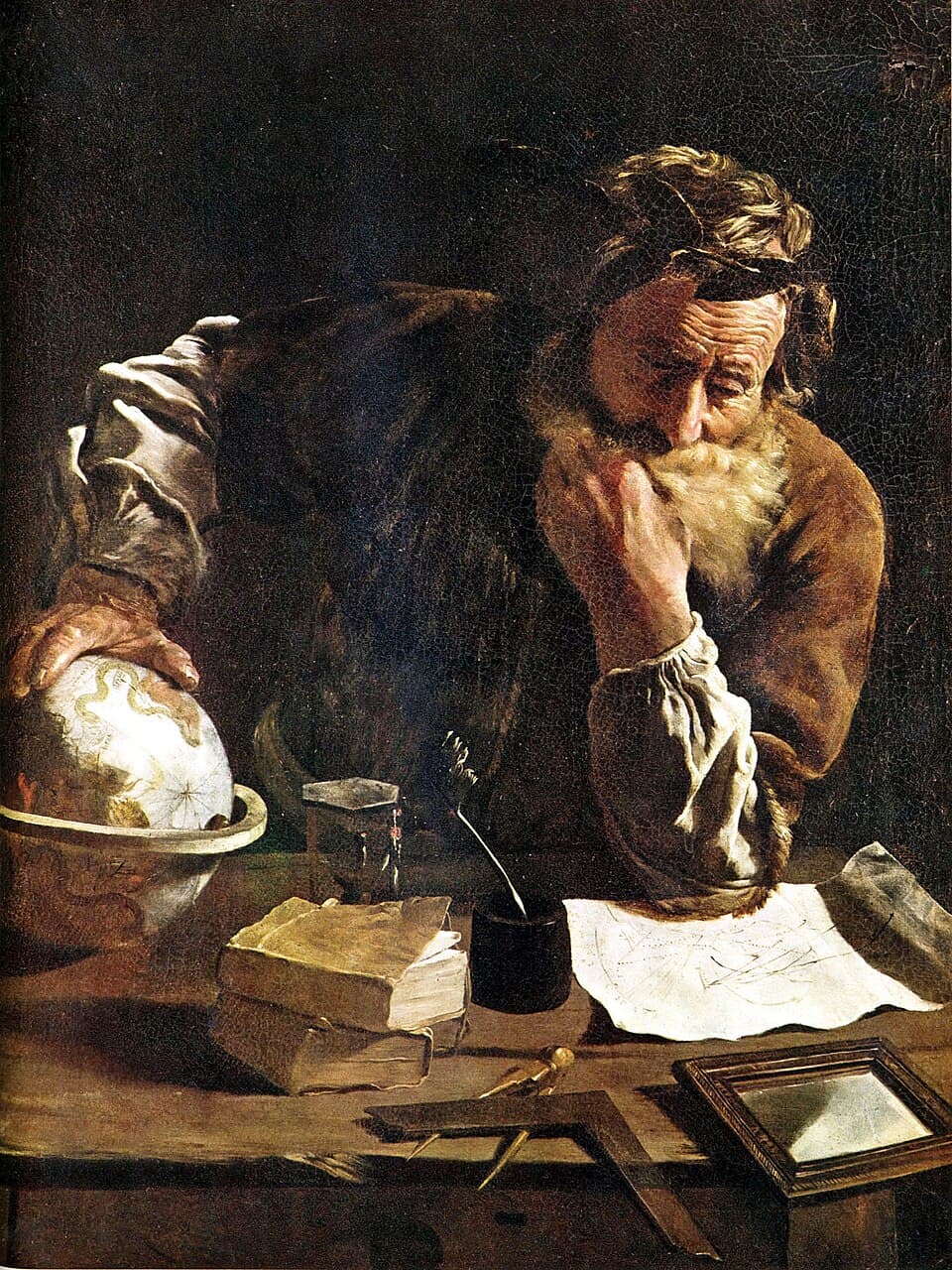
It is under the shaded porticoes of the palace of Ortygia, on an afternoon in the summer of 220 BC, that King Hieron II summons his old relative and scholar Archimedes. The noise of the Porto Grande rises to the gardens, mingled with the scent of fig trees and the scratching of a stylus on wax. The two men have known each other for decades: one rules over Syracuse, the other serves it with his genius. The king, on this day, comes less to command than to listen to the man behind the machines.
—Archimedes, do you remember the crown I entrusted to you, suspecting the goldsmith had cheated me? How did you uncover his secret without melting it down?
How could I forget, Hieron? You had tied my hands: prove the fraud without damaging your offering to the gods. I turned the problem over for days, until a bath revealed it. As I sank into the water, I saw the level rise, even overflow, and I understood in a flash: every body displaces a volume of water equal to its own. I only needed to compare the overflow of your crown with that of an identical weight of pure gold. If the goldsmith had mixed in silver, which is bulkier for the same weight, the water would betray him. They say I ran out into the street without a tunic, shouting Eureka. I won't deny it: the joy of understanding, my king, knows neither modesty nor clothing.
The joy of understanding knows neither modesty nor clothing.
—This principle you call buoyancy—is it only good for exposing fraudsters, or do you see it as a higher law?
A much higher law, Hieron, one that governs everything that floats on your ships as well as in your bathtub. I recorded it in my treatise On Floating Bodies: any body immersed in a fluid experiences an upward force equal to the weight of the fluid it displaces. That is why a ship laden with grain does not sink, as long as its hull pushes aside enough water to equal its load. The crown was merely a fortunate pretext. What I seek is not thieves, but the hidden reason behind ordinary things. The dishonest goldsmith, without meaning to, opened the door to all of hydrostatics. I am almost grateful to him.
What I seek is not thieves, but the hidden reason behind ordinary things.
—Before my entire court, one day, you alone hauled a loaded ship out of the water. Were you so sure of your pulleys, or were you challenging the king?
I was challenging no one, Hieron—I was taking you at your word. You doubted that one man could move a load that a hundred struggled to pull. I had answered that with a place to stand I could move the world, and you wanted to see. So I rigged a block and tackle, those compound pulleys that multiply effort at every turn of the rope. The ship from your fleet, ballasted with men and goods, I drew to me unhurriedly, as one pulls a thread. Force, you see, is not created: it is exchanged for distance. What I gain in power, I pay for in length of rope. Your court saw a miracle; I saw only a proportion faithfully observed.
Force is not created: it is exchanged for distance.
—This law of the lever you speak of constantly—have you only tested it by hand, or demonstrated it like your theorems?
Demonstrated, Hieron, as a truth of geometry, not guessed by trial and error. In my treatise On the Equilibrium of Planes, I establish that two weights balance when their distances from the fulcrum are inversely proportional to their masses: the lighter weight, set farther away, holds its own against the heavier. From this follows the concept of the center of gravity, that unique point where one could support an entire body. The hand merely obeys what the demonstration has already proven. That is why I trust my diagrams more than my muscles. The block and tackle that hauled your ship was only that law made visible, draped in ropes and wood to convince those who do not read diagrams.
I trust my diagrams more than my muscles.
—I am told you claim to count the grains of sand that would fill the universe. Is this a mental game, or a serious challenge you set yourself?
Both at once, Hieron. People repeat that sand is countless, that no number could encompass it. I wanted to show that this is false. The problem was not the sand, but our words: our language runs out at the myriad of myriads and refuses to go further. So I forged, in the work I call the Sand Reckoner, a new way of naming large numbers, by orders and periods, up to magnitudes no one had dared to write. Then, taking the size of the cosmos as estimated, measured in stades, I calculated how many grains would fill it. The number is immense, but finite, and I can state it. That is what I wanted to prove: infinity is but an admission of laziness before calculation.
Infinity is but an admission of laziness before calculation.
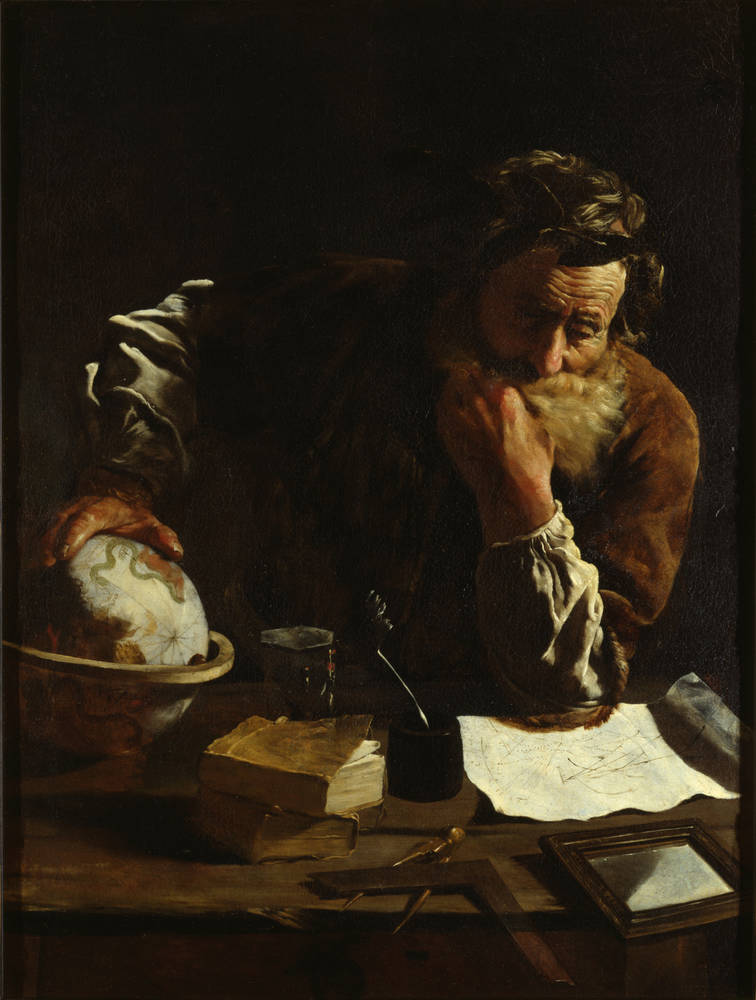
—You exchange, they say, letters with the scholars of Alexandria, across the sea. What do you seek so far away, when you have my city?
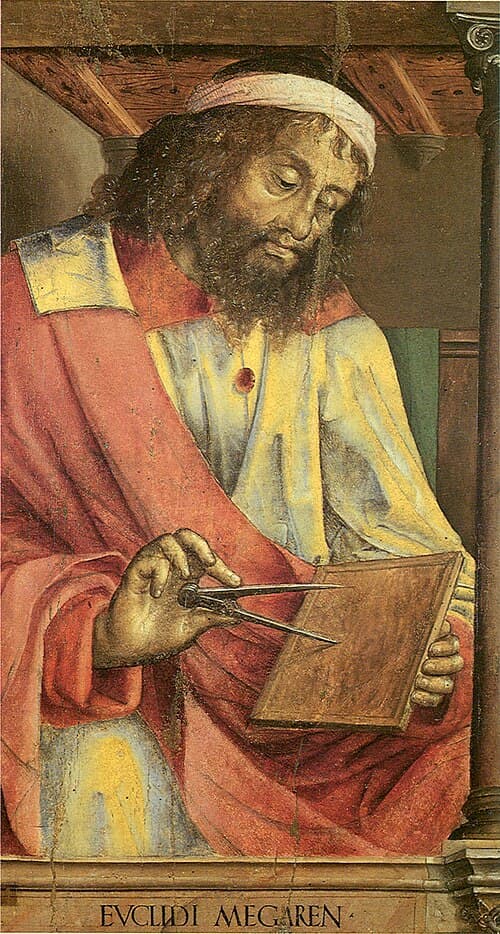
What your city alone cannot give me, Hieron: a mind that answers me on my level. I write to Eratosthenes, who directs the great Library of Alexandria and who first measured the circumference of the Earth by the shadows of the sun. I send him my problems as challenges, sometimes slipping in false results to confound those who claim to solve without proving. Science, you see, is not a treasure to be kept: it is a letter to be sent, and it is only worth as much as the reply. I knew Alexandria in my youth, its masters heirs of Euclid. Today the sea separates us, but a demonstration crosses the waves better than any ship in your fleet.
Science is not a treasure to be kept: it is a letter to be sent.
—Of all your discoveries, machines and theorems, which one would you want to be remembered for, my old friend?
Neither machines nor numbers, Hieron, but a single figure: the sphere inscribed in its cylinder. I proved, in my treatise On the Sphere and Cylinder, that the sphere occupies exactly two-thirds of the cylinder that encloses it, and that its surface area is four times that of its great circle. This may seem a geometer's trifle, but consider: two bodies so different, linked by a ratio so simple, so pure. No king has ever possessed such a truth. When the day comes that I am buried, I want no warlike inscription or title: let them engrave on my stone this sphere and cylinder, with their ratio of two to three. Let passersby understand that here rests a man who first loved the measure of forms.
Let them engrave on my stone this sphere and cylinder, with their ratio of two to three.
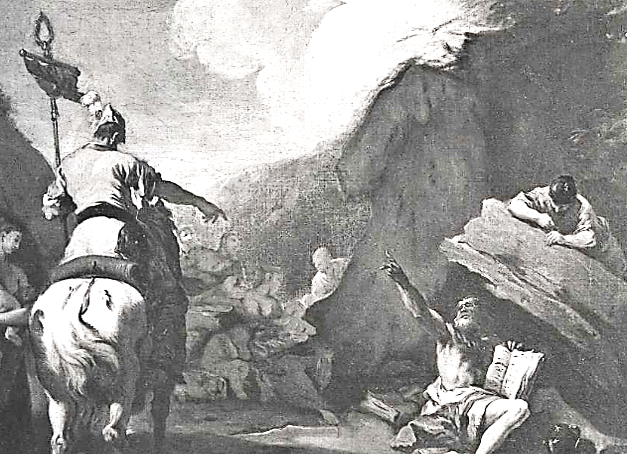
—Rome and Carthage are tearing each other apart around us, and Syracuse is coveted. These engines I have ordered from you for our walls—will they be ready in time?
They will, Hieron, and your foresight will have saved them even before they are used. You had the wisdom, you who kept the peace so long, to let me arm the city in advance rather than in haste. I have designed cranes capable of grabbing the prow of an enemy ship entering the Porto Grande, hoisting it, then dropping it to sink. I have also calibrated catapults to strike accurately at any distance, some for long range, others for the enemy already under our walls. The same proportion that hauled your ceremonial ship can, reversed, break a fleet. This is the art of siege, poliorcetics, but taken from the other side: not to take a city, but to make it impregnable.
The same proportion that hauled your ship can, reversed, break a fleet.
—Does it disgust you, you who love pure forms, to put your geometry at the service of war and blood?
I will not lie to you, Hieron: I far prefer drawing a spiral to adjusting a catapult. My treatises are my true domain; the war machines are only a service I owe to the city that has nourished me. But when the walls tremble, the geometer has no right to take refuge in his circles. Our Porto Grande is the gateway to Syracuse; whoever holds it holds us. So I have bent my science to necessity, knowing that a dead city reads no more theorems. Let the Romans one day call me their torment, I care little: I defend first the streets where I drew in the sand, and the roof under which we speak, you and I, at this moment.
A dead city reads no more theorems.
—Before I leave you to your figures, tell me: that screw that raises water—did you derive it from a theorem or from a farmer's need?
From both again, Hieron—for need and demonstration feed each other. People wanted to raise water from the lowlands to the fields and ships' holds without buckets or excessive effort. I enclosed a helix in a cylinder, that cochlea which one turns and seems to make water rise when in fact it only lets it slide along its slope. The farmer sees a miracle; I, the spiral made useful. You see, I do not separate what your court separates: the reckoning of sand, the law of the lever, the irrigation screw—all proceed from the same thirst to measure the world. You have given me Syracuse as a workshop, Hieron; I strive to give it back to you in forms that men may keep.
The farmer sees a miracle; I, the spiral made useful.
Read further
This imaginary interview was generated by artificial intelligence from sources documented in Archimedes's profile. It dramatises what the figure might have said based on what we know about them, but does not constitute attested historical testimony. For primary sources and factual documentation, refer to the full profile.