Imaginary interview with Aristotle
by Charactorium · Aristotle (460 av. J.-C. — 401 av. J.-C.) · Philosophy · Sciences · 7 min read
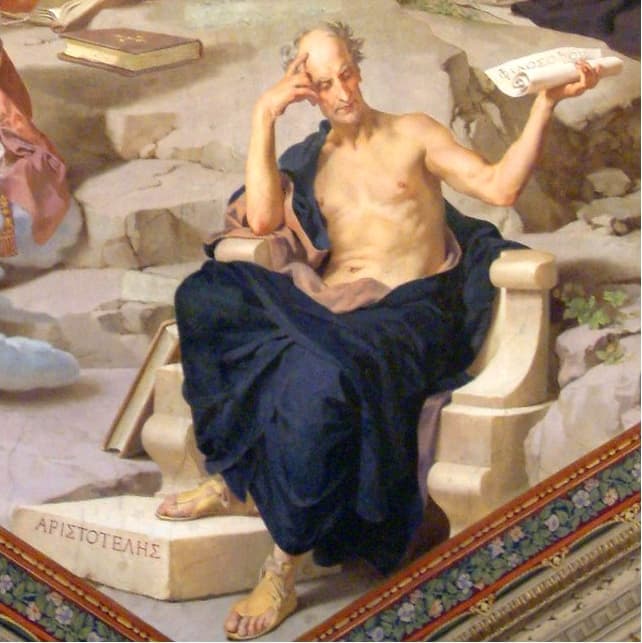
We find Aristotle at Chalcis, on the island of Euboea, in the autumn of 322 BC — driven from Athens by an accusation of impiety, he receives visitors in a borrowed room overlooking the Euripus strait, a wax tablet propped against the wall and a dried cuttlefish lying on the table beside him. He speaks with the methodical calm of a man who has spent a lifetime turning observation into argument, and if there is grief in his voice when Athens comes up, it is well-controlled.
—How did it come to pass that King Philip entrusted you with his son's education?
Philip sent word in 343 — not as a request, but as a summons from a king who happened to phrase things politely. He wanted a philosopher for his son, and I think he wanted one he could trust to remain near Macedonia without growing dangerous. My father had served as physician at the Macedonian court; Stagire was close enough for them to feel comfortable with me. And Alexander — he was thirteen, sharp-eyed, impatient with slow explanations. The sanctuary of the Nymphs at Miéza gave us gardens and colonnades for our lessons, which suited me well: I have never believed that thought confined to a room travels very far. We read Homer together. We spoke of plants, of animal bodies, of what distinguishes one kind of rule from another. Whether any of it remained with him through his campaigns in Persia and beyond, I cannot know with certainty.
—What kind of student was the young Alexander, and what did you most hope to give him beyond the texts?
He had a restless intelligence — the kind that grasps quickly and grows bored of what it has grasped. In that, he reminded me of no one so much as myself at seventeen when I first entered Platon's Academy. I tried to give him what my master had given me: not conclusions, but the habit of questioning. We worked through problems of justice, of what makes a man fit to lead, of why some peoples seem constituted for command. I also brought him into natural inquiry: the shapes of bones, the habits of fish pulled from nearby streams. The virtue I most wanted to plant in him was phronesis — that practical wisdom which sees what each situation actually requires, not what the rule prescribes in the abstract. Whether a conqueror can consistently possess phronesis is a question I have never resolved to my own satisfaction.
—When you founded the Lyceum in 335, what were you building — a school, a library, a method?
All three, though I did not think of it in those terms at the start. I needed a place where observation could accumulate — where a student's notes on the anatomy of a shark could sit beside a colleague's study of the constitutions of a hundred and fifty-eight cities. The library was essential to that: documents, records, specimens collected from Lesbos and beyond. But a library without living discourse is merely a warehouse. So I kept the peripatos — the covered walkway near the temple of Apollo Lycian — as the place where argument happened. Not seated on benches but moving, so that thought moves with the body. I gave my demanding courses in the mornings to advanced students, and opened the afternoons to anyone in Athens who wished to hear about rhetoric or the art of a well-made speech. The polis deserves to think, not merely to vote.
—Why does walking matter to how you think? Is it a physical habit or something deeper?
A conviction born from habit — which is how most genuine convictions are formed, as I argue in the Nicomachean Ethics. When a man sits, he tends to treat a question as already fixed in shape, like a statue he circles. When he walks, the question moves with him and reveals different faces. I have found that the best refutations come when one is three steps past where the argument was first formulated. There is also something in the rhythm of footfall that prevents the kind of overconfident symmetry that kills inquiry — the beautiful false system, constructed too quickly and too neatly. My students at the Lyceum learned to pause mid-stride when an objection struck them; sometimes we would turn back and retrace fifty feet, as though the ground itself held the clue to what we had missed. The peripatos is not a decoration. It is the method.
The best refutations come when you are three steps past where you formulated the argument.
—Before founding the Lyceum, you spent time on the island of Lesbos studying marine life. What drew a philosopher to tidal pools?
The question assumes that philosophy and the study of animals belong in different rooms. I reject that partition. Between 347 and 343, on the shores of Lesbos, I watched the octopus change color to match the sea floor. I opened mussels and traced their muscular hinges with the same blade I used to trim my wax tablets. I followed the spawning of fish into the lagoon at Pyrrha. None of this was subordinate to philosophy — it was philosophy, the part that begins with patient looking rather than inherited assumptions. A cuttlefish moving through shallow water is a more intricate argument than most of what passes for debate at a symposion. In the Historia Animalium I tried to record not merely what each creature does but what it is — its form, its characteristic activity, the purpose woven through its structure. The man who bends over a sea urchin and the man who argues about virtue are the same man.
—Some find the dissection of animals repugnant — beneath the dignity of a philosopher. How do you answer them?
I wrote what I believe: we must approach the study of every animal without repugnance, for in each there is something natural and beautiful. That sentence is not rhetorical encouragement — it is a methodological claim. Beauty is not ornament. It is the signature of form working as it should, and form working as it should is precisely what I am always searching for, in animals as in arguments as in constitutions. The blade and the wax tablet are companions: I observe, I note, I compare. To refuse to open a creature because the interior is wet and dark seems to me a failure of nerve dressed up as refinement. Platon asked us to distrust the visible world and seek the Forms beyond it. I trust the visible — provisionally, carefully, with instruments in hand. The truth about a cephalopod is not less philosophical than the truth about the Good.
Beauty is the signature of form working as it should.
—The word eudaimonia sits at the heart of your ethical thinking. What does it mean, in your account, to truly live well?
The common rendering — 'happiness' — misleads by making it sound passive, as though one receives it the way one receives a gift or good weather. What I mean by eudaimonia is an activity: the sustained exercise of the soul's best capacities in conformity with virtue. In the Nicomachean Ethics I wrote that happiness is an activity of the soul conforming to virtue, and if there are several virtues, then conforming to the most excellent and most complete. Notice the word 'activity.' A lyre lying unplayed produces no music. A person who possesses virtue but never exercises it — never chooses, never acts, never endures difficulty to do what is right — has not yet lived well. Phronesis, practical wisdom, is what guides those choices in the particular moment, the messy, specific, unrepeatable situation that no general rule ever fully covers. Philosophy that cannot reach that moment stays permanently unfinished.
—You write that man is by nature a political animal. What becomes of those who try to live entirely outside the city — the hermit, the exile, the wanderer?
The one who lives outside the polis by nature and not by accident is either a degraded creature or something above the human — I wrote that in the Politics, and I stand by it. But the qualification matters enormously. The man expelled unjustly, the man who retreats to the islands for a season of research, the man who flees to save his life: none of these are what I mean. Language itself is a political phenomenon. We do not have mere voices to signal pain and pleasure, as animals do — we have logos, speech, which allows us to deliberate together about what is just and unjust, beneficial and harmful. Strip the polis away and speech collapses into noise. I know something of living at the margins of Athens: years in Assos, then Lesbos, then a return. Each time I felt the loss of the agora like a missing faculty of the mind.
—When you left Athens in 323, after Alexander's death, an accusation of impiety was pursuing you. What were you actually afraid of?
I was afraid of what happened to Socrates in 399 — not the death itself, but the mechanism: a city turning grief and anger into a legal procedure, clean and formal, that produces a corpse and calls it justice. My association with Macedonia made me the convenient figure to absorb that anger. The charge, as always in such cases, was impiety — the all-purpose instrument for destroying a philosopher without appearing to punish thought directly. I was not unwilling to die for a principle, but I saw no principle in allowing Athens to panic its way into another such verdict. I am said to have remarked that I would not give the city an opportunity to sin twice against philosophy — the first time being Socrates, the hemlock, the vote. I said something of that kind. It seemed the only honest way to describe a decision that was not quite courage and not quite cowardice.
I would not give the city an opportunity to sin twice against philosophy.
—Looking back at Socrates' fate and your own forced departure, what does it reveal about the relationship between a city and its thinkers?
The polis needs philosophy the way a man needs someone willing to tell him when he is wrong — which is to say, it needs it desperately and resents it profoundly. Socrates walked the agora for decades, questioning generals and poets and craftsmen who sensed, even as he provoked them, that they did not know what they claimed to know. Athens tolerated him until it could not, and then it killed him with its own laws, with a vote, correctly, legally. That efficiency is what should disturb us. It was not a mob but a court. I do not think the city is wicked for this — I think it is afraid, which is a different condition and one that admits of a remedy. Fear is an emotion that can be educated. This is why philosophy must remain inside the polis, even at risk, rather than flee permanently to Chalcis. I came here to survive. I would not have stayed.
Read further

This imaginary interview was generated by artificial intelligence from sources documented in Aristotle's profile. It dramatises what the figure might have said based on what we know about them, but does not constitute attested historical testimony. For primary sources and factual documentation, refer to the full profile.