Imaginary dialogue between Alexander the Great and Aristotle
by Charactorium · Aristotle (460 av. J.-C. — 401 av. J.-C.) · Philosophy · Sciences · 6 min read
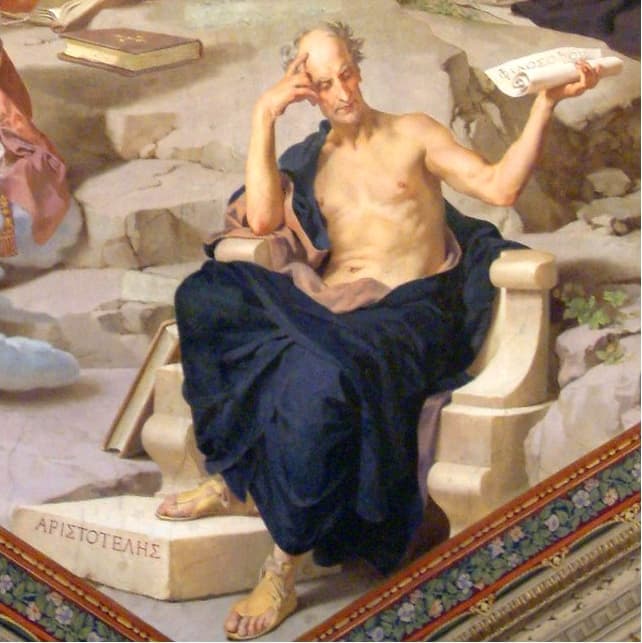
It is in the shaded peripatos of the Lyceum, in the early autumn of 335 BC, that Alexander seeks out his former teacher for what both sense may be their last unhurried conversation. The air carries the smell of dried herbs and open papyrus rolls; somewhere in the grove, a student reads aloud from a treatise on animals. Aristotle, not yet fifty, paces his covered walkway as he always has — thinking through motion. Alexander, twenty-one years old, comes not as a king commanding but as a pupil who still has questions, and whose army is already assembled to the north.
—Master, do you remember Mieza — the gardens, the shade of the Nymphs' sanctuary? What did you truly want to give me there, beyond grammar and geometry?
I remember every morning of it, Alexander — the dew still on the grass when you arrived, the way you argued about the nature of justice before the first hour of lesson was over. What I wanted to give you was not a catalogue of facts but a habit of mind: the capacity to ask why before asking what. A king who knows only what is told to him is no more than an instrument in the hands of his counselors. At Mieza I hoped to give you something that could not be confiscated — the ability to reason for yourself under pressure. Whether you needed me to give it, or whether it was already in you and I merely sharpened it, I have never been entirely sure.
A king who knows only what is told to him is no more than an instrument in the hands of his counselors.
—You sent me away from Mieza with a copy of Homer and a set of medical notes. Which did you think I would need more on campaign?
You smiled when I gave you both, as if you already knew the answer. I gave you Homer because a commander must understand the souls of the men he leads — what they fear, what they love, what moves them to follow a stranger into the unknown. I gave you the medical texts because a body that fails its master on campaign is simply a corpse with ambitions. But I confess I may have misjudged the proportions. You have always been drawn more to the Iliad than to remedies, and that, too, told me something about you that I stored away carefully.
—Your students follow you up and down this walkway all morning. Why must wisdom be learned while walking?
The body in motion keeps the mind honest — that is the short answer. When we sit still, we are tempted to treat a thought as finished, as a settled object we can set down and return to later. Walking does not permit that comfort. Each step asks the argument to prove itself again. I also find that students pay closer attention when they are in movement; they cannot fall into a kind of dozing respectfulness that I have always distrusted. This peripatos has produced more genuine thinking than any chair I have ever occupied. Besides, you yourself could never stay seated for long at Mieza — I learned the method partly from watching you.
When we sit still, we are tempted to treat a thought as finished.
—I have heard you teach different audiences at different hours of the day. Why divide the work that way?
Because not all questions are for everyone, and the honest teacher admits this. In the mornings I work with students who have already mastered the ground — we can go further, faster, without stopping to define every term. In the afternoons I speak to a wider gathering: the curious citizen, the young man who wandered in from the agora, the visitor passing through Athens. I do not simplify for them — I would insult them if I did — but I choose the entry point with greater care. The Lyceum is not merely a school; it is a place where knowledge is organized for future use. If I neglect one of these two audiences, half of what we have assembled here will die without reaching the people it was made for.
—On the island of Lesbos you spent months cutting open fish and measuring the lagoon's currents. Was that truly philosophy, or something else entirely?
It was the most philosophical thing I have ever done, and I say that with full awareness of everything else on my shelves. There is a temptation — I felt it powerfully during my years at the Academy under Plato — to believe that the truth of things can be reasoned out entirely from first principles, without ever touching the world. Lesbos cured me of that. When I examined the cephalopods in the lagoon at Pyrrha, I found structures that no armchair reasoning could have predicted. The material world surprises you; it has no obligation to confirm your theory. I wrote it down as an instruction to myself: approach every animal without repugnance, for in each there is something natural and beautiful. That is not a sentimental remark. It is a rule of method.
—You collected and described hundreds of animals. Do you trust what the eyes see, or do the eyes deceive?
The eyes see what is there; the error belongs to the interpreter. When I described the ink-sac of the octopus, I was not theorizing — I was reporting. The real risk is not observation itself but the leap from a single observation to a universal claim. In the Historia Animalium I was careful to distinguish what I had verified directly from what I received from fishermen, merchants, and travelers. Some of those reports I trust; others I record with a deliberate note of reservation. A responsible natural philosopher marks the boundaries of his own certainty. The world will continue to be observed long after I am gone, and I would rather leave behind a reliable method than a closed system that forbids correction.
—You dedicated the Nicomachean Ethics to your son Nicomachus. Would the counsel have been different if you had addressed it to me?
The Nicomachean Ethics is addressed to Nicomachus but it is not counsel for a child — it is counsel for a man deciding how to live. You were, in many respects, the other young man I had in mind as I worked through it, even if I could not say so openly. What I argue there is that eudaimonia — the fullest flourishing of a human being — is not a condition you can accumulate the way one accumulates tribute or territory. It is an activity, a continuous exercise of the soul in accordance with what is best in it. I have watched you in motion, Alexander, and I believe you are genuinely capable of it. Whether the scale of your ambitions will leave sufficient room for it is a question I cannot answer in your place.
Eudaimonia is not a condition you can accumulate the way one accumulates tribute or territory.
—You speak of phronesis — practical wisdom — as a virtue apart from theoretical knowledge. Can a commander cultivate it in the field?
It is precisely in the field that phronesis is tested most sharply. Book knowledge can tell you the theory of courage; it cannot tell you how much risk is appropriate on this particular morning, with these particular men, against this particular enemy. Phronesis is the capacity to read the singular situation and act well without leisure for deliberation. It is not instinct — instinct is merely repeated habit — it is trained perception, sharpened by experience and guided by an understanding of what a good outcome actually looks like. The danger for a great commander is that success can seduce phronesis into something cruder. When every decision proves correct, a man stops examining his decisions. That, I would warn you, is the moment the virtue begins to erode.
—You have lived in Athens for decades without ever becoming a citizen. Does the city owe you anything — or do you owe it?
As a métoikos I owe Athens the taxes, the deference, and the discretion the city extracts from those it permits to reside without belonging. What Athens has given me in return is incomparably greater: the libraries, the conversations, the community of minds that could not have assembled anywhere else in the Greek world. But I do not confuse gratitude with security. Socrates was a citizen — born in Athens, who fought for it at Potidaea — and the city killed him for his thinking. I am a foreigner from Stagire. If the political wind turns, I will have even less legal protection than he did. I trust the Lyceum; I trust my work; I trust a handful of people. Cities I trust somewhat less.
—If Athens ever turned against you — as it once turned against Socrates — what would you choose to do?
I would leave, and I say this without shame. Socrates chose to stay and accept the hemlock, and there is a grandeur in that choice I do not diminish. But I do not believe philosophy is served by the philosopher's needless death. The works, the students, the method — these are what must survive, not the body of the man who produced them. I would not allow Athens to commit the same error twice if I could prevent it by the simple act of walking out through the gate. The city is not the whole of the world; I have already learned this at Assos, at Lesbos, at Mieza with you. A mind can work anywhere. It needs a room, a lamp, and a few hours without interruption.
Read further


This imaginary interview was generated by artificial intelligence from sources documented in Aristotle's profile. It dramatises what the figure might have said based on what we know about them, but does not constitute attested historical testimony. For primary sources and factual documentation, refer to the full profile.