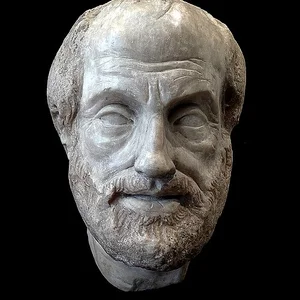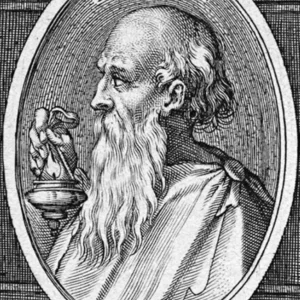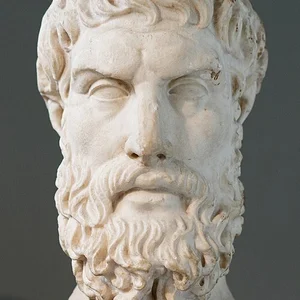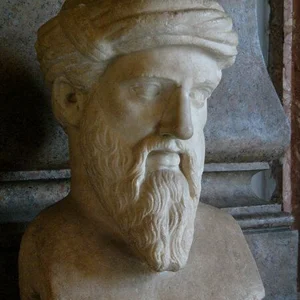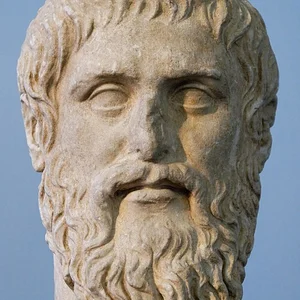

Ancient Greek philosopher (428–348 BC), founder of the Academy in Athens. A student of Socrates, he developed the Theory of Forms, arguing that the visible world is merely a shadow of an intelligible reality. His influence on Western thought is foundational.
Plato(428 av. J.-C. — 348 av. J.-C.)
Plato
Athènes
9 min read
Frequently asked questions
Famous Quotes
« The visible world is a prison; the intelligible world is freedom.»
« Knowledge is recollection.»
« No one does wrong willingly.»
Key Facts
- 428 BC: Born in Athens
- 407–404 BC: Decisive encounter with Socrates and the beginning of his philosophical commitment
- 387 BC: Foundation of the Academy of Athens, the first institution of higher learning in the Western world
- 380 BC: Writing of the Republic, his major work presenting the Theory of Forms
- 348 BC: Death in Athens at the age of 80
Works & Achievements
A reconstruction of Socrates' defense speech at his trial. It is Plato's earliest work — an act of loyalty to his condemned master — and the first exposition of the Socratic philosophical ideal.
A dialogue devoted to love (Eros), presented as a series of speeches at a banquet. Plato sets out his famous theory of the ascent through love toward absolute Beauty — the foundation of what we call 'platonic love'.
Plato's masterwork in ten books, devoted to justice and the ideal city-state governed by philosophers. It contains the Allegory of the Cave, the most famous image in Western philosophy, used to illustrate the Theory of Forms.
A dialogue recounting Socrates' final hours before he drinks the hemlock. Plato develops his arguments for the immortality of the soul and offers an in-depth exposition of the Theory of Forms.
A dialogue on the nature of virtue and whether it can be taught. Plato develops his theory of recollection: learning is not the acquisition of new knowledge, but the remembering of what the soul contemplated before it took bodily form.
A late dialogue devoted to cosmology and the creation of the world. It was the most widely read of Plato's works in medieval Europe, deeply influencing Christian theology and the medieval vision of the universe.
Plato's last dialogue, left unfinished at his death. In it he revises the political ideal of The Republic, proposing a 'second-best' city — more realistic, governed by precise laws rather than solely by the wisdom of philosophers.
Anecdotes
Plato was not his real name: he was actually born Aristocles. The nickname 'Plato' is said to have been given to him by his wrestling coach, referring to his broad shoulders (platys means 'broad' in Greek). This detail reveals that the greatest philosopher of the Western world was also an accomplished athlete, having competed in the Isthmian Games.
After Socrates' death in 399 BC, Plato was so shaken that he left Athens and traveled for several years through Egypt, southern Italy, and Sicily. In Sicily, he hoped to convince the tyrant Dionysius I of Syracuse to rule according to philosophical principles, but failed and nearly ended up sold into slavery.
Plato founded the Academy around 387 BC in a garden dedicated to the hero Akademos, near Athens. It was the first institution of higher learning in the Western world, where students studied mathematics, astronomy, philosophy, and politics. An inscription at the entrance reportedly read: 'Let no one ignorant of geometry enter here.'
Aristotle, his most famous student, joined the Academy at the age of 17 and remained there for twenty years until Plato's death. Despite the deep respect he held for his teacher, Aristotle ultimately rejected the Theory of Forms, arguing that universal forms did not exist separately from concrete things. This fundamental philosophical disagreement between master and pupil went on to shape the entire course of Western philosophy.
Primary Sources
Imagine men living in an underground dwelling shaped like a cave... Throughout their lives they have seen neither their own bodies nor those of others — nothing but the shadows cast by the fire on the wall of the cave.
One who wishes to pursue this goal in the right way must begin from youth to seek out beautiful bodies... and then recognize that the beauty found in one body is akin to that found in another.
Is death anything other than the separation of the soul from the body? To be dead — is it not that the body, separated from the soul, subsists alone by itself, and the soul, separated from the body, subsists alone by itself?
The unexamined life is not worth living. This is what I maintain, men of Athens, and it is not easy to convince you of it.
Seeking and learning are, in sum, nothing but recollection. Virtue cannot be taught — it is remembered by the soul that already carries it within.
Key Places
A garden located about 1.5 km northwest of Athens, dedicated to the hero Academus, where Plato founded his school around 387 BC. This place of teaching and collective inquiry remained active for nearly nine centuries.
The central public square of Athens where Socrates, Plato's teacher, would teach by engaging citizens in conversation. It was here that the young Plato first met Socrates — an encounter that changed the course of his life and the history of thought.
A Greek city in Sicily ruled by the tyrants Dionysius I and then Dionysius II. Plato traveled there three times in an attempt to realize his political ideal of a philosopher-king, but each visit ended in bitter failure.
The great commercial port of Athens, a cosmopolitan hub where cultures from across the Mediterranean world mingled. The Republic opens precisely at Piraeus, during the festival of the goddess Bendis — a detail not without symbolic meaning for a dialogue about justice and the ideal city.
Typical Objects

A common writing medium in ancient Greece, consisting of a wooden board coated with wax on which texts were inscribed using a stylus. Plato drafted his dialogues and philosophical notes on such tablets before they were copied onto papyrus.

Plato's dialogues were copied and distributed in the form of papyrus scrolls imported from Egypt. The Academy maintained a library of scrolls that constituted one of the most important intellectual collections in the Greek world.

An essential calculation tool at the Academy, where mathematics lay at the heart of philosophical teaching. For Plato, mathematical truths were the model for all Forms: eternal, immutable, and accessible to pure reason.

A distinctive drinking vessel of classical Greece, used at symposia (philosophical banquets). Plato's Symposium takes place at precisely one of these gatherings, where each guest, cup in hand, presents their conception of love and Beauty.

The tools of Euclidean geometry, the foremost discipline at the Academy. The famous inscription attributed to the Academy's entrance — 'Let no one ignorant of geometry enter here' — reflects the importance of geometric figures as models of the perfect Forms.

The theaters of Athens formed the cultural backdrop in which Plato grew up. Although he criticized poets and theater in The Republic, the dialogue form of his works draws directly from Athenian drama, of which he was once an admirer.
School Curriculum
Vocabulary & Tags
Key Vocabulary
Daily Life
Morning
Plato rose early, at sunrise, following the common practice in the ancient Greek world. He devoted the first hours of the morning to meditation and to writing his dialogues on wax tablets, in the quiet of his residence near the Academy. Personal hygiene began with a cold-water wash — simple but careful grooming.
Afternoon
The heart of Plato's day unfolded at the Academy, where he taught while strolling under the colonnades or seated in the garden, engaging his students in dialogue using the method he inherited from Socrates. The afternoon might also be given over to physical exercise, as Plato had been an athlete in his youth and believed that training the body was essential to the health of the soul.
Evening
In the evening, students and distinguished visitors would sometimes gather for a symposium — a philosophical dinner at which wine diluted with water was drunk while debating weighty subjects: love, justice, beauty. Plato himself portrays these evenings in the Symposium. After nightfall, he would return to his writing or to contemplating the starry sky, whose movements seemed to him to reflect the perfect order of the world of Ideas.
Food
The Athenian diet of the wealthy class included barley or wheat bread, olive oil, olives, vegetables (broad beans, lentils, onions), goat's or sheep's cheese, fresh or dried fish, and figs. Meat was reserved for religious festivals. Plato was known for his sobriety and moderation at the table — virtues he championed in his writings as foundations of wisdom.
Clothing
Plato wore the typical dress of prosperous Greek citizens: a linen or wool tunic (chiton) fastened at the shoulders with fibulae, over which he draped a large woolen mantle (himation) of white or natural-colored wool. Leather sandals completed the outfit. For ceremonies or official occasions, dress was more refined, with dyed fabrics and finely crafted sandals.
Housing
Plato lived in a house of stone and mud brick in Athens, most likely in an aristocratic neighborhood. The classic Greek house was organized around an open courtyard. The main rooms were the andron (the men's hall used for symposia) and the gynaikonitis (the women's quarters). The Academy also had an estate with gardens, a library, and meeting spaces that Plato had developed over the years.
Historical Timeline
Period Vocabulary
Visual Style
Style de la Grèce classique du IVe siècle av. J.-C. : marbre blanc, lumière méditerranéenne chaude, drapés de laine blanche et bleue, compositions géométriques inspirées de la céramique à figures rouges.
Sound Ambience
L'atmosphère sonore de l'Académie athénienne : murmures de débats philosophiques dans un bosquet d'oliviers, éclats de voix de l'Agora au loin, stylus sur tablette de cire et cigales sous le soleil attique.
Liens externes & ressources
Références
Œuvres
L'Apologie de Socrate
vers 399-390 av. J.-C.
Le Banquet (Symposion)
vers 385 av. J.-C.
La République (Politeia)
vers 380 av. J.-C.
Phédon
vers 385-380 av. J.-C.
Ménon
vers 385 av. J.-C.
Timée
vers 360 av. J.-C.
Les Lois (Nomoi)
vers 350 av. J.-C.