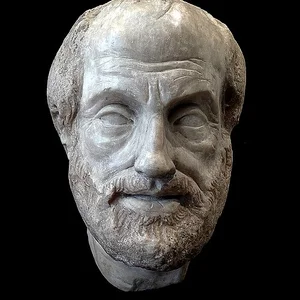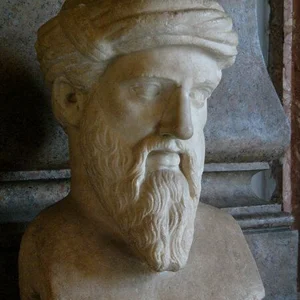

Greek philosopher and mathematician (c. 580–495 BC) from the island of Samos. Founder of a philosophical community in southern Italy, he is famous for his work in geometry, particularly the theorem bearing his name that relates the sides of a right triangle.
Pythagoras(582 av. J.-C. — 490 av. J.-C.)
Pythagoras
Samos
7 min read
Frequently asked questions
Key Facts
- c. 580 BC: Born in Samos
- c. 530 BC: Founded a philosophical and religious community in Croton, southern Italy
- Discovery and proof of the theorem relating the sides of a right triangle (a² + b² = c²)
- Development of number theory and the study of harmonic ratios
- c. 495 BC: Death, most likely in Metapontum
Works & Achievements
A proof that in any right triangle, the square of the hypotenuse equals the sum of the squares of the other two sides (a² + b² = c²). Although the relationship was already known empirically to the Babylonians and Egyptians, Pythagoras is credited with providing the first rigorous mathematical proof.
Pythagoras and his followers developed a theory in which numbers are represented by geometric arrangements of points — giving rise to triangular, square, and pentagonal numbers. This visual approach to mathematics laid the groundwork for Greek arithmetic.
Discovery of the numerical ratios underlying musical intervals: the octave (2:1), the perfect fifth (3:2), and the perfect fourth (4:3). This theory established for the first time a rigorous connection between mathematics and music, shaping musical thought well into the Renaissance.
A philosophical teaching holding that the soul is immortal and is reincarnated into different bodies after death. This doctrine, central to the Pythagorean community, profoundly influenced Plato and the subsequent course of Western philosophy.
The establishment of a philosophical school that combined scientific inquiry with religious practice, governed by strict communal rules. This community produced many disciples who spread Pythagorean ideas throughout the Greek world.
Anecdotes
According to ancient tradition as reported by Iamblichus, Pythagoras is said to have discovered musical harmony while walking past a blacksmith's forge: he noticed that hammers of different weights produced sounds whose ratios were simple fractions. He then reproduced these proportions on taut strings, thereby founding the mathematical theory of music.
Pythagoras built his philosophical community at Croton around strict and sometimes unusual rules of life: his disciples were forbidden to eat beans, walk along main roads, or touch a white rooster. These prohibitions, known as 'acusmata', blended moral precepts with ritual practices whose exact meaning is still debated by historians today.
Legend has it that Pythagoras could remember his past lives. He claimed to have been the Trojan warrior Euphorbus, then a fisherman, then a philosopher, before being born on Samos. This belief in metempsychosis — the transmigration of the soul from one body to another — lay at the heart of his teaching and explained his prohibition against eating meat.
The death of Pythagoras is shrouded in mystery. According to some sources, during an uprising against his community at Croton, his followers were attacked and their meeting place set on fire. Pythagoras reportedly fled, but upon reaching a field of beans that he refused to cross out of respect for his own prohibitions, he was caught and killed by his enemies.
Pythagoras left no personal writings. Everything we know about him comes from his disciples or from authors who lived long after him. This complete absence of direct works makes it difficult to distinguish between what Pythagoras actually taught and what tradition attributed to him over the centuries.
Primary Sources
Pythagoras, son of Mnesarchus, a gem engraver, was a native of Samos. He devoted himself to philosophy and arithmetic, and he also discovered the musical progression of sounds.
He urged his disciples never to harm a living being, to honor the gods and spirits, and to cultivate friendship as the most sacred bond between human beings.
The Pythagoreans were the first to devote themselves to mathematics and to advance that discipline; nourished by these studies, they came to believe that the principles of mathematics were the principles of all existing things.
Pythagoras held that the universal soul, and all individual souls, derive from the universal nature whose foundation is number and harmony.
Key Places
Greek island in the Aegean Sea, considered the birthplace of Pythagoras around 582 BC. It was during the reign of the tyrant Polycrates that Pythagoras reportedly left the island to escape his despotism.
Greek city in Magna Graecia (present-day Calabria, Italy) where Pythagoras settled around 530 BC and founded his famous philosophical and scientific school. The Pythagorean community gained considerable political influence there before being violently suppressed.
Another Greek city in Magna Graecia (present-day Basilicata, Italy) where Pythagoras took refuge in the final years of his life after the destruction of his community at Croton. According to several ancient sources, this is where he died.
Major city in Egypt that Pythagoras is said to have visited during his formative travels. There he reportedly studied geometry and the religious traditions of Egyptian priests, which became a source of part of his mathematical knowledge.
Typical Objects

A board on which the Greeks performed arithmetic calculations using pebbles or counters. Pythagoras and his disciples used such instruments to explore the properties of numbers and their relationships.

A stringed instrument used by Pythagoras to demonstrate the mathematical ratios between sounds. By comparing strings of different lengths, he established that musical harmony is based on simple numerical proportions.

The fundamental tools of ancient Greek geometry. Pythagoras's disciples used them to draw geometric figures and prove properties of triangles, including his famous theorem.

A common writing surface in ancient Greece, consisting of a thin layer of wax on a wooden backing. The Pythagoreans used them to record their calculations and geometric proofs.

The central geometric symbol of the Pythagorean brotherhood, used as a sign of recognition among its members. It embodied harmony and mathematical perfection, particularly through the golden ratio.

The typical garments of a wandering Greek philosopher. Pythagoras, who traveled to Egypt, Phoenicia, and Babylon before settling in southern Italy, wore the simple clothing characteristic of the sages of his time.
School Curriculum
Vocabulary & Tags
Key Vocabulary
Daily Life
Morning
Pythagoras and his disciples rose before dawn for a silent walk along the seashore, encouraging meditation and memorization. The morning was devoted to memory exercises, reciting aloud the knowledge acquired the day before. Lessons in mathematics and music began at sunrise.
Afternoon
The afternoon was reserved for the study of mathematics, geometry, and astronomy, often through hands-on practice: drawing geometric figures in sand or on wax tablets, and stretching cords to explore musical harmonies. Philosophical debates on the nature of numbers and the soul animated the community.
Evening
In the evening, the community gathered for a communal vegetarian meal, followed by philosophical discussions and music. Before going to sleep, each disciple was invited to review the actions of their day in order to improve themselves morally. The night also allowed for observation of the starry sky, a cornerstone of Pythagorean cosmology.
Food
Pythagoras imposed a strict vegetarian diet on his disciples, based on a belief in metempsychosis: eating an animal might mean devouring a reincarnated human soul. Beans were strictly forbidden for obscure ritual reasons. The diet was simple: grains, vegetables, fruits, honey, and bread.
Clothing
Pythagoras wore a white himation, a rectangular woolen cloak that Greeks draped over their bodies. White symbolized purity and wisdom. His disciples adopted the same plain attire, without ornaments, as a sign of their renunciation of material pleasures and their belonging to the community.
Housing
The Pythagorean community lived in communal buildings in Croton, organized around a central courtyard. Disciples gave up personal property and pooled their belongings. The rooms were austere, decorated with geometric figures, and open to nature to encourage contemplation.
Historical Timeline
Period Vocabulary
Visual Style
Un visuel baigné de lumière méditerranéenne dorée, avec des colonnes blanches, des figures géométriques tracées au sol et une mer d'un bleu profond : l'image d'un savoir calme et ordonné, à la fois mathématique et spirituel.
Sound Ambience
L'atmosphère sonore de l'école de Pythagore à Crotone : la mer Méditerranée en fond, des lyres explorant les harmonies, des voix méditatives récitant des nombres, dans la quiétude d'une vie communautaire dédiée à la sagesse.
Liens externes & ressources
Références
Œuvres
Théorème de Pythagore
vers 530 av. J.-C.
Théorie des nombres (nombres figurés)
vers 530-500 av. J.-C.
Théorie musicale pythagoricienne
vers 530 av. J.-C.
Doctrine de la métempsychose
vers 530 av. J.-C.
Fondation de la communauté pythagoricienne à Crotone
vers 530 av. J.-C.