Kids interview Aspasia
by Charactorium · Aspasia (469 av. J.-C. — 399 av. J.-C.) · Literature · Philosophy · 5 min read
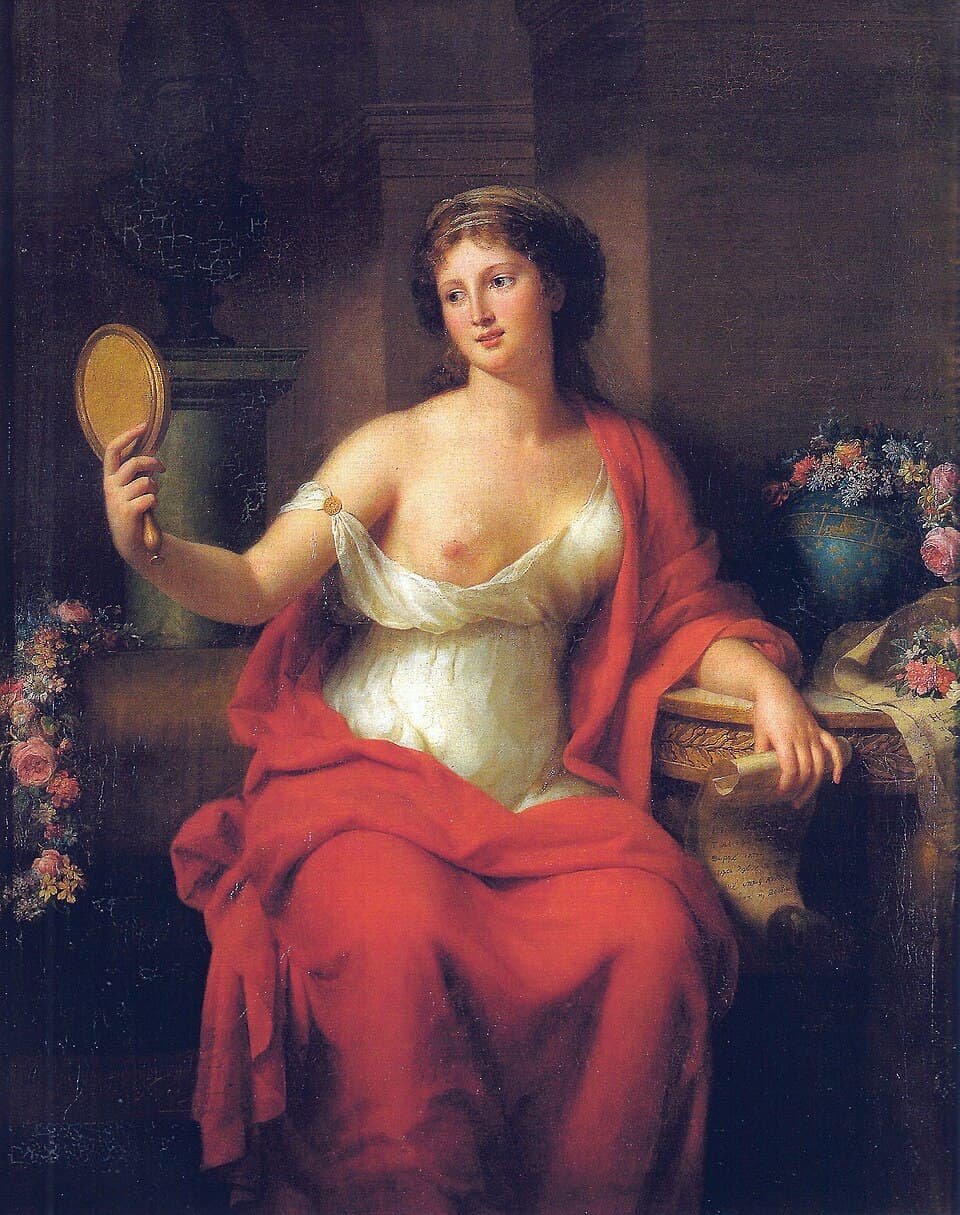
Two young visitors of twelve spend the day in a discovery class on ancient Greece. Sitting on stone steps warm from the sun, they meet Aspasia, the most learned woman in Athens. She looks at them with a smile, touched that children from so far away want to listen to her.
—Where did you come from, really? Were you born in Athens?
No, my child, I was born far from here, in Miletus, a Greek city by the sea, in Ionia. Imagine a harbor full of ships, merchants, people speaking a thousand languages. There, I was allowed to learn to read, to think, to speak well. In Athens, a girl did not have that right. When I arrived in the great city, I was called a metic: that means a foreigner who lives there but does not have citizenship. It was hard, sometimes. But that difference made me free where other women were shut up at home.
Being a foreigner made me free where other women were shut up.
—What was a day like at your home? What did it smell like?
In the morning, I took care of the house, a beautiful home around an open courtyard. It smelled of olive oil, barley bread baking, and a little smoke. But in the afternoon, everything changed! Men came to my home to discuss: philosophers, sculptors, politicians. We talked about rhetoric — that is the art of speaking well to persuade. Imagine a room full of papyrus scrolls, voices rising, ideas flying. For a woman to receive men like that was almost a scandal. I called it my true home.
A room full of scrolls, voices rising, ideas flying.
—Girls couldn't go to parties? But you could?
You guessed right. In Athens, wives stayed home. They never went to symposiums — those were banquets where men drank wine mixed with water and talked all evening. I was invited! I debated politics and poetry there, cup in hand, among the greatest minds. Can you imagine the surprise on their faces? A woman who spoke as well as they did, sometimes better! Some hated it. Others came just to listen to me. I learned one thing: it is not the place you are given that matters, but what you dare to do with it.
It is not the place you are given that matters, but what you dare to do with it.
—Is it true you taught Socrates how to speak? The great Socrates?
Yes, and it still moves me to think of it. Socrates, the most famous philosopher in Athens, used to come see me with his students. One day, when someone asked him for advice, he replied: I know a woman, Aspasia, who will help you better than I can. Can you imagine? A master sending his disciples to a woman! In my time, that was almost unthinkable. He said I understood the affairs of the city better than many men. I believe truth does not care if you are man or woman, rich or poor. It settles where people really think.
Truth does not care if you are man or woman: it settles where people really think.
—They say you wrote a great speech for Pericles. What was it?
Ah, that famous speech! When the war began, Pericles had to honor the soldiers who died in battle. It is said — Plato writes it in his book the Menexenus — that I had prepared that funeral oration, the speech given for the dead. It celebrated the courage and beauty of Athens. I cannot swear every word was mine. But that people could believe it, in my time, already says something: they knew I handled words. A well-made speech, you see, can console an entire people.
A well-made speech can console an entire people.
—What is the use of knowing how to speak so well, really?
Excellent question, my child! In Athens, everything was decided by speaking. On the great square, the Agora, citizens voted on laws after listening to speeches. Whoever spoke well could change the minds of thousands. Rhetoric, that art of persuasion, was thus a weapon and a power. I taught it. I showed how to choose each word, how to touch the heart before the head. But beware: speaking well to lie is dangerous. Speaking well to tell the truth is magnificent. Words can build a city or burn it. It is up to you to choose what you do with them.
Words can build a city or burn it.
—Were you taken to court? Were you scared?
Yes, and I was very scared. Around 432 BCE, I was dragged before the Heliaea, the great court of Athens. I was accused of asebeia: that means disrespect toward the gods. In truth, it was a pretext. My enemies mainly wanted to hurt Pericles through me. Imagine yourself alone, a foreigner, facing hundreds of judges who could condemn you. Pericles came to defend me himself. And he, the most powerful man in the city, wept before the judges. They say he had never shed tears like that. I was acquitted.
The most powerful man in the city wept before the judges to save me.
—Did people mock you in plays? Why?
Oh yes, and it was not kind! In Athens, comedies were performed that made fun of famous people. A famous author, Aristophanes, put me in a play, the Acharnians. He joked that the great war against Sparta had broken out because of me! As if a single woman could start a war between cities. It was absurd, of course. But you see, when a woman takes too much space, people invent anything to bring her down. Those mockeries hurt me. Yet they proved one thing: I could no longer be ignored.
When a woman takes too much space, people invent anything to bring her down.
—Is it true a law prevented you from marrying Pericles?
Alas, yes, and the saddest part is that Pericles himself had it passed! In 451 BCE, a law decreed that only children born of two Athenian parents would be citizens. Born in Miletus, I was not a citizen. So we could not truly marry. And our son, little Pericles, was declared illegitimate — as if he did not count. Imagine making a rule, then seeing that rule strike your own child. It is a harsh lesson: sometimes laws we think are just turn against those we love.
Sometimes laws we think are just turn against those we love.
—And your son, was he eventually recognized?
Yes, but in sorrow. Around 430 BCE, a terrible disease, the plague, fell upon Athens. The streets smelled of death, people fell everywhere. Pericles lost his two legitimate sons to the illness. Then, heartbroken, he begged the Assembly of the people to recognize our son. And the Assembly agreed, as an exception. Our child finally became a citizen — but at what cost! Pericles himself died of the plague soon after. You see, my little one, life always mingles tears and victories. We move forward carrying both.
Life always mingles tears and victories: we move forward carrying both.
—If we met you today, what would we notice first?
My voice, no doubt! Not because it is beautiful, but because I ask questions. Just as you have done with me. I loved to listen, then question, over and over, until the idea became clear. That is what Socrates did too. You might notice my himation, that large draped woolen cloak worn by cultured women. But above all, you would see someone who speaks to you as an equal, even if you are only twelve years old. For I have learned one thing: a good question is worth more than a ready-made answer.
A good question is worth more than a ready-made answer.
Read further
This imaginary interview was generated by artificial intelligence from sources documented in Aspasia's profile. It dramatises what the figure might have said based on what we know about them, but does not constitute attested historical testimony. For primary sources and factual documentation, refer to the full profile.