Imaginary dialogue between Kimberlé Crenshaw and Audre Lorde
by Charactorium · Audre Lorde (1934 — 1992) · Literature · Philosophy · 5 min read
It is in the small apartment on Staten Island, cluttered with books and West African masks, that Kimberlé Crenshaw meets Audre Lorde one afternoon in 1990. On the coffee table, a typewriter and notebooks filled with tight handwriting. The young legal scholar discovered Sister Outsider during her studies and seeks, in the elder's words, the living substance of what the law struggles to name. Between them, the respect of an heir who knows to whom she owes her grammar.
—Audre, before being a theorist, I was a child who read. You tell how your mother, nearly blind, taught you words. What did she pass on to you?
My mother's eyesight was so weak that she showed me words at the tip of her finger, in picture books, when I was four. I couldn't find my own sentences, so I answered people by reciting memorized poems — poetry was my first language, before it was even a choice. You understand, Kimberlé, when words are given to you at such a price, you never consider them a luxury. For women, poetry is not a luxury. It is a vital necessity of our existence. I spent my life defending that sentence because it saved me twice: as a mute child, then as a sick woman. Writing was never decorative for me. It was breathing.
One never considers words given at such a price as a luxury.
—You once said, at the podium of the Modern Language Association in 1977, that we must transform silence into language. What drove you to that?
That year, I lived in fear of a diagnosis, and I understood that silence protected me from nothing. We think that keeping quiet keeps us safe; it's false, silence suffocates us just the same. I came to believe, again and again, that what matters most must be said, made verbal and shared, even at the risk of being hurt or misunderstood. Before that room of academics, I didn't speak as a literary critic, I spoke as a woman who refused to die mute. My typewriter, over there on the table, was the extension of that decision. Every page torn from silence was a political act, not a confession.
We think that keeping quiet protects us; it's false, silence suffocates us just the same.
—In 1980, you refused the prosthesis after your mastectomy, and you wrote about it. Many criticized you for it. Do you regret this self-exposure?
Not for a second. They wanted me to hide the trace of my struggle under a piece of foam, so that others wouldn't be disturbed by the sight of a real woman. I refused, and I made my body a declaration. The Cancer Journals came directly from my notebooks, those pages where I examined, in my dreams as in my analyses, the devastating effects of having overextended myself. The cancer had already begun its battle with me. Hiding would have meant consenting to the idea that a mutilated woman must be discreet. I preferred that people look me in the eye. Some women readers wrote to me that this refusal had liberated them — that was worth all the criticism.
They wanted me to hide the trace of my struggle so as not to disturb others.
—After the illness, you changed your daily life, your diet. How does one live while healing both the body and the activist voice?
I turned to a macrobiotic diet, natural remedies, a new attention to what I ate — me, the Grenadian who cooked fish, tropical vegetables, and spices from my heritage. But healing the body never made me silent; the two went together. I would wake up early to write in my notebooks before the world demanded anything, that solitary time was my real remedy. Survival, for a Black, lesbian, sick woman, is not obvious: it is built each morning. I did not separate health from struggle. Taking care of myself had become, in itself, an act of war against what wanted to erase me.
Taking care of myself had become, in itself, an act of war.
—You know my legal work on those women whom the law sees neither as Black nor as women. Your 1979 phrase about the master's tools haunts me. What did you mean?
You, who are well placed to measure it, Kimberlé, in your courtrooms: the master's tools will never dismantle the master's house. Faced with those white feminists who had invited me and then barely listened, I meant that one does not liberate anyone with the very instruments of oppression. They allow, at best, to beat the master at his own game for a moment, never to bring real change. One cannot think of woman without thinking of race, class, desire — otherwise one rebuilds the master's house, in smaller form. I had no scholarly word for this interlocking; I lived it in the flesh of a Black lesbian woman. Perhaps it is for your generation to give it a name.
One cannot think of woman without thinking of race, class, desire.
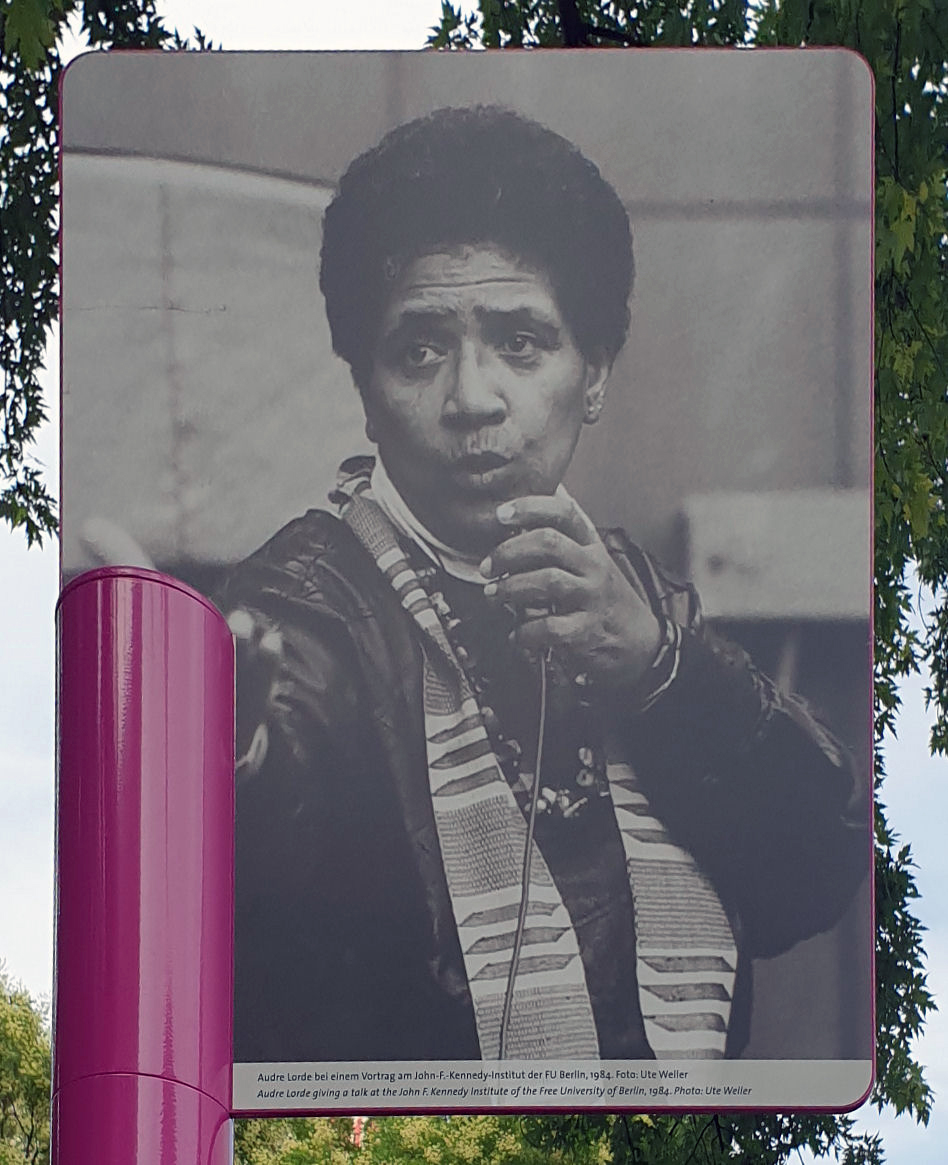
—In Sister Outsider, this interlocking runs through everything. Did you feel, at the time, that you were forging a theoretical tool — or just describing your life?
I was describing my life, first. For me, theory never started from a concept; it started from a body that fit into no one else's box. Too Black for feminists, too woman for Black nationalists, too lesbian for almost everyone. So I wrote from that margin, and it turned out that the margin saw the center better. Sister Outsider collects speeches given standing, at the microphone, often improvised from three notes. They were not theses; they were organized cries. If this becomes a tool in your hands, so much the better — but keep in mind that it was born of a survival necessity, not a seminar.
The margin saw the center better.
—Let's talk about poetry. The Black Unicorn, in 1978, delves into Yoruba goddesses. Why mythical Africa, when your struggle was so rooted in America?
Because a Black woman in America needs ancestors that America stole from her. I drew on Yoruba mythology, on those goddess figures, to give myself a genealogy broader than slavery and the ghetto. The black unicorn is not a gentle creature: it is proud, elusive, it refuses to be tamed. It is my masterpiece, they say, because African spirituality and Black feminism finally merge without fighting. I also wear these West African fabrics, these boubous, not as folklore but as a declaration: I belong to the diaspora, and this belonging nourishes me. Writing those poems was repatriating a part of me that had been thrown into the sea.
A Black woman in America needs ancestors that America stole from her.
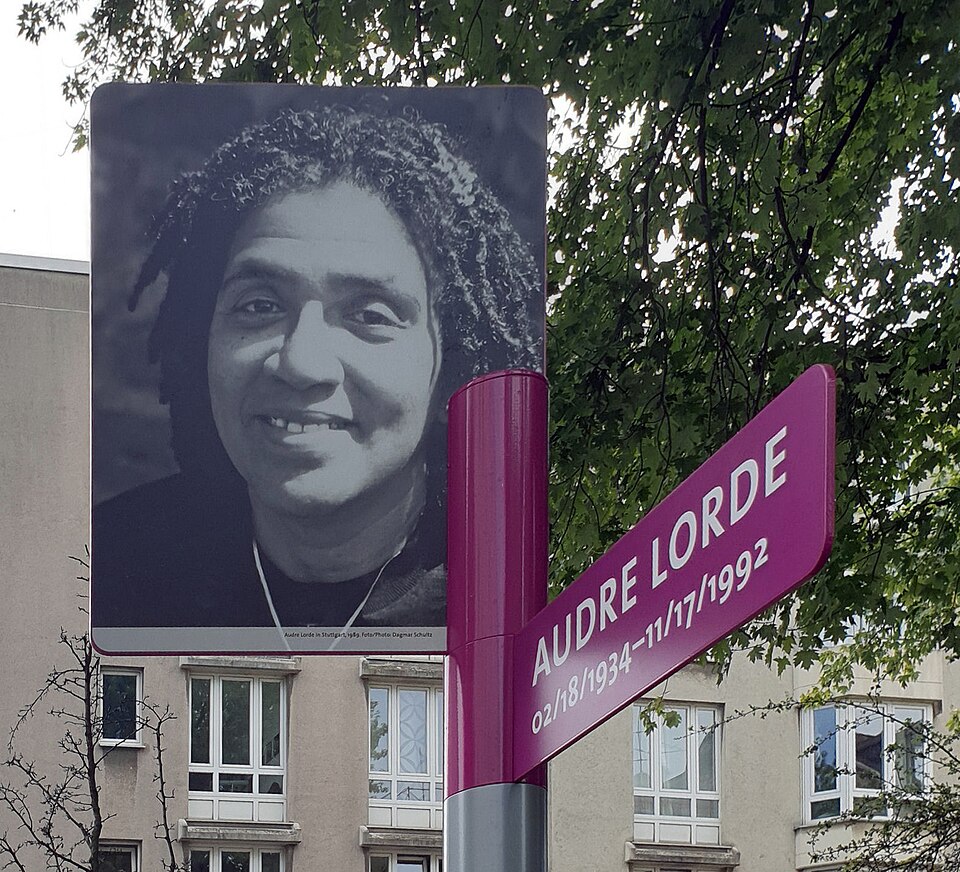
—With Zami, in 1982, you invented a word: biomythography. What did this genre say about you that classic autobiography could not?
Autobiography claims to report facts; I wanted to tell a truth greater than facts. I coined the word biomythography to weave my childhood in Harlem, my sexuality, my loves of women, with myth and symbol. The life of a Black lesbian woman is not told only in dates: it is also told in legends we create to keep standing. In Zami, a four-year-old girl proudly spells out words — that was me, already conquering language. I blend my mothers, those of flesh and those of myth. It was not lying about my life; it was restoring its sacred dimension, the one that archives never record.
I wanted to tell a truth greater than the facts.
—Your parents came from Grenada, and you were born in Harlem. This dual Caribbean and American belonging, how did you carry it all your life?
I carried it as both a wealth and a splinter. At home, in Harlem, photographs of my Grenadian parents were everywhere; the island lived in our kitchen, in the spices, in a nostalgia we didn't name. I was never quite from here or from there, and I came to understand that this was my own territory. Today I spend time on St. Croix, in the Virgin Islands, closer to my island roots and gentler for my health. There is something just about returning to the Caribbean Sea at the end of the journey. The diaspora is not an exile, Kimberlé — it is a multiple belonging that one finally learns to inhabit without apology.
I was never quite from here or from there — it was my own territory.
—It is said that in 1984, in West Germany, you revealed to women their own community. What happened during that stay?
I met Afro-German women who did not know they formed a community, that they had a history, sisters a few streets away. They thought they were alone, shameful exceptions. I told them what my mother had told me with books: name yourselves, write your own stories, otherwise others will write them for you or not at all. From those conversations came a whole movement, and a collective work where they finally took the floor. It was exactly my struggle, transposed: transforming silence into language. Nothing made me prouder than seeing women the world ignored stand up and give themselves a name. The margin, again, learning to speak.
Name yourselves, write your own stories, otherwise others will write them for you.
This imaginary interview was generated by artificial intelligence from sources documented in Audre Lorde's profile. It dramatises what the figure might have said based on what we know about them, but does not constitute attested historical testimony. For primary sources and factual documentation, refer to the full profile.