Kids interview Audre Lorde
by Charactorium · Audre Lorde (1934 — 1992) · Literature · Philosophy · 5 min read
Two sixth-graders visit an exhibition on 20th-century poets and activists. Turning a corner, they meet Audre Lorde, a notebook in hand. She smiles, puts down her pen, and invites them to sit beside her to answer all their questions.
—Where were you born, and where did your parents really come from?
You know, my child, I was born in Harlem, a neighborhood in New York, in 1934. My parents came from much farther away: a small Caribbean island called Grenada. Imagine a warm land, surrounded by a blue sea, full of spices and fish. They left everything to live in a big gray, cold city. At home, we talked about that island like a lost country. All my life, I carried these two worlds within me: the city where I was born, and my parents' island. That's what it means to be a child of the diaspora: to belong to two places at once.
I carried two worlds within me: a big city, and a lost island.
—Is it true that you used to speak by reciting poems when you were little?
Yes, it's absolutely true! My mother had very poor eyesight. So, to teach me to read, she would point out words with her fingertip in big picture books. Words became my friends very early. And here's the secret: when I was little, I couldn't always find my own sentences. So, to answer, I would recite a poem I knew by heart. Imagine a little girl who, instead of saying "I'm sad," answers you with four lines learned the day before. Other people's words taught me to find my own.
Other people's words taught me to find my own.
—For you, was writing poems just to make things pretty?
Oh no, never just to make things pretty! Writing, for me, was breathing. It was survival. Many people think poetry is a small luxury, a dessert you have after the meal when you have time. I said the opposite. For a woman, a poem is not a luxury: it is a necessity, like water or bread. I wrote early in the morning, in my notebooks, on my old typewriter, before the world woke up and demanded things of me. A poem is a lamp you light inside yourself to see where you're going.
A poem is not a luxury: it is a necessity, like water or bread.
—What did you write about? About princesses and dragons?
Almost! In 1978, I wrote a collection called The Black Unicorn. But my creatures didn't come from the fairy tales you know. They came from very old West African stories, from the Yoruba people: powerful goddesses, warrior queens. You see, I was taught to admire other people's heroes. I wanted to restore my own figures to their rightful place. Imagine a little Black girl who, for the first time, reads a story where the goddess looks like her. I wrote to offer that mirror. A black unicorn doesn't exist in schoolbooks — so I invented it.
I was taught to admire other people's heroes; I restored my own to their place.
—Is it true that you became very ill? Were you afraid?
Yes. In 1980, the doctors told me I had breast cancer. Of course I was afraid, my child. I wrote in my notebooks that the disease had already begun its battle with me, in my body and in my dreams. They removed a breast to save me. Then the doctors wanted me to hide this changed body, with a false form, to make things "like before." I refused. I wanted my body to be seen as it had become, without lies. I told all this in a book, The Cancer Journals. Hiding my scar meant accepting shame. And I had nothing to hide.
Hiding my scar meant accepting shame. I had nothing to hide.
—Did writing all that in a notebook help you?
A lot. Since my adolescence, I kept a diary. It was my oldest companion. When fear became too great, I didn't keep it prisoner inside: I put it on paper. Writing about my illness was preventing it from controlling me. You know, what matters most to me, I think you have to say it out loud, even if you risk being hurt or misunderstood. Silence never protected me. So my sick notebooks became a book, for other women who were also afraid alone in their rooms. A fear that is named is already a little less frightening.
A fear that is named is already a little less frightening.
—You said something weird about the master's tools and his house, what was that?
Ah, you remembered well! In 1979, in a big speech, I said a phrase that made people think a lot: the master's tools will never dismantle the master's house. Imagine someone locks you in an unjust house. They hand you their own hammer and their own rules to free yourself. But those tools were made to keep you inside! With them, you can beat him at his own game for a moment, but never change the rules for good. To build a just house, we need our own tools: our voices, our stories, our differences. All being alike frees no one.
The master's tools will never dismantle the master's house.
—Who exactly did you want to defend with all these ideas?
All those who were forgotten at once. You see, in my time, some fought for Black people, others for women. But I was a woman, and Black, and I loved women. In each group, a part of me was always missing. So I said: let's stop cutting people into pieces! A person sometimes suffers several injustices at once, and they mix together. We call this today intersectionality — a complicated word for a simple idea: no one has only one identity. I brought all this together in a book of essays, Sister Outsider, in 1984. I refused to leave any part of myself at the door.
No one has only one identity.
—Is it true that in Germany, women didn't know they had a history?
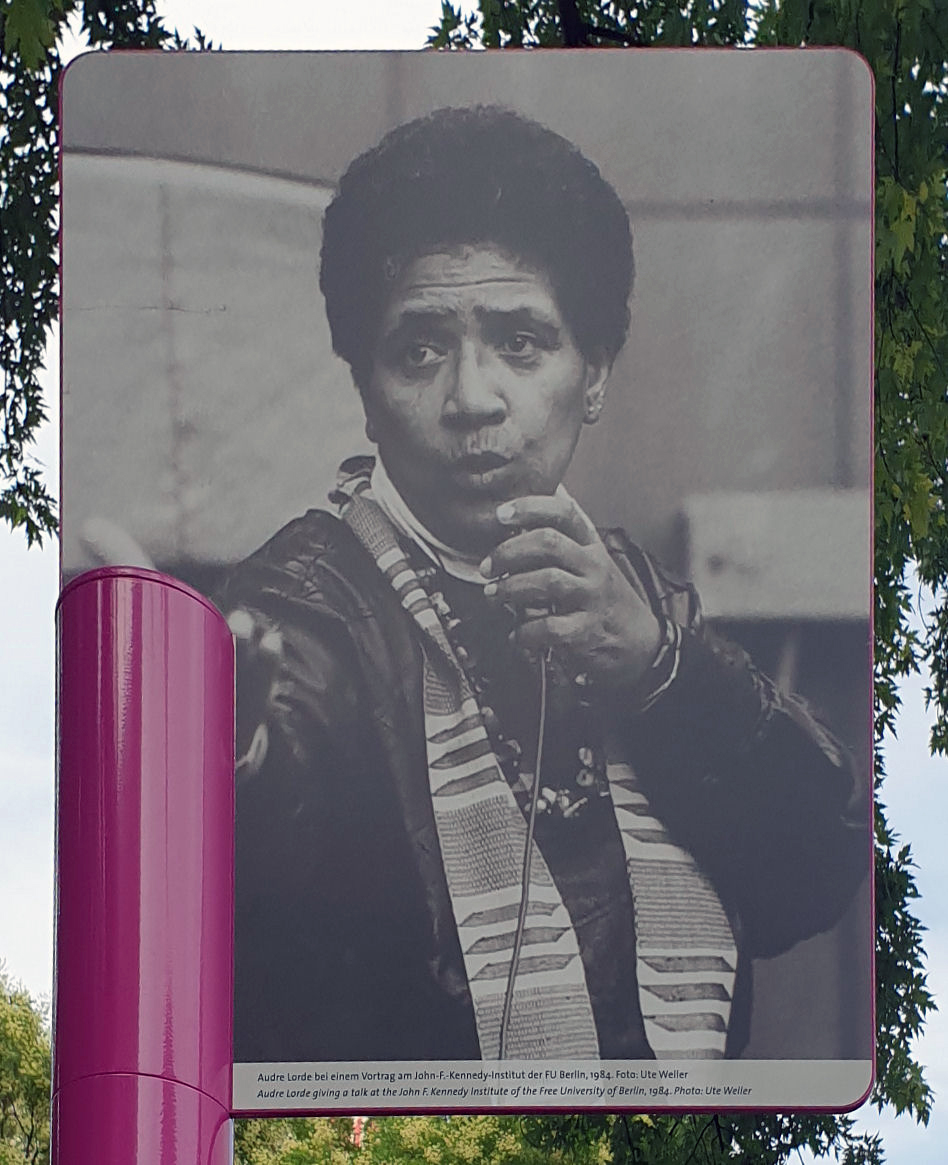
That's a story that moved me deeply. In 1984, I went to teach in West Germany. There, I met Black women, born German. And guess what? They thought they were almost alone! No one had ever told them that a Black community existed in their own country. So, behind my microphone, I told them one thing: your history exists, but as long as you don't write it, it remains invisible. Write it yourselves! They did. From their words was born a movement, the Afro-Deutsch movement, and a book, Farbe bekennen. A story that isn't written is a story that might disappear.
A story that isn't written might disappear.
—At the end of your life, did you return to the sea of your parents?
Yes, my child. At the end, I settled on a Caribbean island, St. Croix. The climate was gentler on my tired body, and above all, I found there the sea and warmth my parents had talked about so much. The circle closed: born in Harlem to a family from the islands, I ended my life on an island. I even took an African name, Gamba Adisa, which roughly means: "the warrior who makes her voice clearly heard." It was my last poem, in a way: choosing for myself the name by which I would be remembered.
Choosing for yourself the name by which you will be remembered.
This imaginary interview was generated by artificial intelligence from sources documented in Audre Lorde's profile. It dramatises what the figure might have said based on what we know about them, but does not constitute attested historical testimony. For primary sources and factual documentation, refer to the full profile.