Imaginary interview with Banksy
by Charactorium · Banksy (1974 — ?) · Visual Arts · 6 min read
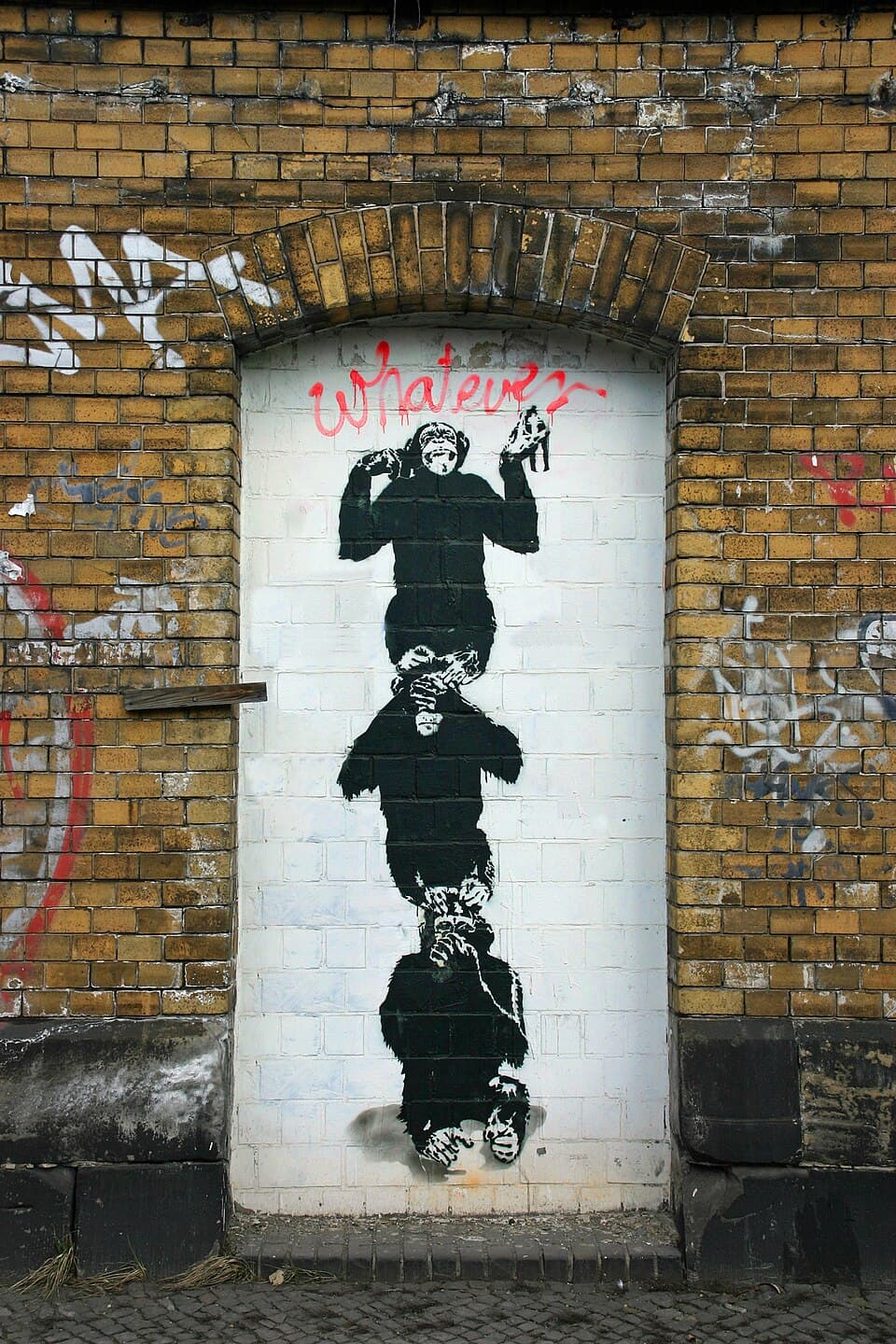
The meeting was arranged through encrypted messages, in an unmarked warehouse somewhere between Bristol and London. The room smells of spray paint and cut cardboard; on a table, dozens of stencils wait their turn. The man who answers stays in the shadows, hood up, and will never let himself be photographed.
—How does one of your street interventions actually happen?
It all starts long before nightfall, here, in this studio that nobody knows. I cut my stencils with a craft knife, sometimes for hours, because a failed design on the wall means an arrest. When darkness falls, I leave only with a discreet bag, my spray cans, and someone keeping watch on the corner. On site, I work in a few minutes — the stencil isn't an aesthetic whim, it's a matter of speed. I adopted it for that reason back in 1999: paint fast, disappear before anyone looks up. Sometimes I put on a high-visibility vest; a man in a fluorescent vest painting a wall in broad daylight, nobody stops him, they take him for a municipal worker. Once the piece is done, I photograph it, and I fade into the night. The next day, it belongs to the street, not to me.
The stencil isn't an aesthetic whim: paint fast, disappear before anyone looks up.
—Why are you so committed to anonymity, even in your working method?
Because a known graffiti artist is a graffiti artist in prison. The hood, the cap, the face you don't show: it's not mythical coquetry, it's practical survival. In Wall and Piece, I put it in my own way — there are far worse crimes than drawing on walls, and the worst is making people believe that those who do it are criminals. Society calls me a vandal; I call vandalism a ten-meter-high advertising billboard that nobody asked to see. My hidden face is what keeps me free to respond to those walls. The day people know who I am, I'll become a name on a catalog, and a name can't climb onto a roof at three in the morning.
—Do you remember arriving at the separation wall in the West Bank?
2005. You only measure that wall by standing under it: eight meters of concrete cutting a neighborhood in two, cutting a life in two. I painted nine murals there. A little girl carried up by a bunch of balloons over the concrete; a trompe-l'oeil that opens a breach onto a beach, a paradise you glimpse behind the grayness. I think, as I wrote in Existencilism, that a wall is a very big weapon, one of the nastiest things you can hit someone with. So I wanted to turn it around: make that weapon into a window. An old man told me that day that I was beautifying the wall, and he didn't want it to be found beautiful. He was right. I wasn't beautifying it — I was refusing to let people get used to it.
I wasn't beautifying the wall — I was refusing to let people get used to it.
—Twelve years later, you opened a hotel there. Why come back with keys instead of spray cans?
The Walled Off Hotel, in 2017, in Bethlehem, right across from the wall. I presented it as the establishment with the worst view in the world — every room looks out onto concrete and watchtowers. A mural on a wall, people photograph it and move on. A hotel, you sleep there, you have breakfast there, you're forced to look at that wall when you wake up for three days. It's a different weapon, slower. I wanted tourists from all over the world to come sleep against that border, eat facing it, and leave unable to say they didn't know. The brush catches the eye for a second; a room keeps you prisoner of the landscape. And the money stays local, in the hands of the people who live in the shadow of that concrete.
—Let's talk about that Sotheby's sale in 2018. What exactly did you plan?
Girl with Balloon — that little girl letting go of a heart, the most reproduced image of mine. Years earlier, I had hidden a shredder inside the thickness of the frame, dormant, like a patient time bomb. That evening in 2018, the hammer fell at over a million pounds, and at the same instant the canvas began to slide, to shred into strips before the stunned room. On my website, I answered with the words I owed to Picasso: the urge to destroy is also a creative urge. The painting changed its name — Love is in the Bin — and that's the real joke: half-shredded, the work was suddenly worth more. I wanted to bite the hand of the market; the market found it delicious and asked for more.
I wanted to bite the hand of the market; the market found it delicious and asked for more.
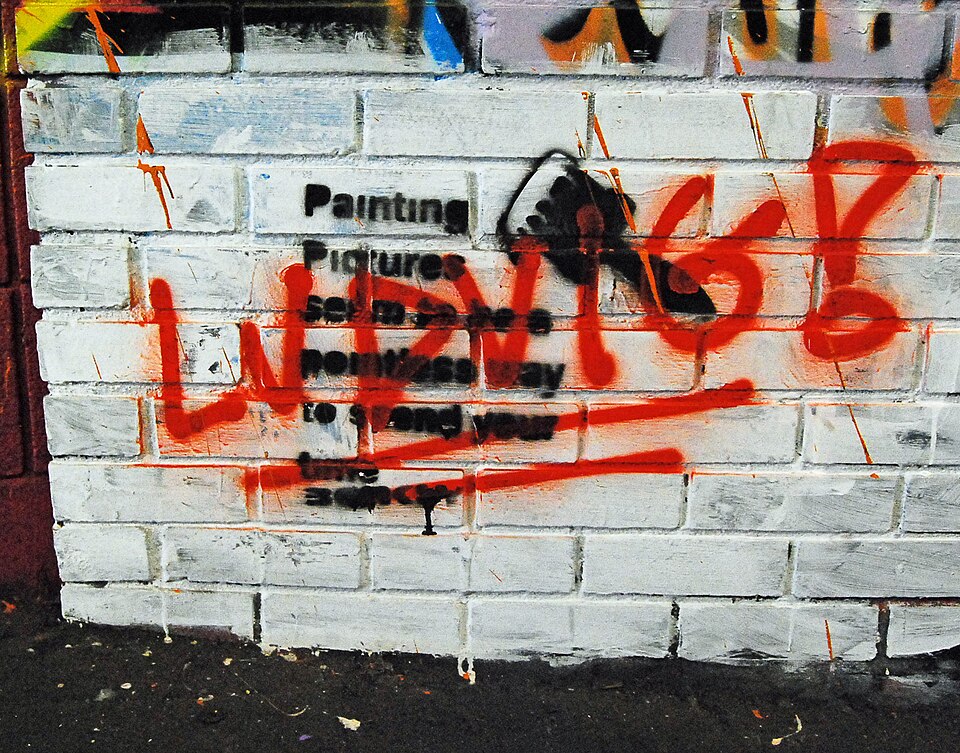
—That resale three years later, for eighteen million — did it make you feel you had failed?
Failed, I don't know. Disarmed, certainly. A work I wanted to shred into pieces sold, partially destroyed, for nearly eighteen million pounds in 2021. The gesture was meant to say: this is priceless, this is from the street, don't put it under glass. And the glass triumphed. I think I wrote it as early as 2001, in Banging Your Head Against a Brick Wall — those who really run this country don't stand for election. The art market works the same way: it swallows criticism, digests it, resells it framed. My shredder didn't kill market value, it made it more appetizing. The lesson is that you don't blow up a machine from the inside by giving it a show it loves.
—In 2015, you opened Dismaland. How would you describe that place to someone who never went in?
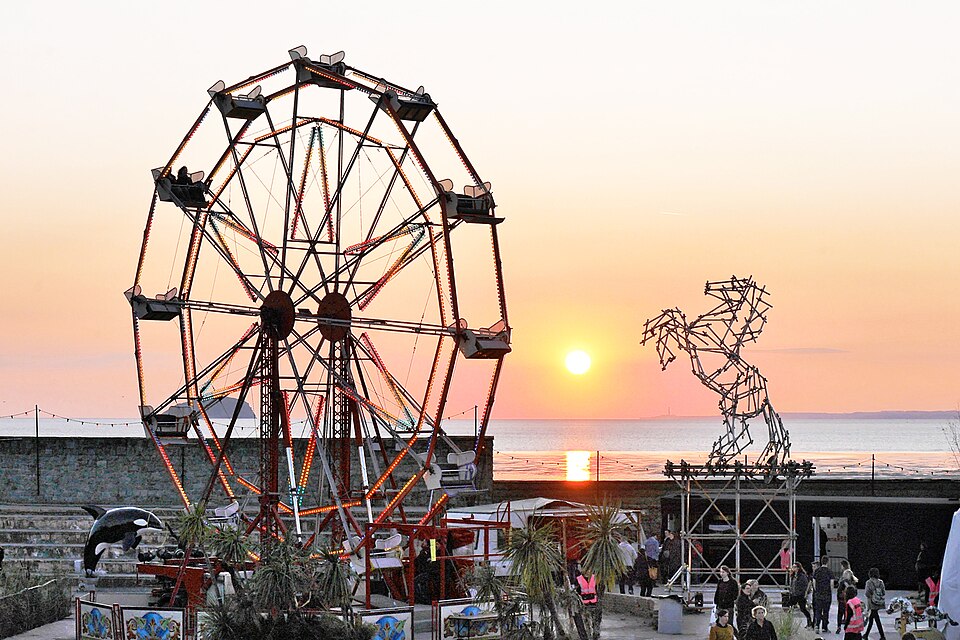
Imagine a theme park where everything is off: a decrepit castle, deliberately grumpy employees, a princess tipped over in her carriage surrounded by paparazzi. I set it up in Weston-super-Mare, in an abandoned lido, and I announced it as a family theme park unsuitable for children. Dismaland — Disney that depresses you. Fifty-eight artists, overloaded migrant boats floating in a pool, surveillance and consumerism mocked. In five weeks, over a hundred and fifty thousand people came to pay to feel uncomfortable. That's what people call culture jamming: you take the happiest imagery of mass culture, those pink castles and forced smiles, and you turn it inside out to show what it covers.
A family theme park unsuitable for children: Disney that depresses you.
—What attracts you so much to hijacking popular culture?
Because it's everywhere, and because we've gotten too used to it to still see it. Subversion, for me, isn't shouting louder than advertising — it's using its own language against it. A fairytale castle taught us from childhood that everything ends well; in Weston-super-Mare, I let it crumble so we'd ask who really pays for the happy ending. It's more effective than a flyer. Nobody reads a flyer, but everyone recognizes Mickey, everyone recognizes a theme park. When you distort an image that people have carried inside since childhood, the unease settles in a place no speech can reach. My weapon isn't the slogan, it's the smile turned against the one who smiled.
—Your documentary was nominated for an Oscar. How do you experience such consecration when you refuse to show your face?
Exit Through the Gift Shop, 2010, nominated for an Oscar in the documentary category — a film that questions the myth of street art and my own along the way. The funniest part is that no one has ever been able to confirm whether I was in the room that night, among the tuxedos and cameras. Maybe at the back of the balcony, maybe thousands of miles away. Anonymity isn't just protection from the police, it's become part of the work itself. The day the film industry hands you a golden statuette and you remain untraceable, you remind it that it can't absorb everything. Hollywood loves to put a face to talent, turn it into a brand. My absent face is my way of refusing them that product.
My absent face is my way of refusing them that product.
—After so many years, hasn't anonymity become a prison as much as a freedom?
People always ask me that, as if I were carrying a burden. But think where I come from: Bristol, in the 1990s, trip-hop, Massive Attack, a city that taught me you could speak loudly without signing your name. Presumably born in 1974 — you see, even my date remains a presumption. This blur isn't a cage, it's space. As long as nobody knows who I am, the work remains bigger than the man; people project onto Banksy what they want to put there, and that's just fine. The day my name comes out, people will stop looking at the walls and only look at my biography. The mystery isn't a lie I protect: it's the last space where art still breathes freely, out of reach of the catalog and the rumor.
As long as nobody knows who I am, the work remains bigger than the man.

This imaginary interview was generated by artificial intelligence from sources documented in Banksy's profile. It dramatises what the figure might have said based on what we know about them, but does not constitute attested historical testimony. For primary sources and factual documentation, refer to the full profile.