Kids interview Banksy
by Charactorium · Banksy (1974 — ?) · Visual Arts · 5 min read
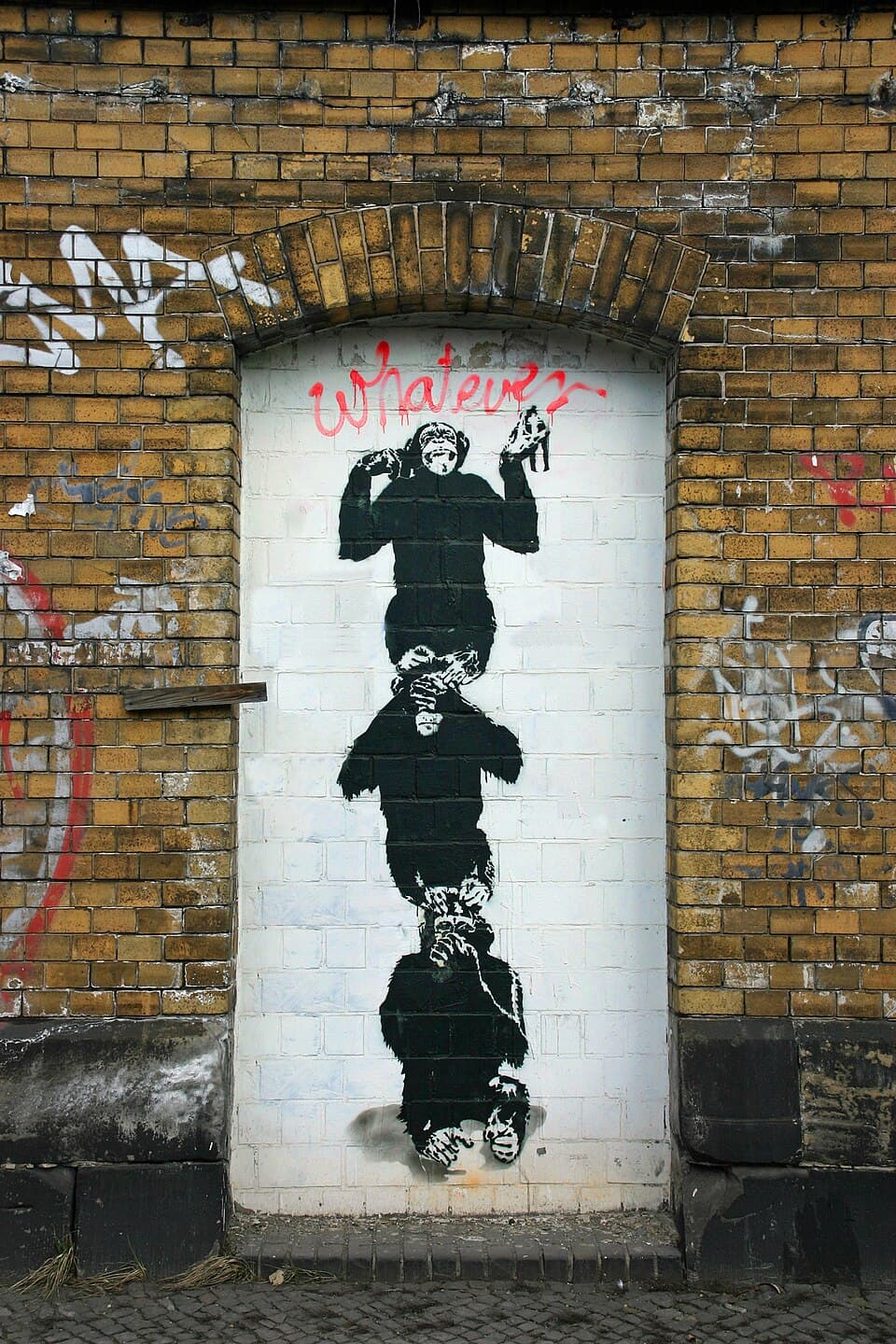
That morning, two Year 7 students on a school trip push open the door of a secret workshop, somewhere in Bristol. A hooded man awaits them, his face in shadow. His name is Banksy, and for once, he has agreed to answer.
—How old were you when you started painting on walls?
I was barely older than you, you know. I hung around the streets of Bristol, my city, where music and graffiti artists were everywhere. At first, I drew freehand. But it took too long! At night, on a wall, every minute counts. So around 1999, I adopted the stencil. It's simple: you cut a shape out of cardboard, put the spray can over it, and boom, the image appears in seconds. Imagine a giant stamp. Thanks to that, I could scram before anyone saw me. Because painting without permission, my child, can get you arrested.
On a wall at night, every minute counts.
—What was a real night when you went painting like?
Heart pounding, that I remember. I'd prepare all afternoon: cutting with the utility knife, choosing the wall. Then night fell. I'd slip my stencils and spray cans into a discreet backpack. Sometimes a friend stayed as a lookout to watch the street. We worked fast, very fast. The cleverest trick? The fluorescent yellow worker vest. With that on, nobody looks at you, you become invisible in broad daylight. Once the piece was done, I'd photograph it and disappear into the dark. That was my secret job.
With a yellow vest on, you become invisible in broad daylight.
—Why do you hide your face from everyone?
Because what I do, many people call vandalism, my child — damaging a wall that isn't yours. If people knew my face, they could arrest me. So I wear a hood, a cap, and stay in the shadows. But there's another reason, a nicer one. When you don't know who I am, you don't look at the artist: you look at the artwork. That's what matters, not my face. One day I wrote a phrase I like: they say people who draw on walls are criminals, yet there are far worse crimes.
When you don't know who I am, you look at the artwork, not the artist.
—Is it true that your painting shredded itself in the auction room?
Absolutely true! And you know what? I had prepared that stunt years in advance. In 2018, at Sotheby's in London, my drawing Girl with Balloon — a little girl letting go of a heart-shaped balloon — had just been sold for over a million pounds. And then, before everyone's eyes, the painting began to slide down inside its frame. A little shredder hidden inside was cutting it into strips! People were stunned. I had rigged that mechanism long before, in secret. Picasso said the urge to destroy is also a creative urge. I believe that.
The urge to destroy is sometimes the urge to create.
—But why did you want to damage your own drawing?
Good question, it bothered me too. You see, I find it strange that a drawing made for the street, for free, ends up sold for a fortune to very rich people. So I wanted to ask a question with my shredder: is a painting really worth millions? The funniest part is what followed. The half-shredded drawing was renamed Love is in the Bin. And three years later, it was resold for even more: almost 18.5 million pounds! My joke backfired. Life is full of irony, my child.
A street drawing selling for millions deserves a question.
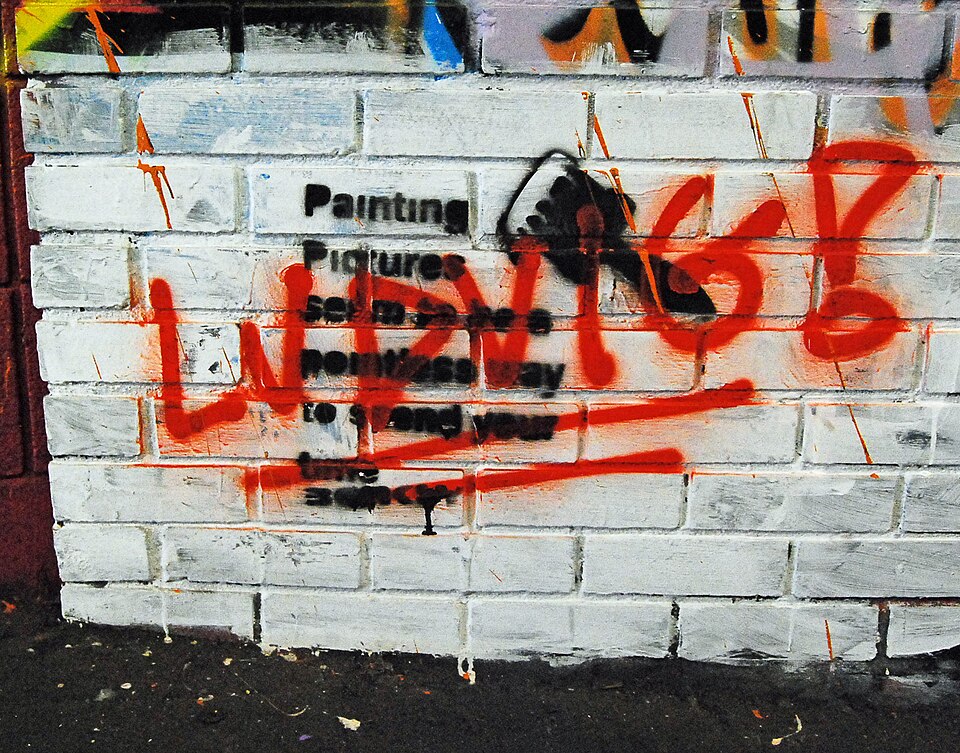
—They say you hung your paintings in museums in secret, is that true?
Heh heh, yes, in 2005, it was one of my favorite pranks. I casually walked into major museums: the British Museum, the Louvre, the MoMA, the Metropolitan in New York. Under my coat, I hid my own works. And discreetly, I hung them on the wall, among the real masterpieces, with a little label as if nothing were amiss. The craziest part? Nobody noticed! Some remained on display for several days before a guard stumbled upon them. I laughed to myself. It was my way of asking: who decides that an image has the right to be in a museum?
Who decides that an image has the right to enter a museum?
—You went to paint on a real war wall, aren't you scared?
Yes, it is scary, I won't lie. In 2005, I went to the West Bank, near Bethlehem, in front of a huge concrete wall that separates families. I painted nine murals there. On one, a little girl flies up, carried by a bunch of balloons over the wall. On another, a trompe-l'oeil: it looks like a crack opening onto a paradise landscape on the other side. It was my way of telling the whole world: look at this wall, look at these trapped people. A wall is a terrible weapon. But you can also paint a window on it.
On a wall that imprisons, you can still paint a window.
—Why would an artist get involved in a conflict, isn't that for politicians?
You know, I don't give speeches. I have no power. But I have spray cans, and that's already a lot. When I paint a little girl flying over the Bethlehem wall, I'm not giving orders to anyone. I just show. And an image, sometimes, touches the heart more strongly than a long speech. Later, in 2017, I even opened a hotel right in front of that wall, the Walled Off Hotel, so visitors could see it with their own eyes. My job is to draw attention where people don't want to look.
My job is to draw attention where people don't want to look.
—What's that story about the sad theme park you made?
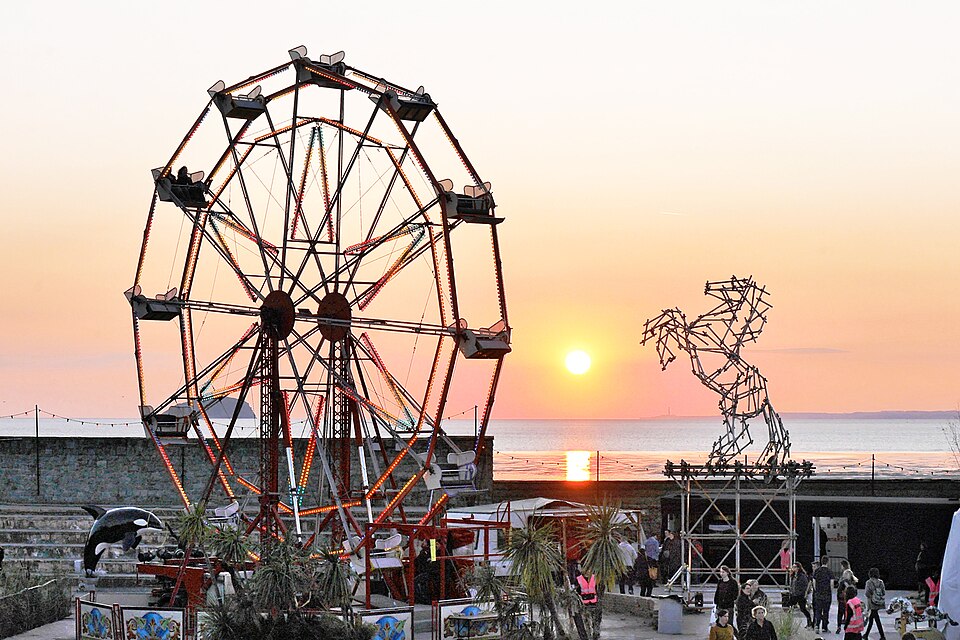
Ah, Dismaland! My slightly crazy idea from 2015. I took an old abandoned pool in Weston-super-Mare, by the sea, and turned it into a fake theme park. But the opposite of Disney: a gray castle, sad characters, rides that talked about real world problems. I presented it as 'a family theme park unsuitable for children' — that was to make people smile! Over 150,000 people came in five weeks. My goal wasn't to scare, but to make people think while having fun. It's called subverting cheerful images to say serious things.
A family theme park unsuitable for children: now that makes you think.
—If we ran into you on the street today, what would we notice first?
Probably… nothing at all! And that's exactly what I want. I dress like everyone else: jeans, a hoodie, sneakers. You could walk right past me and never know. Maybe that's my greatest work: staying invisible. But if one day, while walking, you see a stencil on a wall — a little girl, a heart-shaped balloon — then stop. Look at it closely. Ask yourself a question. That wall will have spoken to you. And that day, my child, you won't need to know my name.
Staying invisible might be my greatest work.

This imaginary interview was generated by artificial intelligence from sources documented in Banksy's profile. It dramatises what the figure might have said based on what we know about them, but does not constitute attested historical testimony. For primary sources and factual documentation, refer to the full profile.