Imaginary dialogue between Robert Del Naja (3D, de Massive Attack) and Banksy
by Charactorium · Banksy (1974 — ?) · Visual Arts · 5 min read
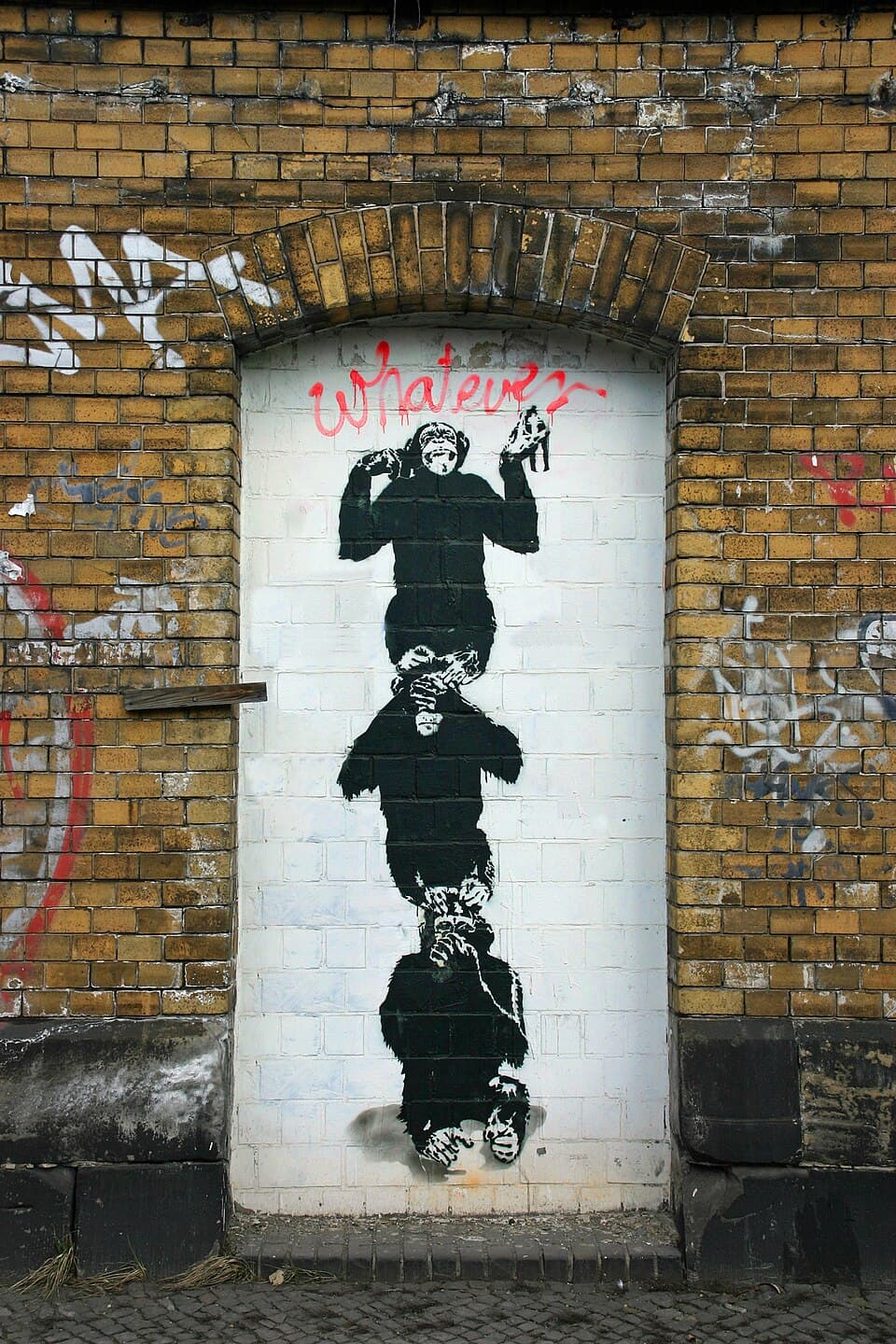
It's in a disused warehouse in Stokes Croft, Bristol, that one evening in 2018 I meet the man everyone is looking for and no one sees. The smell of spray paint still lingers, cardboard stencils dry against a cracked wall, and an old trip-hop tape spins in a corner. We've known each other since the underground nights of our city, those years when painting a wall and making music were the same forbidden gesture. I came without a journalist's microphone, just with our shared memories and the desire to push him to his limits.
—We had barely come out of the Bristol nights when your painting started shredding itself at Sotheby's. Explain that gesture to me?
You who saw me rig frames in squats, you probably weren't that surprised. Girl with Balloon had become an icon fetching over a million pounds, and that bothered me. So I had slipped a shredder into the frame years before, waiting for the right moment. When the hammer fell, the mechanism triggered and the little girl began to descend in shreds. For me, destroying was part of the artwork, not the opposite. The market wanted to freeze an image; I gave it a living object, half-shredded, renamed Love is in the Bin. The irony is that they loved it even more damaged.
The market wanted to freeze an image; I gave it a living object, half-shredded.
—You who hate being explained to, what makes you say that damaging a work is still creating?
Because something too precious ceases to be art and becomes a safe. When an image sells for so much that you're afraid to touch it, it's already dead; it no longer speaks to anyone. By shredding it, I gave it back the right to mean something. The urge to destroy is also a creative urge, as the other guy said — it's not mine, but it sums it up. I grew up painting walls that were erased by morning, you know that better than anyone. Ephemeral, decay — that's always been my raw material. The self-destructing frame was just my old street invited into an auction room.
Something too precious ceases to be art and becomes a safe.
—In 2005, you went to paint the separation wall in the West Bank. Why go looking for a wall so far from ours?
Because a wall is the greatest weapon you can wield against someone, and that one imprisoned an entire people. I painted nine murals there: a little girl lifted by balloons above the concrete, a trompe-l'oeil opening onto a paradise landscape, like a crack to somewhere else. The idea wasn't to decorate horror, but to make it absurd, to force the gaze. The physical danger there had nothing to do with dodging a cop in Bristol. Years later, I opened the Walled Off Hotel right opposite, the hotel with the worst view in the world. You don't change a wall by painting it, but you can stop people from forgetting it's there.
You don't change a wall by painting it, but you can stop people from forgetting it's there.
—When we started, in Bristol, you painted freehand. Tell me why you switched to stencils around 1999?
For the same reason you sped up when the siren approached: to save time. Freehand, a piece takes hours, and every hour is an extra risk of arrest. Around 1999 I realized that the stencil let me put down a complex image in minutes. I spend my afternoons cutting cardboard with a knife, testing the composition in a studio no one knows about. At night I go out with my cans, my stencils, sometimes a hi-vis vest to pass as a worker in broad daylight. Hoodie, cap, I work fast, often with a lookout, I photograph, and I disappear. The entire method is dictated by two words: speed and anonymity.
The entire method is dictated by two words: speed and anonymity.
—We ended up putting our names on album covers. For you, is anonymity a prison or a freedom?
A freedom, without any hesitation. The day my face is known, people will look at the man instead of the wall, and everything will be lost. Anonymity lets me paint in broad daylight disguised as a worker, blend into the street, jeans, sneakers, hoodie, nothing that catches the eye. I'm not a brand; I'm a signature that can be reproduced anywhere. You, your face is part of your music — that's your choice and I respect it. Me, I prefer my images to survive without me. The people who really run this country don't stand for election — neither do I, and that's exactly where my leeway lies.
The day my face is known, people will look at the man instead of the wall.
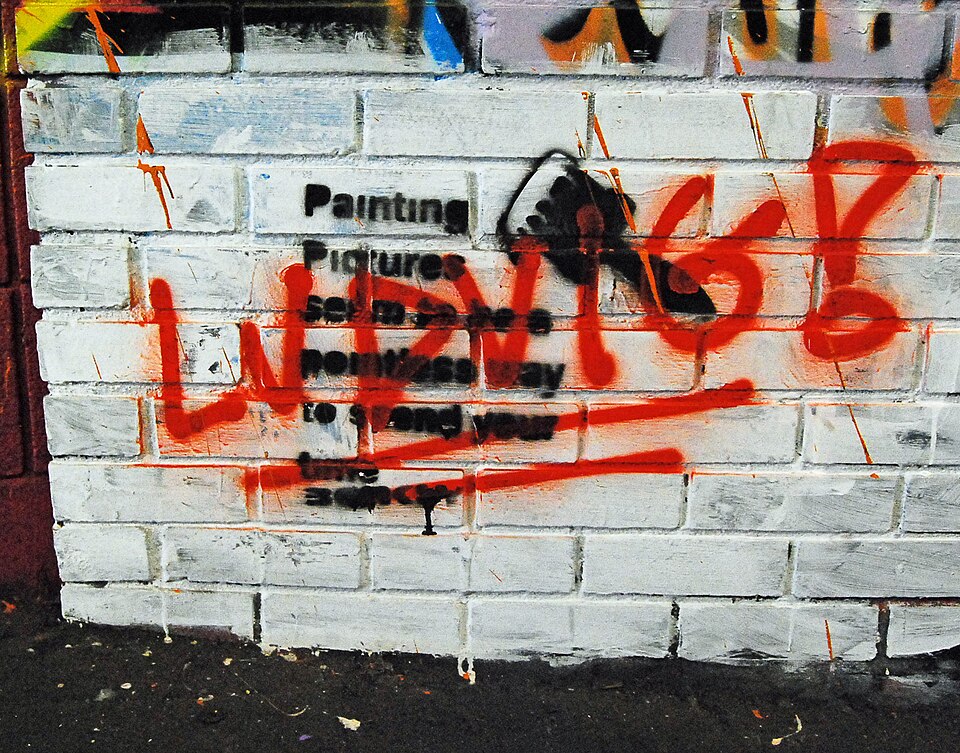
—Still in 2005, you hung your own paintings in the world's greatest museums. Tell me about your best heist.
It was an insolent child's game, and that's what I liked about it. I walked into the British Museum, the Louvre, the MoMA, the Met in New York, and hung my pieces on the walls as if they had always been there. No one noticed. Some remained on display for several days before being removed; visitors walked past nodding knowingly. It says a lot about how we look at art: we respect the frame and the label, not the work. There are far worse crimes than drawing on walls, and one of them is making people believe that those who do it are criminals. Infiltrating the museum was turning that idea back against the institution itself.
We respect the frame and the label, not the work.
—With Exit Through the Gift Shop, I admit I no longer knew where the real and the hoax were. Was that blurring intentional?
Completely intentional, and seeing you lost in it, you who know me, is the greatest compliment. The film tells the story of street art and a guy who starts making it any old way until he becomes a market star. But everyone wondered if that character really existed, or if I had fabricated him. I never settled it. Authenticity and hoax, in this world, are the same currency: all it takes is for something to be expensive for people to believe it's real. The documentary was nominated for an Oscar, and no one could say if I was in the room that night. That's exactly the kind of uncertainty I cultivate — a myth that feeds on its own gaps.
Authenticity and hoax, in this world, are the same currency.
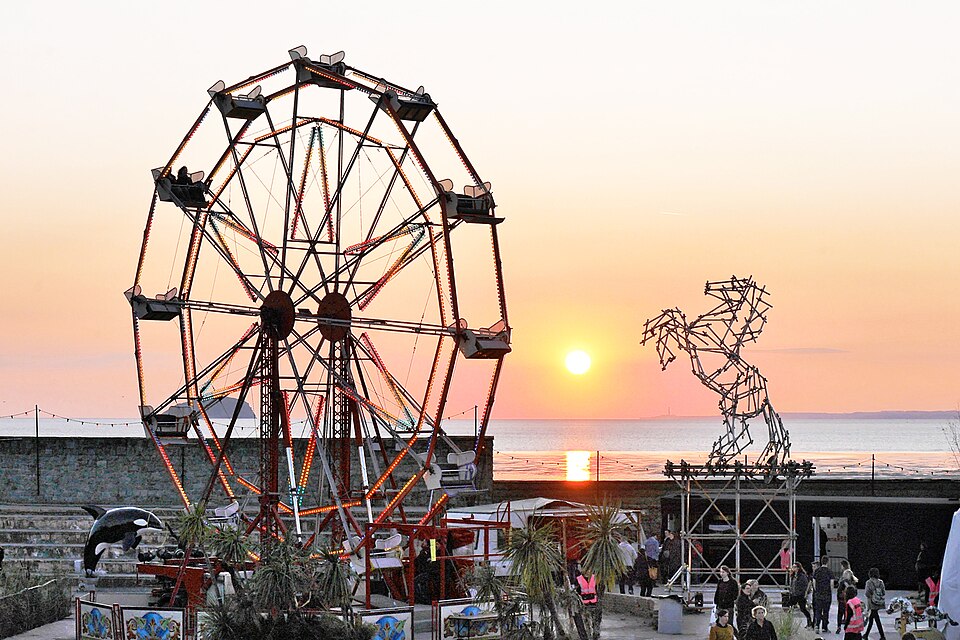
—And then you opened Dismaland, a deliberately failed amusement park. Where did that twisted idea come from?
From the desire to take the sweetest dream sold to families and turn it inside out. In Weston-super-Mare, I transformed an old abandoned lido into a dystopian theme park, a place I openly advertised as unsuitable for children. The castle was gloomy, the rides were about migration, surveillance, consumer society. Fifty-eight artists participated; over one hundred fifty thousand people came in five weeks to queue up and feel uncomfortable. That's culture jamming: you hijack the symbols of mass culture to reveal what they hide. Disney sells escape; I sold a return to reality, with a grim smile and a popped balloon.
Disney sells escape; I sold a return to reality.
—Do you remember the nights we reshaped the world in the basements of Bristol? Dismaland was the same anger, wasn't it?
The same anger, yes, but thirty years older and with a bigger playground. Back then, in those basements, we only had spray cans, turntables, and the feeling that the city belonged to us at night. Massive Attack put that rage into music; I put it on walls. Dismaland is that same underground spirit scaled up to an entire park: we just replaced the basement with a rotten lido and the audience with thousands of people. Subversion, dark humor, détournement — it all comes directly from there, from our Bristol. I didn't invent anything new; I just kept intact that urge to jam the machine. You with your records, me with my stencils — we do the same job.
You with your records, me with my stencils — we do the same job.
—To finish: between a prison wall in Bethlehem and a gilded frame at Sotheby's, where do you really feel at home?
On the wall, always, without the slightest hesitation. The auction room, I drop in to sabotage it, not to live there — it's enemy territory where I set traps. The wall, though, is my studio, my diary, my platform. Whether it's concrete in Bethlehem, brick in Shoreditch, or covered in soot in Bristol, that's where my image meets someone who wasn't expecting it. A hung painting waits for you to come see it; a street mural ambushes you. I prefer the ambush to the exhibition. As long as there are walls and nights to paint them, I'll know where to stand — and it will never be behind a velvet rope.
A hung painting waits for you to come see it; a street mural ambushes you.

This imaginary interview was generated by artificial intelligence from sources documented in Banksy's profile. It dramatises what the figure might have said based on what we know about them, but does not constitute attested historical testimony. For primary sources and factual documentation, refer to the full profile.