Kids interview Barbara McClintock
by Charactorium · Barbara McClintock (1902 — 1992) · Sciences · 5 min read

Two twelve-year-old visitors push open the door of a small laboratory surrounded by cornfields. An old lady in denim pants awaits them, an ear of corn in her hand. She smiles: she is rarely interviewed, and never by children.
—Hello! What was a normal day like for you in your fields?
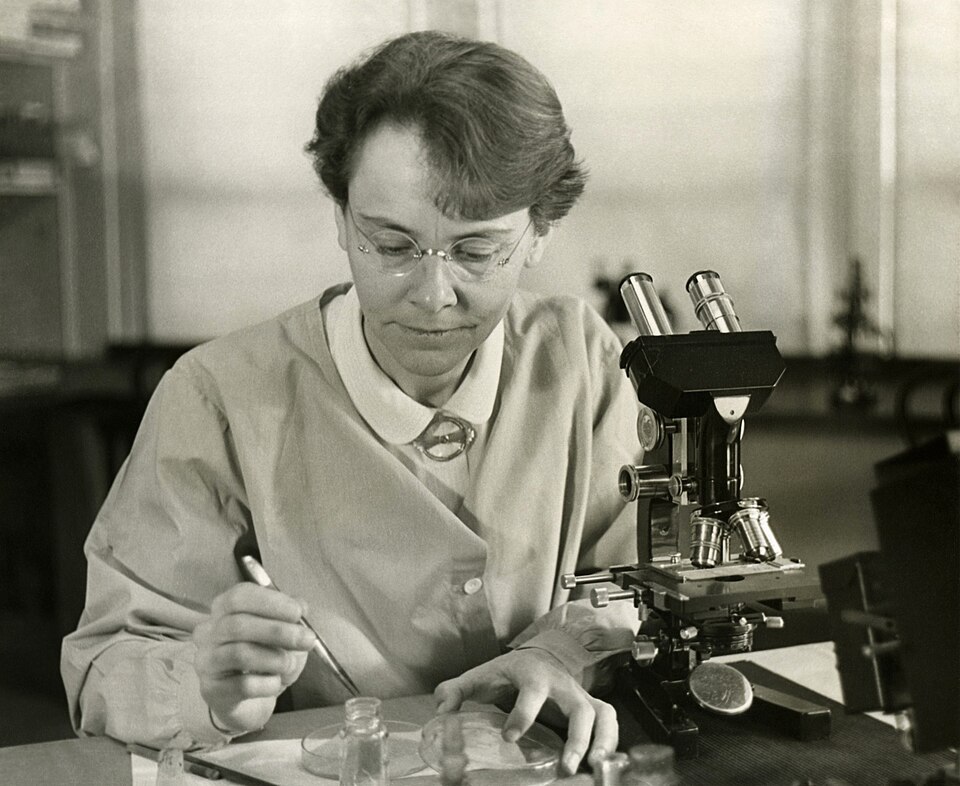
You know, my child, I got up with the sun. Imagine a vast silent field, just the sound of the wind in the corn leaves. I spent hours outside, plant by plant, tying little numbered tags on each stalk. I noted everything: the color of the kernels, the shape of the leaves. In the afternoon, I went back to the Cold Spring Harbor lab and put my eye to the microscope. I filled entire notebooks with little drawings. It was slow, patient—a bit like being a gardener and a detective at the same time. I ate quickly, I lived simply. My real joy was understanding what the plants were trying to tell me.
I was both a gardener and a detective.
—They called you "the woman who talked to corn." Why that funny nickname?
Ah, that nickname made me smile! You'll laugh, but I knew my plants one by one. Imagine you had hundreds of brothers and sisters and you recognized each one just by a facial detail. For me, it was the same with corn. I would see a tiny spot, a slightly different vein, even before taking the microscope. My colleagues thought it was almost magic. But it wasn't magic: it was attention. If you really look at something, for a long time, with love, it eventually gives up its secrets. The corn didn't talk, of course. I had learned to listen to it.
If you look at something with love, it gives up its secrets.
—Is it true that corn kernels changed color? How is that possible?
Yes, and at first it intrigued me a lot! In the 1940s, I saw kernels become speckled, change color from one generation to the next, for no apparent reason. Imagine you plant a red seed, and it grows red kernels with speckles, then almost white kernels. No one understood. I, through constant observation, guessed something incredible: little pieces inside the plant were moving. They jumped from one place to another, and depending on where they landed, they turned color on or off. That's what I called transposition—elements that change places. The kernels were telling me about this invisible journey.
The corn kernels were telling me about an invisible journey.
—And with your microscope, could you really see those little jumping pieces?
Not see them jump in real time, no! It was more subtle than that. I used special stains to dye the chromosomes—those little rods in the cell that carry heredity. Once stained, they became visible under my microscope. Imagine tiny coiled threads that I could finally examine up close. I would spot breaks, pieces that were missing or had moved. Then I compared them with the color of the corresponding kernels. Little by little, like a puzzle, the picture formed in my mind. I spent entire afternoons like that, without moving. What my eyes didn't see directly, my reasoning reconstructed, kernel by kernel, chromosome by chromosome.
What my eyes didn't see, my reasoning reconstructed.
—You turned down a job at the university. Why did you refuse it?
You're asking a delicate question, my child. In my time, it was very hard for a woman to do science. At the University of Missouri, I soon felt they would never give me a real stable position because I was a woman. They would have kept me at the bottom of the ladder forever. So in 1942, I preferred to leave and join a foundation, the Carnegie Institution, at Cold Spring Harbor. There, I had little money and modest housing, but one precious thing: freedom. No one told me what to research. It was a risky bet. But I preferred to be free and poor than stuck and half-respected.
I preferred to be free and poor than half-respected.
—You still received honors before that. What was the proudest moment?
Yes, and I admit it moved me. In 1944, I was elected to the National Academy of Sciences—a great circle of scholars where there were almost only men. I was one of the very first women to enter. The following year, in 1945, my colleagues chose me as president of the Genetics Society of America. Imagine: a woman at the head of an entire society of scholars, at a time when people still said a lady had no place in the lab. It didn't go to my head, you know. For me, the most beautiful thing wasn't the title. It was being able to continue my work.
The most beautiful thing wasn't the title, it was continuing my work.
—Other scientists didn't believe you. Did that make you sad?
Sad, sometimes, yes. In 1951, I presented my discovery before a large assembly of scientists. Imagine yourself standing, heart pounding, and around you closed, skeptical faces. My idea seemed crazy, incomprehensible to them. For years, almost no one followed me. It's hard, you know, to work alone in obscurity. But I never doubted what my plants were showing me. I repeated a very simple thing to myself: 'If you know you are right, you don't need others to know it.' So I continued, in my fields, faithful to my observations. Truth doesn't need applause to remain true.
Truth doesn't need applause to remain true.
—And when you got the Nobel Prize, were you super happy?
I was eighty-one years old, my child! In 1983, nearly forty years after my discoveries, I was finally awarded the Nobel Prize, and alone at that, without sharing it. But do you know what I felt? Not pride. Relief. I was simply happy that my work was finally understood. I said that day: 'I did not seek recognition—only understanding.' You see, I had never doubted. The medal didn't make my ideas truer than before. They were already true, in my fields, for decades. The world had just taken a long time to catch up.
I did not seek recognition, only understanding.
—Deep down, what do your little jumping pieces teach us about life?
Something that still amazes me. People thought heredity was something fixed, neatly arranged, that never moved. My plants showed the opposite. Inside a living being, things stir, reorganize. In my 1983 speech, I spoke of a living heritage capable of responding to outside challenges. Imagine a great library where books move by themselves according to the house's needs. That's a bit like it. The living is not a stone statue; it's a flexible, attentive thing that adapts. And that, you see, applies to corn as well as to people.
The living is not a stone statue; it adapts.
—If someone could tell you a secret from the future, what would make you happy?
What a lovely question! You know, in my lifetime, I saw my ideas go from 'crazy' to 'correct.' Around 1970, scientists found jumping pieces in bacteria too. Suddenly, I was believed. But what would make me happiest is to know that children like you understand that one must be patient with truth. My discoveries waited forty years. Today, we even study how the environment can change the way our genes express themselves, without altering their writing. I had glimpsed that in my corn. So my secret for the future is simple: observe, doubt, and never let go of what you have seen with your own eyes.
Observe, doubt, and never let go of what you have seen with your own eyes.

This imaginary interview was generated by artificial intelligence from sources documented in Barbara McClintock's profile. It dramatises what the figure might have said based on what we know about them, but does not constitute attested historical testimony. For primary sources and factual documentation, refer to the full profile.