Imaginary interview with Barbara McClintock
by Charactorium · Barbara McClintock (1902 — 1992) · Sciences · 5 min read

Summer 1983, a few weeks after the announcement from Stockholm. Barbara McClintock receives visitors in her small office at Cold Spring Harbor, window open onto the cornfields she has walked for forty years. At eighty-one, quick of step, she speaks of her plants as old friends.
—How did you arrive at the idea that pieces of DNA could move within a chromosome?
Through the kernels, always through the kernels. In the 1940s, at Cold Spring Harbor, I was husking ears of Zea mays and I saw variegations that made no sense: a pigmented kernel here, a pale one next to it, and the pattern changed from one generation to the next as if obeying an invisible clock. Most people would have shrugged. I counted, I crossed, I started over under the optical microscope with my carmine stains. And the only explanation that held was that a segment left its place and went to silence a gene elsewhere, then came back. Activator and Dissociation, I called them. The kernels were telling me their story; you just had to listen with enough patience.
The kernels were telling me their story; you just had to listen with enough patience.
—Your colleagues say you recognized each of your plants individually. What was special about the way you looked?
They called me the woman who talked to corn, and it wasn't entirely a joke. I had spent so many hours in my rows that I knew the stance of each plant, the vein of a leaf, the spot on a kernel, even before I put my eye to the microscope. That visual memory, I had already sharpened at Cornell back in 1931, when Harriet Creighton and I showed that crossing-over was not a mathematical abstraction but a physical, tangible exchange between chromosomes. My lab notebooks overflowed with diagrams and genealogies. People think science advances through instruments; it advances first through an attention so total that you become one with the object you study.
An attention so total that you become one with the object you study.
—That 1931 proof of crossing-over — why did it matter so much to you?
Because it anchored heredity in matter. Before, people talked about loci, crossovers, like symbols on paper. With Harriet Creighton, at Cornell, we took maize chromosomes marked with visible knobs, and we showed that after recombination, the chromosome segment had indeed traveled from one homolog to the other. You could see it. With aceto-orcein stains, under the lens, abstraction became geography. That's when, I think, I got into the habit of never believing a concept until I could place it on a glass slide and look it in the eye. Cytogenetics was that: marrying the eye and the idea.
I never believed a concept until I could place it on a slide and look it in the eye.
—In 1941, you left the University of Missouri. What motivated that departure?
Clear-sightedness, more than bitterness. At Columbia, I had understood that a woman would never get tenure there, that I was tolerated without any promise. Marcus Rhoades told me about Cold Spring Harbor, and the Carnegie Institution offered me in 1942 what was worth all the chairs: a field, a laboratory, and peace. No committees, no required courses, no begging for grants. Only my ears and my microscope. People saw it as a sacrifice; I saw it as liberation. Better to till a free field alone than to teach under a glass ceiling. I kept that position until the end, and I never regretted trading prestige for freedom.
Better to till a free field alone than to teach under a glass ceiling.
—Working for years in near-indifference — how did you bear it?
People often ask me how I endured without applause. But I never worked for applause. If you know you're right, you don't need others to know it. I had my fields, my notebooks, my generations of corn confirming season after season what I saw. My life was frugal — a modest Carnegie apartment, meals eaten quickly between observations, field clothes, a checkered shirt and good shoes. I never missed material comfort because I didn't seek it. What would have been unbearable, on the other hand, would have been to doubt my own data to please an audience. That, I never did.
If you know you're right, you don't need others to know it.
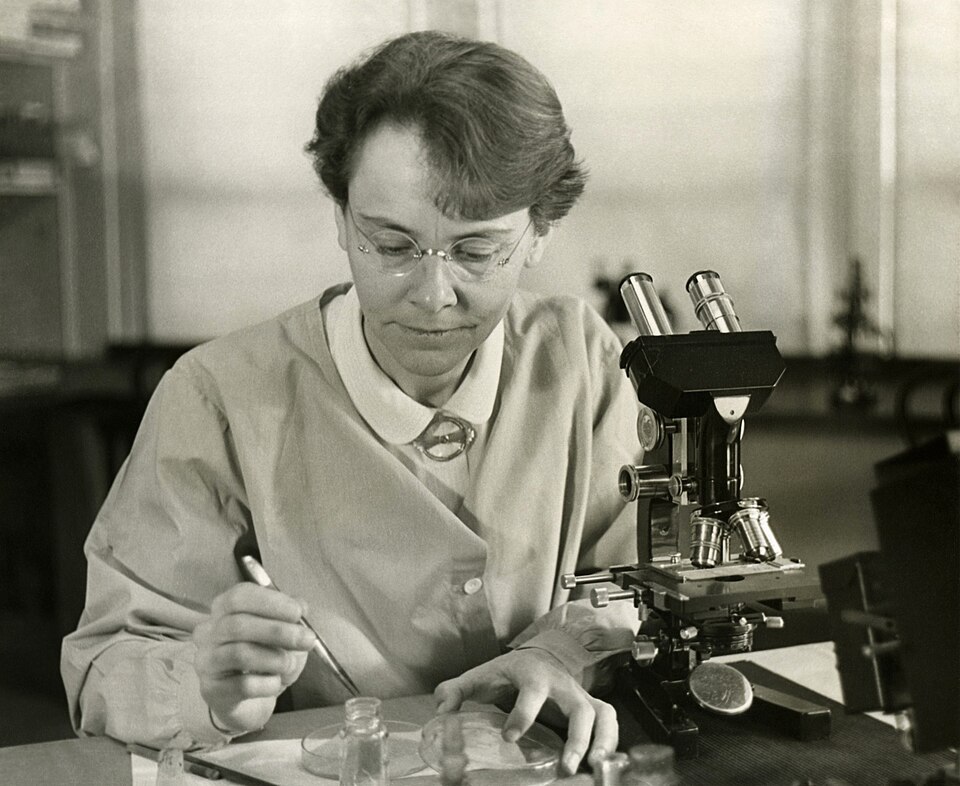
—In 1951, you presented your work at Cold Spring Harbor. How did the audience react?
With polite silence, and behind that silence, incomprehension. I had prepared my talk on chromosome organization and gene expression, convinced I was bringing something new. They listened as one listens to someone speaking an unknown language. The idea of a mobile genome that reorganizes itself clashed with everything they took for granted. And 1953 didn't help: when Watson and Crick unveiled the double helix, that magnificent regular staircase, everyone wanted a stable, well-behaved, immutable DNA. My jumping elements seemed a fantasy. I didn't insist in public; I stopped publishing those results and went back to my ears. The corn, at least, never contradicted me.
Everyone wanted a stable, well-behaved DNA; my jumping elements seemed a fantasy.
—From the 1960s onward, the wind seems to shift. What changed?
Biology finally caught up with what the corn had been showing me for a long time. In 1960, Jacob and Monod described the operon in bacteria: here were genes regulating others, turned on, turned off, exactly the spirit of what I was observing. Then, around 1970, molecular biologists began finding insertion sequences, transposons, in bacteria — elements that change places. Suddenly, my mutable loci were no longer a corn-breeder's fancy. I felt neither triumph nor revenge. Rather the calm of a gardener who sees, twenty years later, a seed he thought lost sprouting. Nature had been consistent from the start; it just took others' tools to catch up.
The calm of a gardener who sees, twenty years later, a seed he thought lost sprouting.
—The Lasker Prize in 1981, then the Nobel in 1983: did you see this late recognition coming?
Not really, and it almost unsettled me. Nothing prepared me for the period of sudden attention I received after the Nobel Prize announcement. It was a bewildering experience. I had not sought recognition — only understanding. The Lasker in 1981 had been the first sign that the world was turning back to my fields. Then Stockholm, in 1983, nearly forty years after my first results on Ac and Ds. At eighty-one, they handed me a medal for work I had done in complete solitude. What touched me was not the honor, but knowing that they had finally read what the kernels had dictated to me.
I had not sought recognition — only understanding.
—In your Stockholm lecture, you describe the genome as a system that responds to challenges. What did you want to convey?
That the genome is not a fixed library, but a vigilant organism. I titled my lecture The Significance of Responses of the Genome to Challenge, because all my corn was shouting that to me: faced with stress, a break, a signal from outside, the genome reorganizes, moves its elements, alters gene expression without touching the DNA letter itself. It is a cellular intelligence, a capacity for response. I didn't have all the words to name it, but I saw its work season after season on my ears. I believe the cell knows far more about itself than we, its observers, do. Our task is only to learn to let it speak.
The cell knows far more about itself than we, its observers, do.
—If you had to explain to a child what a jumping gene is, how would you go about it?
I would put an ear of corn in their hands, first. I would show them those speckled, mottled kernels, some dark, some pale, and ask why the pattern is never the same. Then I would say: imagine a little switch that won't stay put, that jumps from one row to another and, depending on where it lands, turns the color off or on. Those are my Ac and Ds elements. The beauty of it is that it is written right there, in the child's hand, readable without any instrument for anyone willing to look long enough. I spent my life learning that kind of reading — patient, stubborn, at plant level.
It is written right there, readable without any instrument, for anyone willing to look long enough.
This imaginary interview was generated by artificial intelligence from sources documented in Barbara McClintock's profile. It dramatises what the figure might have said based on what we know about them, but does not constitute attested historical testimony. For primary sources and factual documentation, refer to the full profile.