Imaginary dialogue between Voltaire and Beaumarchais
by Charactorium · Beaumarchais (1732 — 1799) · Literature · 5 min read
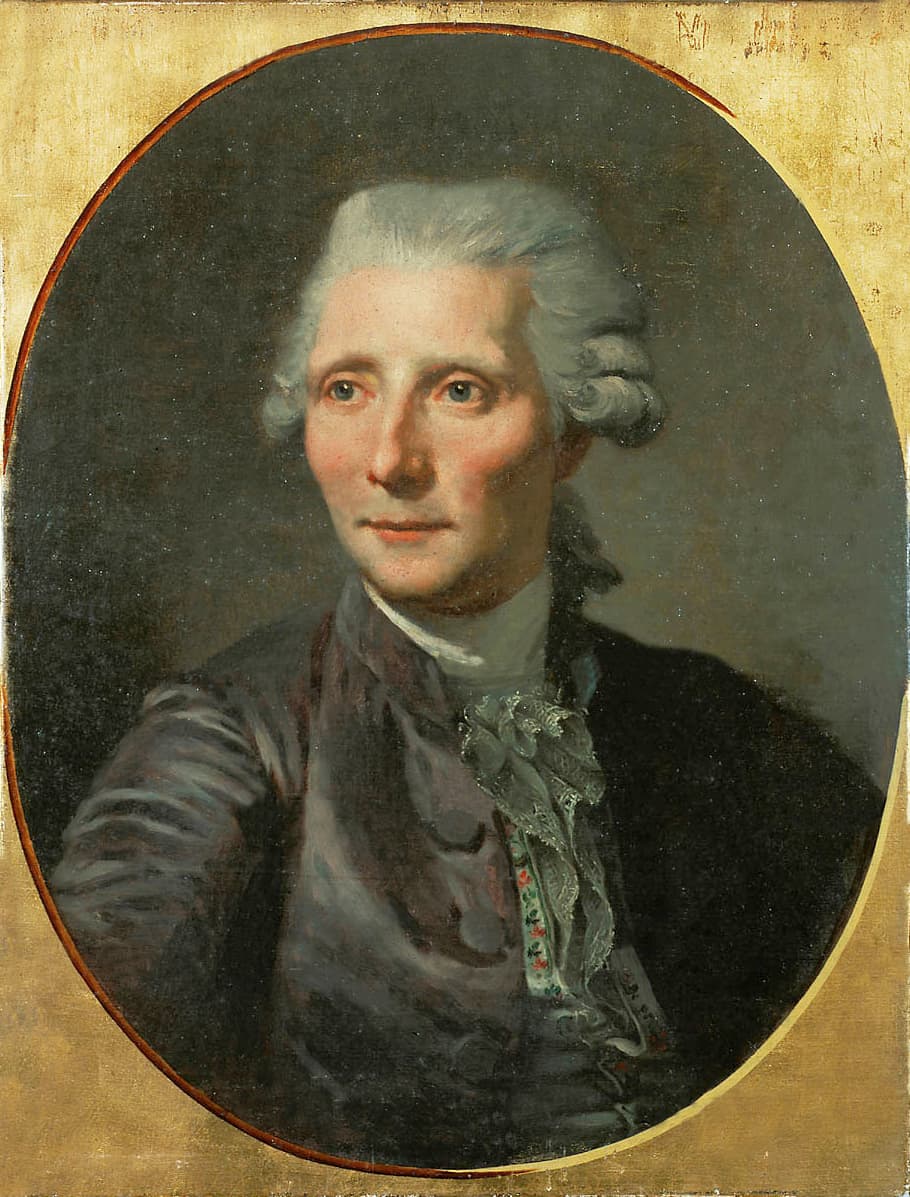
It is in a Parisian salon, in the spring of 1778, that Voltaire — returned to the capital after twenty-eight years of absence and carried in triumph — receives the young Beaumarchais. The candles make the gilding shine, and on a table lie the proofs of a new comedy, still marked with corrections. The old philosopher knows by reputation this son of a clockmaker who has become the darling of the courts and theaters. He observes him with the greedy curiosity of one who senses a kindred spirit.
—I am told, my dear Caron, that you were a watchmaker before letters. How does one go from the father's workshop to the king's court?
You hit the mark, Voltaire: it all begins at the bench. At twenty-one, I devised a new escapement for watches, more accurate than anything known. The watchmaker Lepaute tried to claim it as a stolen feather; I took the matter before the Academy of Sciences, which ruled in my favor in 1754. That was my first battle — and I acquired a taste for it. The king made me court watchmaker, then the harp completed the work: I taught that instrument to the daughters of Louis XV, and I was listened to at Versailles, I, the son of a craftsman. In 1761, I bought a position as king's secretary, which made me a gentleman. A clockwork mechanism gave me the time of my own fortune.
A clockwork mechanism gave me the time of my own fortune.
—So you are a gentleman by office, not by birth. Do the great lords forgive you for it, you who still smell of the workshop?
Forgive me? They make me pay for it every day, Voltaire. To them I remain little Caron, the man who smells of watch oil under the lace. But what have they done to deserve their titles, except take the trouble to be born? I had to conquer everything: my name, my fortune, my rank. That arrogance of the privileged, I keep it in memory, and believe me, it nourishes my pen better than all the ink in the world. When I was scorned at court, I learned to strike back — not with the sword, but with wit, which wounds deeper and can never be washed away. The contempt of the great made me a better writer than any academy.
—You know that I spent years clearing the honor of the Calas. You yourself, in the Goëzman affair, turned the courtroom into a stage. Tell me about it.
Ah, Voltaire, you who cried out for the Calas, you will understand me better than anyone! I was stripped, slandered; Judge Goëzman demanded even a bribe just to deign to hear me. Rather than bend, I published four Memoirs in which I appealed to public opinion. I wrote: I am attacked in my fortune, in my honor, and it is I who am dragged before the courts! All of Paris snatched up these pages. I had turned the judicial memoir into a literary work, a weapon in its own right. The parliament condemned me pro forma, but the public had absolved me — and that is the only court that cannot be corrupted.
—You are said to be the happiest man in Paris after the worst trial. Where does this habit of laughing at your misfortunes come from?
But that is my only wisdom, Voltaire! In my Barber of Seville, Figaro utters this line that is entirely me: I hasten to laugh at everything, for fear of being forced to weep. Laughter is my armor and my sword. When I was accused, ruined, threatened with prison, I could have groaned; I preferred satire, because it disarms the adversary and rallies the laughers. A man you have made laugh will never fully condemn you. You yourself wield irony like a scalpel; we are of the same school, the one that believes a well-placed jest is worth ten pleadings and pierces better than a long speech.
—These proofs on the table — a sequel to The Barber, they say, where the valet stands up to the master. Will you have it performed despite the censorship?
You have a sharp eye, Voltaire! Yes, I am finishing a comedy where Figaro, my valet, dares to say to his master's face what a whole people murmurs quietly. Listen: Because you are a great lord, you think you are a great genius! And further on, he throws at him: You took the trouble to be born, and nothing more. That is not easily forgiven in high places. I already know the censorship will hound me, the nobles will cry seditious scandal. No matter: I will have it performed, even if I must impose it scene by scene. The theater is the only platform where the valet can lecture the prince without being hanged.
The theater is the only platform where the valet can lecture the prince without being hanged.
—My Philosophical Letters were burned by the executioner. Do you think a king will allow a valet to lecture dukes on his stage?
You were burned, I will be banned — that is the price for those who disturb, Voltaire. I already know the censors' song: my play would be dangerous, seditious, a firebrand thrown under the throne. The king himself, they say, will judge it too bold. But I have a force that no censor can control: the pit. When the public wants a play, they always end up getting it; the court itself burns to see what is forbidden. I will read my comedy in salons, I will stir curiosity, I will make the ban so ridiculous that they must yield. A work that is banned soon becomes the work that everyone demands.
—It is whispered that you are arming the American insurgents under a Spanish name. A man of letters turned gunrunner — what drives you to this?
The whispers are true, Voltaire, but do not spread it! Under the name of the house Rodrigue Hortalez and Company, I ship to the American insurgents rifles, powder, uniforms — everything needed for a people to conquer their liberty. Minister Vergennes turns a blind eye, the king pretends to ignore; I advance my own fortune in this adventure. My letters go out sealed with wax, for a single word overheard would ruin everything. Why? Because a man who has sung liberty on the stage must know how to serve it in the world. I only fear I will never be reimbursed — but one does not buy the honor of having helped a nation to be born.
One does not buy the honor of having helped a nation to be born.
—You risk your gold and your head for men you will never see. The philosopher in me admires; the financier worries. And you?
The financier in you is right to worry, Voltaire — I myself miscalculate my risks when a great cause inflames me! I have always been two men: the poet who dreams and the merchant who calculates. One needs the other. Without my speculations, I would have neither the leisure to write nor the independence to say what I think. This American affair may devour me; the states that will be born there will quickly forget to whom they owe their first cartridges. But I prefer a glorious bankruptcy to an idle fortune. A man who has never risked everything has never truly lived, nor written anything worthwhile.
—Last year you founded a society to defend authors against actors. Why this fight, when you already lead so many?
Because it is the most just of all, Voltaire! The actors pocket the money, the booksellers plunder our texts, and the author — he without whom nothing would exist — often dies in poverty. In 1777, I gathered my fellow authors into a society to demand that a writer be master and owner of his work. That is copyright: not charity, but what is due. And I dream even bigger: one day to collect the complete works of the greatest minds of our century, print them in a magnificent edition, and spread them throughout Europe, beyond borders and censors. Spreading the Enlightenment — that is the printing press I wish to serve, for a thought that can no longer be stifled is a thought that has triumphed.
—My young friend, I have not much longer to crush the infamous. When my pen falls silent, who will carry the torch? Will you be that one?
Do not speak of falling silent, Voltaire: your voice will resound long after all of us. But if the torch must pass to other hands, may mine be worthy to hold it. I am neither a mathematician nor a great philosopher; my weapon is the stage, the courtroom, the press — wherever an idea can be introduced through laughter or indignation. I will continue to print, to plead, to perform what they would silence. You taught an entire century that one could think freely; I will strive that the path is never forgotten. The torch only goes out if no one stoops to pick it up — and believe me, I will stoop.
This imaginary interview was generated by artificial intelligence from sources documented in Beaumarchais's profile. It dramatises what the figure might have said based on what we know about them, but does not constitute attested historical testimony. For primary sources and factual documentation, refer to the full profile.