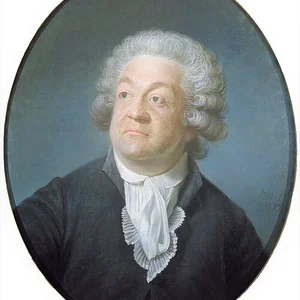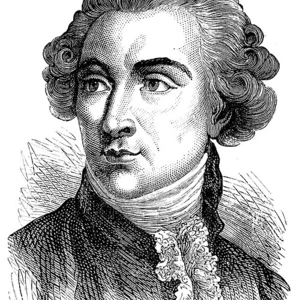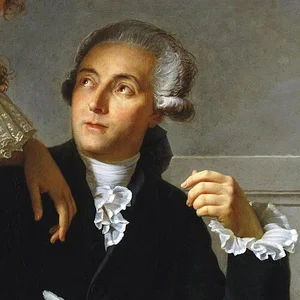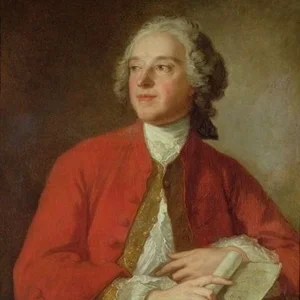

French writer, musician, and businessman (1732-1799), Beaumarchais is the author of The Barber of Seville and The Marriage of Figaro, two plays that revolutionized 18th-century comedy through their social criticism and complex plotting.
Beaumarchais(1732 — 1799)
Pierre-Augustin Caron de Beaumarchais
France
7 min read
Frequently asked questions
Famous Quotes
« Provided I make no mention of authority, religion, politics, morality, public officials, respectable bodies, the Opera, or any other public entertainments, or anyone who is connected with anything, I can print whatever I like, subject to the approval of two or three censors.»
« Without the freedom to criticize, there is no true praise.»
Key Facts
- 1775: Premiere of The Barber of Seville, a comedy in four acts that immediately became a popular success
- 1784: Premiere of The Marriage of Figaro after several years of censorship, a highly subversive play criticizing the aristocratic social order
- 1732-1799: Career spanning court musician, goldsmith, harp teacher, and businessman, in addition to playwright
- Involvement in the American Revolution, financing arms shipments to the insurgents fighting against England
- Dramatic innovations: use of vaudeville, mistaken identity, and complex plotting combining humor with social criticism
Works & Achievements
A comedy in four acts featuring the cunning Figaro helping Count Almaviva win Rosine's heart. The play revitalizes the comic genre with its wit and sparkling dialogue.
A sequel to The Barber of Seville, this bold comedy in which Figaro confronts his master is considered a harbinger of the French Revolution for its critique of aristocratic privilege.
The final installment of the Figaro trilogy, a darker and more sentimental drama showing the characters aged, confronted with secrets and remorse.
Four legal briefs published during his trial against Judge Goëzman. These texts, blending irony and eloquence, made Beaumarchais a celebrity and a champion of justice.
An opera set to music by Salieri, an ambitious work with philosophical scope depicting a common soldier triumphing over an oriental tyrant.
A monumental publishing undertaking in 70 volumes, financed and directed by Beaumarchais to spread the Enlightenment legacy across Europe.
Anecdotes
The son of a Parisian watchmaker, young Caron invented a new escapement mechanism for watches at the age of 21. The king's watchmaker Lepaute attempted to claim credit for the invention, but Beaumarchais brought the matter before the Académie des sciences, which ruled in his favor in 1754. This first legal victory shaped his combative character.
Beaumarchais taught himself the harp and became so talented that he was invited to give lessons to the daughters of Louis XV at Versailles. It was through music that he gained access to court circles and began his social ascent — a mere craftsman's son.
During the American War of Independence, Beaumarchais secretly organized, under the name of the company Rodrigue Hortalez et Compagnie, the shipment of weapons, ammunition, and supplies to the American insurgents. He invested his personal fortune in the venture and was never fully reimbursed, neither by France nor by the United States.
The premiere of The Marriage of Figaro, on April 27, 1784 at the Comédie-Française, drew such a crowd that three people were crushed to death in the rush. Louis XVI had initially banned the play, deeming it dangerous, before yielding to pressure from the court, which was desperate to see it.
Beaumarchais was briefly imprisoned during the Terror in 1792. He had attempted to purchase 60,000 muskets in Holland on behalf of the French Republic, but the affair turned into a diplomatic fiasco. Suspected of emigration, he spent several years in exile in Hamburg before returning to Paris in 1796.
Primary Sources
Because you are a great lord, you believe yourself a great genius!... Nobility, fortune, rank, positions — all this makes one so proud! What did you do to deserve such gifts? You took the trouble to be born, and nothing more.
I make haste to laugh at everything, for fear of being obliged to weep.
I was a peaceful citizen, carrying on in my own way the trade of books and music; I am attacked in my fortune, in my honor, and yet it is I who am dragged before the courts!
Only small men fear small writings. To dare laugh on stage at the follies of society — that is what every author should attempt.
Key Places
His sumptuous residence built opposite the Bastille, where he spent the last years of his life and died in 1799. The house was demolished but the neighborhood preserves his memory.
Theatre where The Barber of Seville (1775) and The Marriage of Figaro (1784) were premiered, his two greatest dramatic triumphs.
The place where Beaumarchais gave harp lessons to the daughters of Louis XV and frequented the court, forging connections essential to his rise.
The city where Beaumarchais set up a printing house to publish the complete edition of Voltaire's works, a colossal undertaking spanning 70 volumes.
The neighborhood where Beaumarchais was born in 1732, in his father's watchmaking workshop, in the heart of working-class and merchant Paris.
Typical Objects

Beaumarchais invented a new watch escapement mechanism at age 21, even before becoming a playwright. This object symbolizes his beginnings as an ingenious craftsman.

An instrument he mastered self-taught, which earned him a position as music teacher to the daughters of Louis XV, opening the doors of Versailles to him.

His crossed-out and annotated manuscripts bear witness to relentless work on dramatic writing, with every line carefully crafted for its comic and critical effect.

18th-century writing tools, inseparable from literary activity and the many legal briefs that Beaumarchais drafted himself.

His secret diplomatic correspondence with the American insurgents and Minister Vergennes was carried out through carefully sealed letters.

Beaumarchais financed and supervised the complete edition of Voltaire's works at Kehl, becoming a major figure in the dissemination of Enlightenment ideas.
School Curriculum
Vocabulary & Tags
Key Vocabulary
Tags
Daily Life
Morning
Beaumarchais rises relatively late, as was customary in good Parisian society of the 18th century. He dedicates his mornings to his extensive correspondence — commercial affairs, diplomatic dispatches, and personal letters. He sometimes receives visitors in his study, surrounded by his manuscripts.
Afternoon
The afternoon is often devoted to business: commercial negotiations, visits to publishers, or court appearances during his many lawsuits. A tireless businessman, he manages his publishing enterprises, speculative ventures, and arms contracts. He may also attend rehearsals at the Comédie-Française.
Evening
Evenings are reserved for the theatre and fashionable suppers in Parisian salons. Beaumarchais is a sought-after guest for his wit and brilliant conversation. He sometimes plays the harp or flute to entertain the company. He often writes late into the night, working on his plays or memoirs.
Food
Beaumarchais's table reflects that of a wealthy bourgeois of the 18th century: soups, roasted poultry, pâtés, seasonal vegetables, and cheeses. Burgundy or Bordeaux wine accompanies meals. Fine suppers feature several courses with elaborate dishes, in keeping with the customs of Parisian society.
Clothing
Beaumarchais dresses as a man of quality: embroidered silk coat, ornate waistcoat, fitted breeches, silk stockings, and buckled shoes. He wears a powdered wig in the fashion of the time. His careful appearance reflects his social ascent, from the son of a clockmaker to a gentleman received at court.
Housing
He lives in a sumptuous private mansion he has built opposite the Bastille, on the rue du Pas-de-la-Mule, complete with gardens, a music salon, and a vast library. The residence, completed in 1789, is one of the finest in the Marais, testifying to his financial success and taste for grandeur.
Historical Timeline
Period Vocabulary
Visual Style
Un style visuel entre rococo et néoclassique, baigné dans la lumière dorée des chandelles et des rampes de théâtre. L'élégance des salons parisiens se mêle à l'énergie scénique de la comédie.
Sound Ambience
L'univers sonore de Beaumarchais mêle l'effervescence du théâtre parisien, les salons musicaux de la cour et l'atelier d'horlogerie paternel. On y entend le Paris bouillonnant du XVIIIe siècle, entre rue populaire et salons aristocratiques.
Liens externes & ressources
Références
Œuvres
Le Barbier de Séville
1775
Le Mariage de Figaro
1784
La Mère coupable
1792
Mémoires contre Goëzman
1773-1774
Édition de Kehl des œuvres complètes de Voltaire
1783-1790