Imaginary interview with Benazir Bhutto
by Charactorium · Benazir Bhutto (1953 — 2007) · Politics · 6 min read
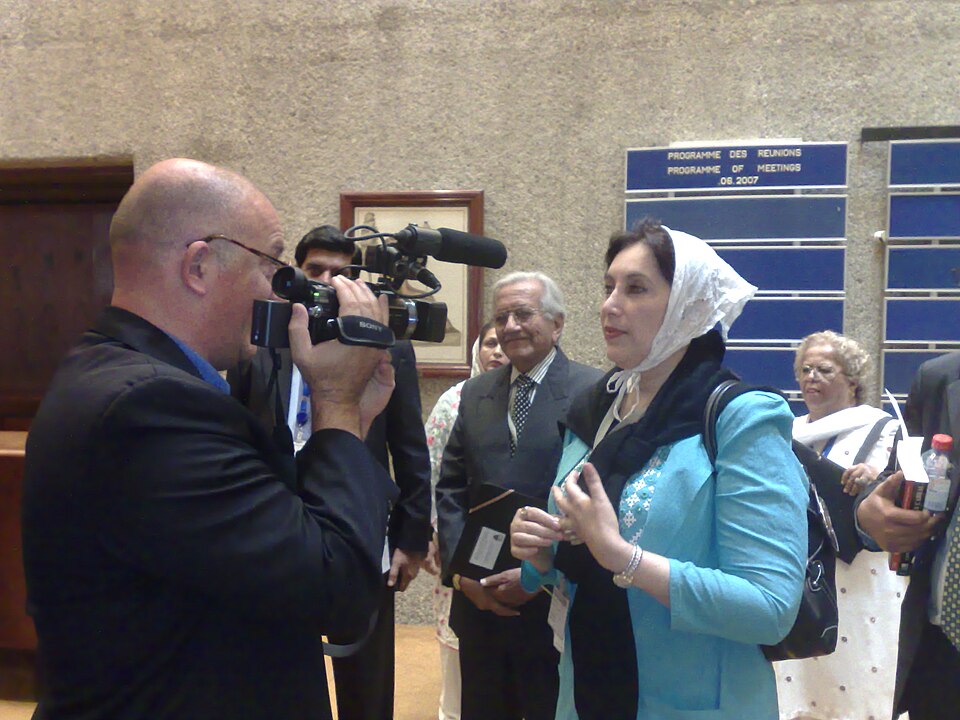
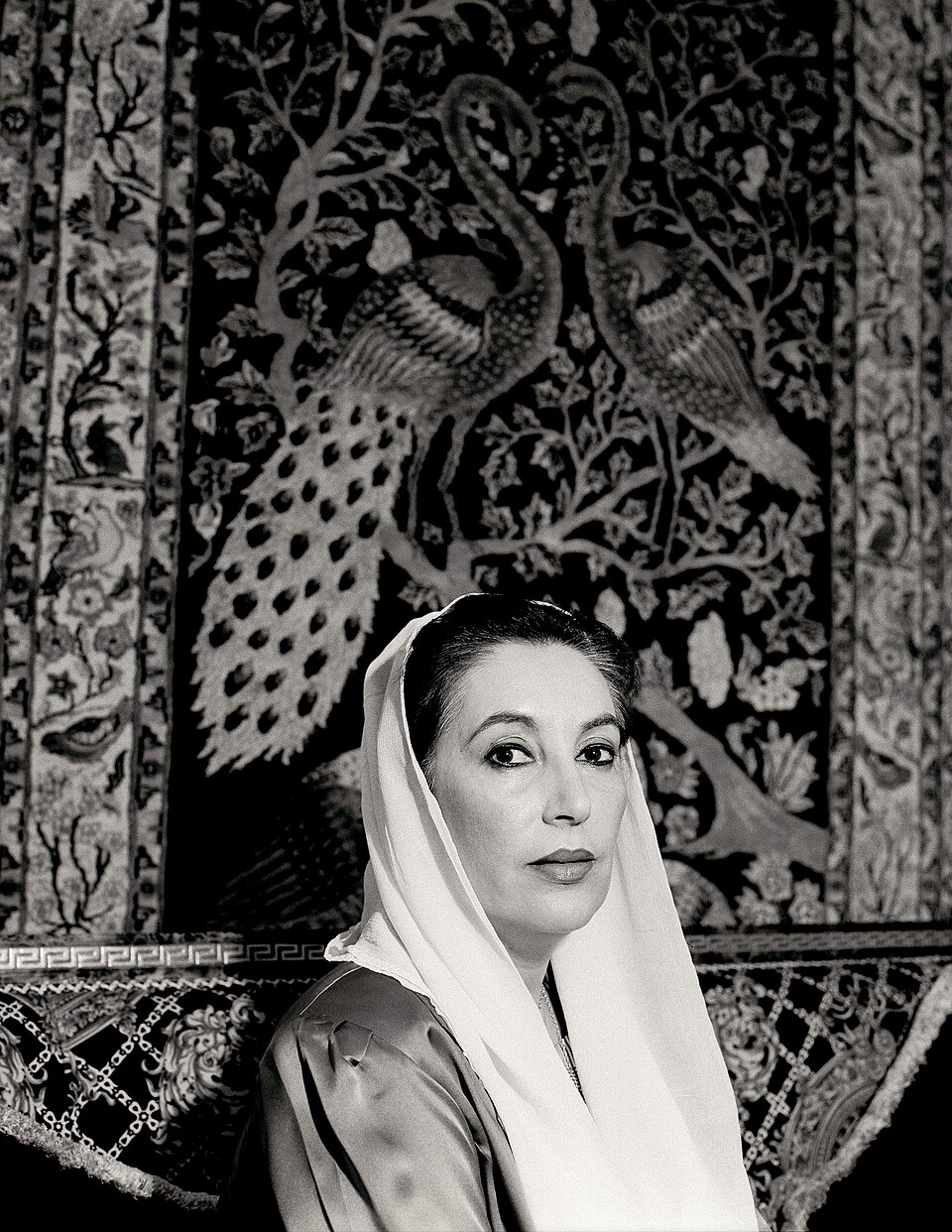
Karachi, late 2007. The white dupatta on her hair, Benazir Bhutto receives us in a spartan room still strewn with campaign files and handwritten notes in Urdu. The crowd from her return from exile still echoes in her voice as she agrees to look back, for us, on a life spent between grief, power, and threat.
—How did you learn of your father's death, and what did it make of you?
They hanged him at dawn, in 1979, on the orders of General Zia-ul-Haq. I was under house arrest, separated from him by the walls of a military prison, and I could only say goodbye through bars. Zulfikar Ali Bhutto had founded the Pakistan People's Party, and by killing him, they thought they could bury an idea. They were wrong. That day I understood that my personal grief no longer belonged to me; it had to become a cause. My father used to say: "My father used to say that democracy is the best revenge." I carried that phrase like an inheritance too heavy to put down. The white dupatta I have never removed since — that is him: grief made into a banner.
They thought they could bury an idea by hanging my father. They were wrong.
—Taking over a party at your age, after such a loss — wasn't it overwhelming?
At twenty-five, you don't feel like a party leader; you feel like an orphan. Yet from 1984, I had to take the helm of the PPP and hold it for over twenty years, facing a dictatorship that imprisoned me, exiled me, harassed me with trials. I learned to turn every prison cell, every house arrest, into a study room. When I returned to Lahore in 1986, millions of faces awaited me, and I felt that these people were not cheering for me, but for the hope my father had embodied. You don't pick up a torch without burning your hands. But it would have taken a cowardice I did not have to let it die in the dust of Larkana.
—On the day of your election in 1988, what did you want to say to Parliament and to the world?
I was thirty-five years old, and I entered an assembly of men who, for many, doubted that a woman could govern a Muslim state. So I told them to their faces: "I am conscious of being the first woman elected to head a government in the Islamic world. I am conscious that some doubt whether a woman can lead an Islamic state. But I am here, before you, democratically elected." There was no challenge in that sentence, only a fact that the ballot boxes had made irrefutable. Breaking that double ceiling — of gender, of tradition — cannot be decreed; it must be proven by the legitimacy of the vote. That day, in Islamabad, it was not Benazir who triumphed, but the idea that no door is definitively closed to the women of my country.
No door is definitively closed to the women of my country.
—What did you reply to those who claimed that women's rights were a Western import?
I countered with a distinction they did not like to hear. At the Harvard Kennedy School, I put it this way: "Women's rights are not Western rights. They are human rights. And human rights are universal." When a mullah told me that women's emancipation came from London or Washington, I reminded him that my faith, Islam, commands justice and equality long before the West invented its declarations. My two terms, from 1988 to 1990 and then from 1993 to 1996, I wanted to devote to social reforms, to schools, to maternal health. They cut them short, under the pretext of corruption, but the idea had taken root. No culture, no tradition, can legitimately claim to deny a woman her full place in society.
—You wrote a book on reconciliation between Islam and democracy. Why was this question so close to your heart?
Because all my life they tried to convince me that these two words exclude each other, and I know that they nourish each other. In Reconciliation: Islam, Democracy, and the West, I wrote that "Islam and democracy are not only compatible but mutually reinforcing." A true Islamic state must be democratic, because Islam itself commands justice and the protection of human dignity. Those who preach the opposite — the Taliban, the merchants of political Islam — betray the religion they claim to defend. I write this as radicalism threatens South Asia, and I firmly believe it: dialogue between civilizations is not a weakness; it is the only lasting weapon against hatred. Democracy is not the enemy of God; it is the instrument of His justice among men.
Democracy is not the enemy of God; it is the instrument of His justice among men.
—Faced with the rise of radicalism, how can you still defend the path of dialogue?
They reproach me for my naivety, they say that against those who blow themselves up, dialogue is a drawing-room affectation. I reply that it is quite the opposite. The military coup, the suicide attack, the impunity that follows — that is the circle that has strangled my country since its birth. Breaking that circle requires more courage than fueling it. I saw with my own eyes what Afghan extremism poured onto the villages of Pakistan in the 1990s, and I know that you do not fight a false idea with arms alone. You fight it with schools, with the vote, with speech. Radicalism thrives where parliamentary democracy has been murdered. Give the people back their voice, and you will dry up the well where fanatics drink.
—On October 18, 2007, your return convoy was hit. What happened inside you that night?
Hardly had I stepped off the plane in Karachi, after eight years of exile, I wanted to walk among my people. And then the night tore apart. Two explosions, and around me, 179 dead, young men of the PPP who had simply come to welcome me, torn to pieces at my feet. I sometimes wore a bulletproof vest, but that evening I understood that no armor protects against a man determined to die. They begged me to flee, to go into hiding. I refused. If I gave in, terrorism would have won without even reaching me. I said I would not be intimidated, and I repeated it every day since. Those deaths had bound me to them by an oath I had no right to betray.
No armor protects against a man determined to die.
—How do you continue an election campaign knowing you are the number one target?
You learn to inhabit the threat like a house whose every creak you know. My days are convoys of security, rallies where I speak into a microphone knowing that a face in the crowd might want me dead. But when I take the stage before tens of thousands, that fear fades — only the voice remains, the one tool that has never failed me. They hound me with corruption cases, they threaten me with death, they have already driven me from power twice. The worst they can take from me, they already took in 1979, with my father. The rest I offer freely, because a people who see their leader retreat learn to retreat themselves.
—Do you remember your years at Oxford and your presidency of the Oxford Union?
Oxford was my forge. At Lady Margaret Hall, then Christ Church, I discovered that a well-spoken idea is worth an army. In 1977, I became the first South Asian woman to preside over the Oxford Union, that debating club where the best British orators duel like swordsmen. There I learned to command a room, to turn an objection, to never show fear. What cruel irony: the very year of my triumph at the podium, my father fell to Zia's coup. I returned from a world of polished words to a country where words could cost you your life. But that rhetoric learned on the banks of the Thames served me on every platform in Sindh and Punjab.
—What did those long years of exile between Dubai, London, and Washington represent for you?
Exile is a passport covered in visas and a heart that stays in Larkana. After my second dismissal in 1996, I lived far from Pakistan, in a villa in Dubai, reading the press in Urdu and English, giving interviews, holding my party together by telephone. People think the exile is idle; on the contrary, he is in a state of exhausting vigilance, because his fight is waged by proxy, thousands of miles away. I traveled from London to Washington to plead the cause of Pakistani democracy with those who could make a difference. But no foreign capital can replace the smell of your native soil. I knew I would return — a Bhutto does not die in exile; he returns, whatever the cost.
This imaginary interview was generated by artificial intelligence from sources documented in Benazir Bhutto's profile. It dramatises what the figure might have said based on what we know about them, but does not constitute attested historical testimony. For primary sources and factual documentation, refer to the full profile.