Imaginary interview with Betty Friedan
by Charactorium · Betty Friedan (1921 — 2006) · Society · Literature · Politics · 6 min read
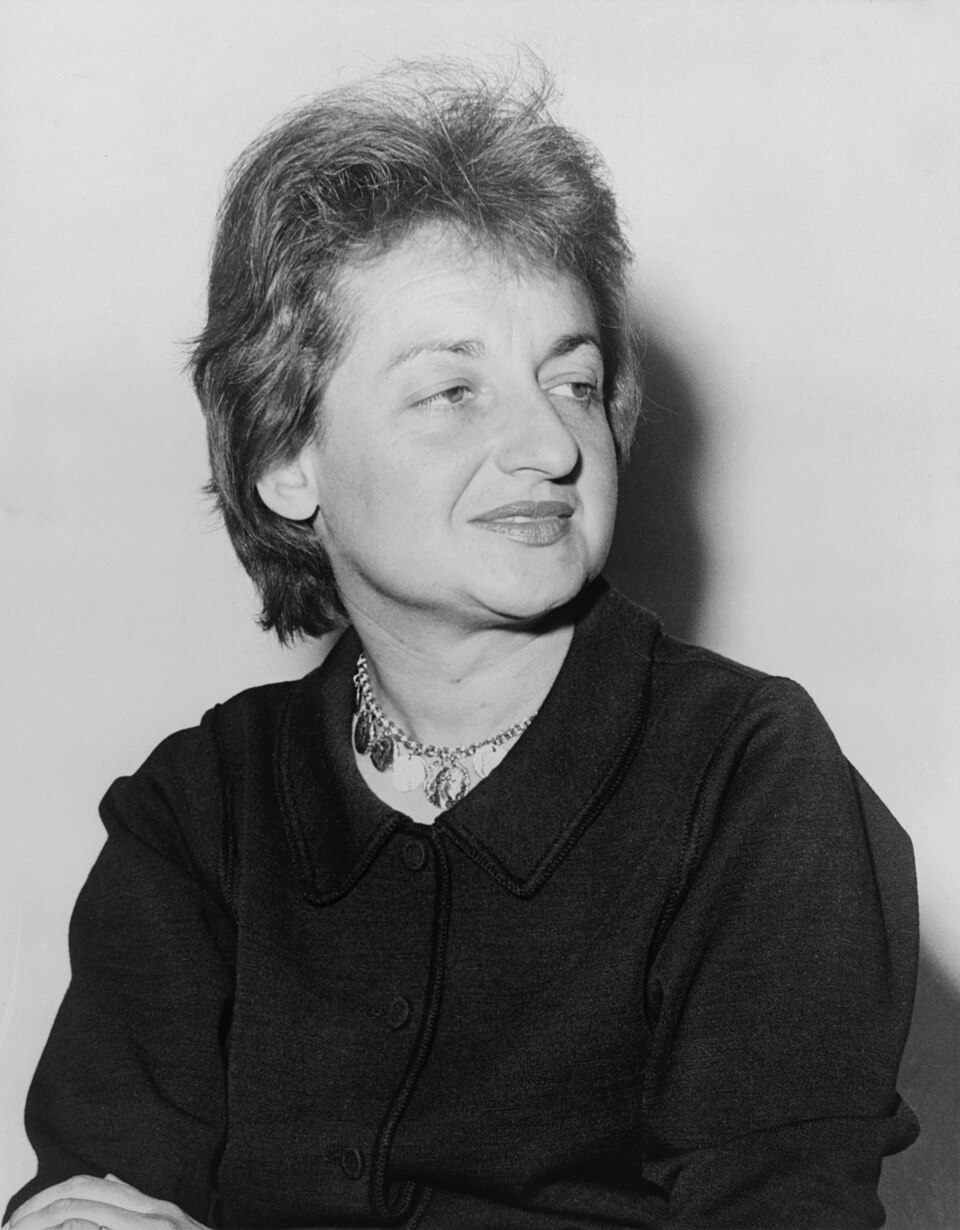
Manhattan, an evening in the late 1970s. Betty Friedan receives guests in her apartment, far from the suburban house she fled. On the table, an annotated manuscript, a full ashtray, and that voice rising at the first question, hoarse and impatient.
—Do you remember the precise moment when the idea of The Feminine Mystique began to take shape?
It started with something as ordinary as a stamped envelope. In 1957, for the fifteenth reunion of our class, I sent a long questionnaire to my former classmates at Smith College. I expected cheerful letters, photos of children, exchanged recipes. I received something else: brilliant, educated women, surrounded by everything that advertising promised as happiness, describing an emptiness they dared not name. I reread those responses for entire nights. I understood that this unease was not a personal weakness, an isolated neurosis—it was the symptom of a collective lie. I called it the problem that has no name, for lack of a better term, and that missing name became, for six years, the thread I never let go of.
This unease was not a personal weakness: it was the symptom of a collective lie.
—What exactly did you mean by that phrase, the “problem that has no name”?
Imagine a woman, in the afternoon, in her immaculate suburban kitchen. Her children are at school, her husband at the office, the dishes put away. And suddenly a question crosses her mind, mute, almost shameful: “Is this really all?” She had been sworn that marriage, motherhood, clean laundry would suffice to fill a human life. When it didn't, she believed she was sick, ungrateful, abnormal. That is the trap of the feminine mystique: convincing millions of women that their dissatisfaction was a matter of psychiatry rather than politics. In my book, published in 1963, I wrote that this trouble was “buried, unnamed, for a long time in the minds of American women.” My work first consisted of giving it a name, because what has no name can neither be thought nor fought.
That is the trap of the feminine mystique: convincing millions of women that their dissatisfaction was a matter of psychiatry rather than politics.
—How did you concretely manage to write such a book while raising three children?
People always imagine the writer alone in his tower. Me, I wrote in the gaps. In the morning, in Rockland County, I got my three children ready for school, and as soon as the door closed I threw myself at my notes or rushed to the library. My portable typewriter almost never left my desk: it had already served me for my freelance journalism, and it served me for the thousands of pages that led to the book. I wrote in the interstices that domestic life would grant me, between two loads of laundry and a snack. There was an irony there that I never forgot: I was dissecting the suburban housewife while being, myself, exactly that woman, bent over her keys stealing time from housework.
I was dissecting the suburban housewife while being, myself, exactly that woman.
—It is said that you pored over women's magazines of the time. What were you looking for in their pages?
I was looking for the manufacture of the lie, and I found it on glossy paper. Titles like McCall's or Ladies' Home Journal did not just sell vacuum cleaners: they sold an image of woman, smiling, devoted, fulfilled by the sole care of her home. I spread years of these publications on my desk and read them like an anthropologist reads ancient tablets. Gradually, a pattern emerged: the intelligent, curious, professional heroine of the 1930s had disappeared from stories, replaced after the war by the perfect radiant housewife. These magazines were not mere entertainment; they were instruments of propaganda, as effective as any political speech, to send women back from the factory to the stove once the soldiers returned. We had to dismantle this mechanism image by image.
—Tell us about the birth of the National Organization for Women, in 1966.
It was born on a paper napkin, and I say that without coyness. We were in Washington, gathered for a government conference on the status of women, and anger was mounting: we had been documenting our inequalities for years without ever implementing anything. One evening, over dinner, a small group of women determined to act had had enough of waiting. I scribbled the first words of our bylaws on whatever came to hand—a napkin. NOW came out of that, not from a solemn congress but from a shared fed-upness. I was its first president until 1970. What I wanted was an organization that didn't just write reports: a pragmatic war machine, made of lawsuits, lobbying, demonstrations. Enough observations. We needed levers.
NOW was born on a paper napkin, not from a solemn congress but from a shared fed-upness.
—What ambition did you carry in founding this organization?
The book had given a name to the ill; now we needed hands to fight it. The feminine mystique had awakened millions of consciences, but a conscience alone, in her kitchen, remains powerless. NOW had to transform that intimate awakening into organized force: equal pay, the right to control one's body, an end to hiring discrimination. On the day of its founding, in 1966, I wanted the tone to be that of a beginning, not a complaint. I said that evening that “the time has come for a new march toward true equality for all women in America, and toward a fully equal society for women and men.” I still weigh those words: for women and men. I never conceived this equality as a war against half of humanity.
—Long before all that, you had given up a doctorate at Berkeley. What does that renunciation mean to you?
It's a wound I carried like a splinter for a long time. I had left Smith in 1942 with honors, specializing in psychology, and the University of California at Berkeley offered me a fellowship for a doctorate. A future as a researcher was opening up. I gave it up—under a pressure I couldn't name at the time, social, emotional, that little voice whispering that a woman too learned would scare off men. I bent. And I regretted it for years. But that splinter eventually became a tool: my own renunciation taught me, in my flesh, what society was taking from intelligent women of my generation. We were not frontally forbidden to exist; we were persuaded to censor ourselves. That is perhaps the most insidious form of oppression there is.
We were not forbidden to exist; we were persuaded to censor ourselves.
—You were also fired while pregnant. How did that episode weigh on your thinking?
I was a freelance journalist at the time, and during my second pregnancy, I was simply let go. At the time, it was perfectly legal, almost mundane: a pregnant woman gave up her place, period. I could have swallowed my anger like so many others, filed it away in the drawer of private injustices. Instead, I started adding things up. The renunciation at Berkeley, that firing, the letters from my Smith classmates: each humiliation I thought was isolated fit into the others. I understood that discrimination was not a series of unfortunate accidents but an organized, coherent system, with its own logic and laws. That is what my personal life taught me even before my research: the private is never purely private. What one woman lives alone, a thousand others live at the same moment, in silence.
—In 1981, with The Second Stage, you took a direction that some feminists found provocative. Why this book?
Because I saw the movement rearing up against itself. We had won immense battles, but part of feminism was beginning to treat family, motherhood, tenderness as enemies to be destroyed. Yet I had never fought for that. In The Second Stage, I wrote that “feminism that denies the reality of family, care, love—that feminism betrays its own humanist values and cannot win.” I was accused of betrayal, of backtracking. I replied that it was not about retreating but about taking a second step: stop opposing career and love as two enemy camps, invent a society where a woman no longer has to choose between the two. An emancipation that requires renouncing care for one's own is not liberation. It is another confinement.
—What do you say to those in the women's liberation movement who find you too moderate, too reformist?
That they are mistaken about the adversary. I have always wanted to reintegrate men into the reflection rather than designate them as absolute evil. The Women's Liberation Movement carried a necessary radicalism, and I do not despise it: it dared to question what NOW sometimes left in the shadows, even in the intimacy of couples. But a revolution that drives away half of humanity condemns itself to remain a noisy, minority avant-garde. Me, I wanted to win, concretely, for the women of Peoria as well as those of Manhattan—equal pay, childcare, the right to control one's body. Pragmatism, they reproach me as lukewarmness; I see it, on the contrary, as the only path to lasting victory. A pure idea that changes no one's life has never emancipated anyone.
A pure idea that changes no one's life has never emancipated anyone.
This imaginary interview was generated by artificial intelligence from sources documented in Betty Friedan's profile. It dramatises what the figure might have said based on what we know about them, but does not constitute attested historical testimony. For primary sources and factual documentation, refer to the full profile.