Imaginary interview with Champollion
by Charactorium · Champollion (1790 — 1832) · Sciences · 5 min read
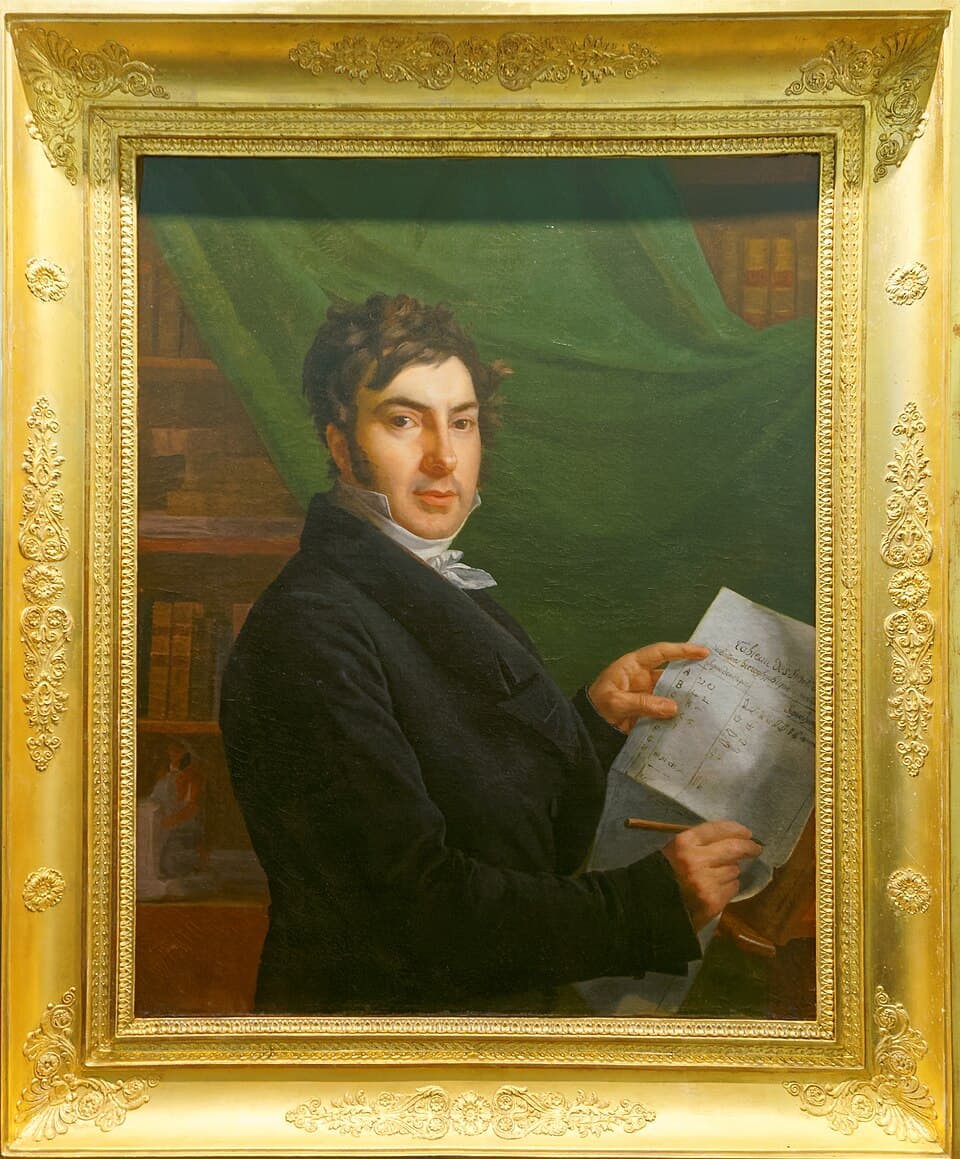
Paris, winter 1831. In a study at the Collège de France, still brand new, where the first chair of Egyptology has just been created for him, a man whose complexion is already marked by fever receives us among unrolled papyri and rubbings of the Rosetta Stone. His voice is calm, almost scholarly, but it kindles at the mere mention of the word hieroglyphs.
—They say it all began long before the decipherment, in childhood. How did your early years prepare you for this task?
At thirteen, I was already devouring Arabic, Syriac, Chaldean, Coptic as much as Latin and Greek. In Grenoble, I spent my evenings bent over a handwritten Coptic Grammar I had compiled myself, convinced that this language, written in Greek characters, was nothing less than the last living form of ancient Egyptian. At sixteen, I presented this insight before the Academy of that city. They thought me too young, too sure of myself. But I held there, without yet fully knowing it, the very key to the problem: to hear the voice of the ancient Egyptians, one first had to know how their last descendants pronounced their words.
Coptic was not just another dead language: it was the last living voice of the ancient Egyptians.
—Many imagined hieroglyphs as mere symbolic pictures. How was your vision different?
That was the error of a whole century of scholars: they wanted every sign to be an idea, a mystical emblem, an allegory. I, with Coptic in my ear, sensed that these engraved figures could also represent sounds, like our letters. In my Précis du système hiéroglyphique of 1824, I demonstrated that this writing is at once figurative, symbolic, and phonetic — sometimes within a single word. That is what they had failed to see: not one system, but three interwoven. The demotic, that simplified cursive found on the Rosetta Stone, served as my bridge between image and sound.
Not one system, but three interwoven within a single sign.
—Let us come to the decisive day. What really happened on September 14, 1822?
For weeks I had been comparing cartouches, those oval frames enclosing royal names. I had before me those from the Rosetta Stone and those recorded from the obelisk of Philae. And suddenly the values began to match, sign after sign, like a lock giving way. In a flash, I understood that my phonetic alphabet held up, that it could read both Greek and Roman names as well as texts engraved a thousand years earlier. I ran to my brother Jacques-Joseph's office at the Institute, and had only the strength to exclaim: 'I've got it!' before collapsing. They say I remained for five days without truly regaining my senses, exhausted from having borne it alone for so long.
The values began to match, sign after sign, like a lock giving way.
—A few days later, you formally presented your discovery. What meaning did you attach to that moment?
On September 27, 1822, I read before the Académie des Inscriptions my Letter to M. Dacier on the Alphabet of Phonetic Hieroglyphs. I was not announcing an opinion, but a certainty: that phonetic hieroglyphs were used to write the names of Greek and Roman rulers, and that similar signs had been employed long before the arrival of the Greeks in Egypt. Understand what that meant: three thousand years of silence were about to speak again. I had appended a table of signs still preserved at the Institute. I trembled as I read, not from fever this time, but from the thought that an entire civilization, mute since antiquity, was waiting behind that slender sheet.
—An English scholar, Thomas Young, had worked on the same puzzles. How do you place your work in relation to his?
I will not deny the merit of Thomas Young. As early as 1821, he had published on demotic and managed to isolate, in the cartouches of the Rosetta Stone, a few signs with phonetic value — notably the name Ptolemy. But he stopped at the threshold. He believed in a handful of phonetic signs lost in an ocean of symbols. I understood that phonetics permeated the entire system, down to the most ancient texts, and that it combined with ideography without dissolving into it. That is the difference between deciphering a word and reading a language. This rivalry was lively, sometimes bitter across the Channel; but the stone does not lie about who made it speak in full.
That is the difference between deciphering a word and reading an entire language.
—Even before leaving for Egypt, you built something in Paris. What did the Louvre Museum represent to you?
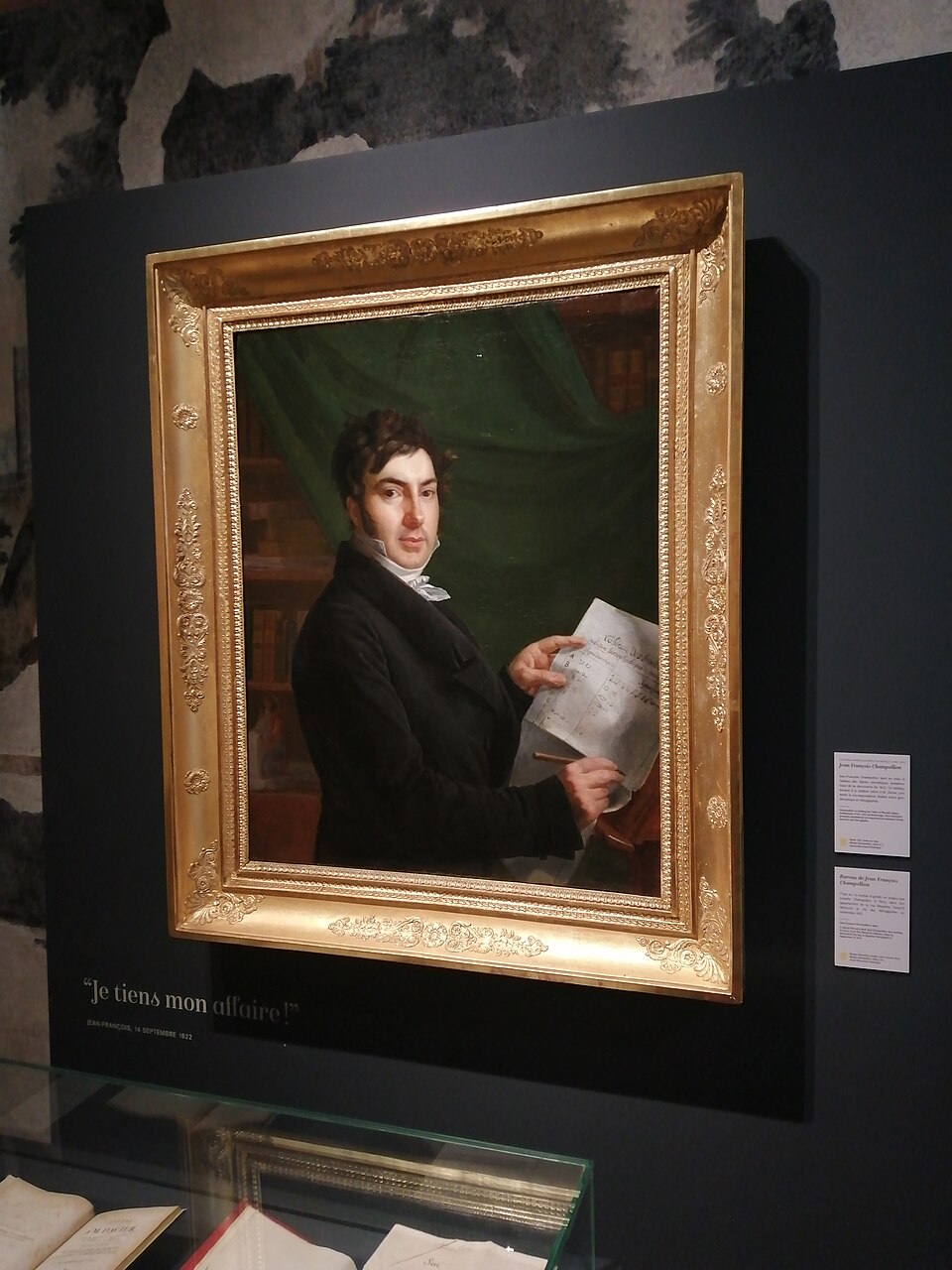
In 1826, I was entrusted with creating the Egyptian division of the Louvre Museum, and I put into it everything a man can put into a patient work. I bought, classified, unrolled papyri that no one before me could read, and organized entire rooms as one composes a book. My afternoons flowed by there, amid stelae and statues, giving order, meaning, and history to what had been merely a heap of curiosities brought back from the Orient. Deciphering was not enough: Egypt had to be offered to the eyes, installed durably at the heart of learned France. This nucleus I formed still constitutes the Egyptian department today.
—In 1828, you finally set sail for Egypt. What did you expect from this long-desired journey?
I had deciphered Egypt without ever seeing it — imagine that torment. The Franco-Tuscan expedition of 1828-1829 was my only visit. I sailed up the Nile with my notebooks of recordings, copying inscriptions by hand onto the stone itself, verifying on the walls what I had guessed in my Paris study. At every temple of Thebes, at Karnak, at Luxor, my system held: I read fluently what no one had read since antiquity. I wrote to my brother that, having followed the river's course to the Second Cataract, I now had the right to say that the Ancients had not exaggerated about that city — that it was even greater in reality.
I had deciphered Egypt without ever seeing it — imagine that torment.
—Was there, during that journey, a moment when emotion overcame the scholar?
Before Abu Simbel. I was there, exhausted by heat and dust, and I looked up at the colossi and then at the texts carved in sandstone. And I could read them. Not guess them, not painfully reconstruct them: read them, as one reads a letter from a friend. All my work in Grenoble, all those nights by candlelight over imperfect copies, took shape in the burning stone. I confess, I wept. A philologist is not supposed to weep over an inscription; but that day, it was pharaohs dead for three millennia speaking to me, and I understood every one of their words.
—Upon your return, Egyptology became a true discipline. What legacy do you wish to leave?
They have just created for me, in 1831, the first chair of Egyptology at the Collège de France. This is, I believe, my greatest pride after the Letter to M. Dacier: no longer merely to have unlocked a secret, but to have made it a science that others can teach and pursue after me. I am working tirelessly on an Egyptian Grammar and a dictionary, so that those who come after will not have to reinvent everything. My health, I feel, will not last long — those vigils by candlelight have worn me out. But what matters the man if the work endures: I will have given Egypt a grammar, and France a discipline.
What matters the man if the work endures: I will have given Egypt a grammar.
—Deep down, what allowed you to succeed where so many scholars had failed?
Pride would have me answer: genius. The truth is humbler. I succeeded because I refused the ease of mystery. My predecessors, and even the clever Thomas Young, sought hidden symbols, secret wisdom; I sought a language, with its sounds, its grammar, its habits. And to hear that language, I needed Coptic, which I had studied since childhood. The rest was a matter of patience: comparing cartouches, starting over a thousand times, doubting, checking every hypothesis against the Rosetta Stone. Chance played no part. You do not make a mute civilization speak by a stroke of luck; you do it by twenty years of obstinate work, and by an intuition you never let go.
This imaginary interview was generated by artificial intelligence from sources documented in Champollion's profile. It dramatises what the figure might have said based on what we know about them, but does not constitute attested historical testimony. For primary sources and factual documentation, refer to the full profile.