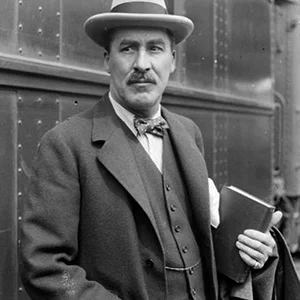

British archaeologist and Egyptologist (1874–1939), Howard Carter is world-famous for discovering in 1922 the nearly intact tomb of Tutankhamun in the Valley of the Kings, Egypt. This discovery is considered the greatest in the history of archaeology.
Howard Carter(1874 — 1939)
Howard Carter
Royaume-Uni
7 min read
Frequently asked questions
Famous Quotes
« I see wonderful things.»
« We have made an extraordinary discovery in the Valley of the Kings.»
Key Facts
- 1874: Born in Swaffham, England.
- 1891: First work in Egypt under the direction of Flinders Petrie.
- 4 November 1922: Discovery of the entrance to Tutankhamun's tomb (KV62).
- 26 November 1922: First opening of the burial chamber with Lord Carnarvon.
- 1939: Death in London, after ten years of painstaking work cataloguing the tomb's treasures.
Works & Achievements
Considered the greatest archaeological discovery in history, the unearthing of this nearly intact tomb yielded more than 5,000 objects and revolutionized our understanding of Egypt's 18th Dynasty.
A landmark three-volume scientific work in which Carter methodically describes the discovery, opening, and cataloguing of the tomb. It remains the primary reference for any Egyptologist.
Carter was the first to scientifically excavate and document the tomb of the pharaoh-queen Hatshepsut, advancing knowledge of one of the most significant female figures in Egyptian history.
Before his landmark discovery, Carter unearthed the tomb of Thutmose IV in the Valley of the Kings — still partially intact — confirming his reputation as a methodical and skilled excavator.
A ten-year scientific undertaking to catalogue, restore, and transfer more than 5,000 artifacts to the Cairo Museum. This preventive conservation project represents the work of a lifetime and remains a methodological benchmark.
Anecdotes
On 4 November 1922, a young water boy working for Carter's team accidentally discovered a step cut into the rock of the Valley of the Kings. Immediately recognizing the significance of the find, Carter cabled his patron Lord Carnarvon, who had remained in England: “At last have made wonderful discovery in valley; a magnificent tomb with seals intact; re-covered same for your arrival.”
On 26 November 1922, Carter made a small breach in the sealed door and inserted a candle. Lord Carnarvon, anxious behind him, asked: “Can you see anything?” Carter replied in a whisper: “Yes, wonderful things!” This phrase has become one of the most famous in the history of archaeology.
Lord Carnarvon, who had been funding the excavations since 1907, died on 5 April 1923, just five months after the discovery, from an infected insect bite. The press immediately gave rise to the legend of the “Curse of the Pharaoh.” In reality, Carter himself lived until 1939, and most members of the team enjoyed a normal lifespan.
Carter devoted no fewer than ten years, from 1922 to 1932, to the meticulous cataloguing of more than 5,000 objects discovered in the tomb. Each artifact was photographed, drawn, numbered, and described before being moved. This titanic work of preventive conservation remains a model for archaeology worldwide.
Howard Carter had no university degree: arriving in Egypt at the age of 17 as a copyist of inscriptions for the Egypt Exploration Fund, he learned Egyptology entirely in the field. Yet this passionate self-taught scholar became one of the world's greatest specialists in ancient Egypt, proof that rigor and curiosity can make up for academic credentials.
Primary Sources
“As the candle light penetrated the darkness, details emerged slowly: strange animals, statues, and gold — everywhere the glint of gold.”
“On the first day of our renewed excavations, at about four metres below the surface, we uncovered a step cut in the rock beneath the accumulated debris.”
“At last have made wonderful discovery in Valley; a magnificent tomb with seals intact; re-covered same for your arrival; congratulations.”
“The inventory of the treasury chamber reveals an exceptional state of preservation. The floral garlands placed on the inner coffin are still partially intact after more than three thousand years.”
Key Places
The town where Howard Carter grew up and was introduced to drawing by his father, an animal painter. It was here that his vocation for precise observation and art took root.
The royal necropolis of ancient Egypt where Carter conducted most of his excavations. It was here that on 4 November 1922 he discovered tomb KV62 of Tutankhamun, nearly intact.
Archaeological site in Middle Egypt where Carter began his career in 1891, copying the tomb paintings of Middle Kingdom nomarchs for the Egypt Exploration Fund.
The institution that received all 5,000 objects from Tutankhamun's tomb. Carter personally coordinated their transport and installation in the museum.
Howard Carter's birthplace, born in Kensington in 1874, and the place of his death in March 1939. He resided there between excavation seasons and gave scientific lectures in the city.
Typical Objects

Carter used fine brushes and spatulas to carefully clear artefacts from the sand. These precision tools were essential to avoid damaging objects more than three thousand years old.

Carter kept a meticulous journal, recording every observation, measurement, and find. These notebooks, preserved at the Griffith Institute in Oxford, are an irreplaceable primary source for Egyptologists.

Carter and his team systematically photographed every object in its discovery context before moving it. This rigorous photographic protocol, innovative for the time, has become a standard of modern archaeology.

Weighing 11 kg of solid gold inlaid with lapis lazuli and semi-precious stones, this mask was discovered directly on the royal mummy in 1925. It is today the most famous object in the Egyptian Museum in Cairo.

These four jars, topped with heads representing the sons of Horus, contained the embalmed internal organs of the pharaoh. Their excellent state of preservation allowed scientists to study mummification techniques.

An indispensable piece of headgear for British archaeologists and explorers in the tropics, it protected Carter from the intense heat of the Valley of the Kings, where temperatures frequently exceed 40 °C in summer.
School Curriculum
Vocabulary & Tags
Key Vocabulary
Tags
Daily Life
Morning
Carter rose before dawn during excavation campaigns to make the most of the cool morning air. Egyptian excavation teams began work at sunrise, under his direct supervision, his notebook always in hand.
Afternoon
The afternoons under the blazing sun of the Valley of the Kings were devoted to recording, photographing, and drawing objects, often inside the tombs themselves. Carter refused to rush, noting the exact position of every artefact before moving it.
Evening
In the evening, in his excavation house nicknamed "Castle Carter", he would write up his notes, correspond with Carnarvon and scientific institutions, and read the latest Egyptological publications. He often worked by lamplight well into the night.
Food
In the field, Carter ate simply in the manner of British expatriates in Egypt: strong tea, bread, cheese, tinned meat, and local fruit. He would receive colleagues and distinguished visitors at his excavation house, and greatly valued the intellectual exchanges these occasions brought.
Clothing
On site, Carter wore the typical colonial dress of the era: a light linen shirt, canvas trousers, and a pith helmet — essential protection against the sun. For official visits and receptions, he wore a three-piece suit in keeping with the customs of the British middle class.
Housing
During excavation campaigns, Carter lived in his house "Castle Carter", a modest dwelling built on the west bank of the Nile at Luxor, near the Valley of the Kings. In London, he kept a flat in Kensington where he housed his Egyptological library.
Historical Timeline
Period Vocabulary
Liens externes & ressources
Références
Œuvres
Découverte de la tombe de Toutânkhamon (KV62)
4 novembre 1922
The Tomb of Tut.Ankh.Amen (3 volumes)
1923-1933
Fouilles et documentation de la tombe d'Hatchepsout (KV20)
1903-1904
Découverte de la tombe de Thoutmosis IV (KV43)
1903
Inventaire et conservation des trésors de Toutânkhamon
1922-1932