Kids interview Champollion
by Charactorium · Champollion (1790 — 1832) · Sciences · 5 min read
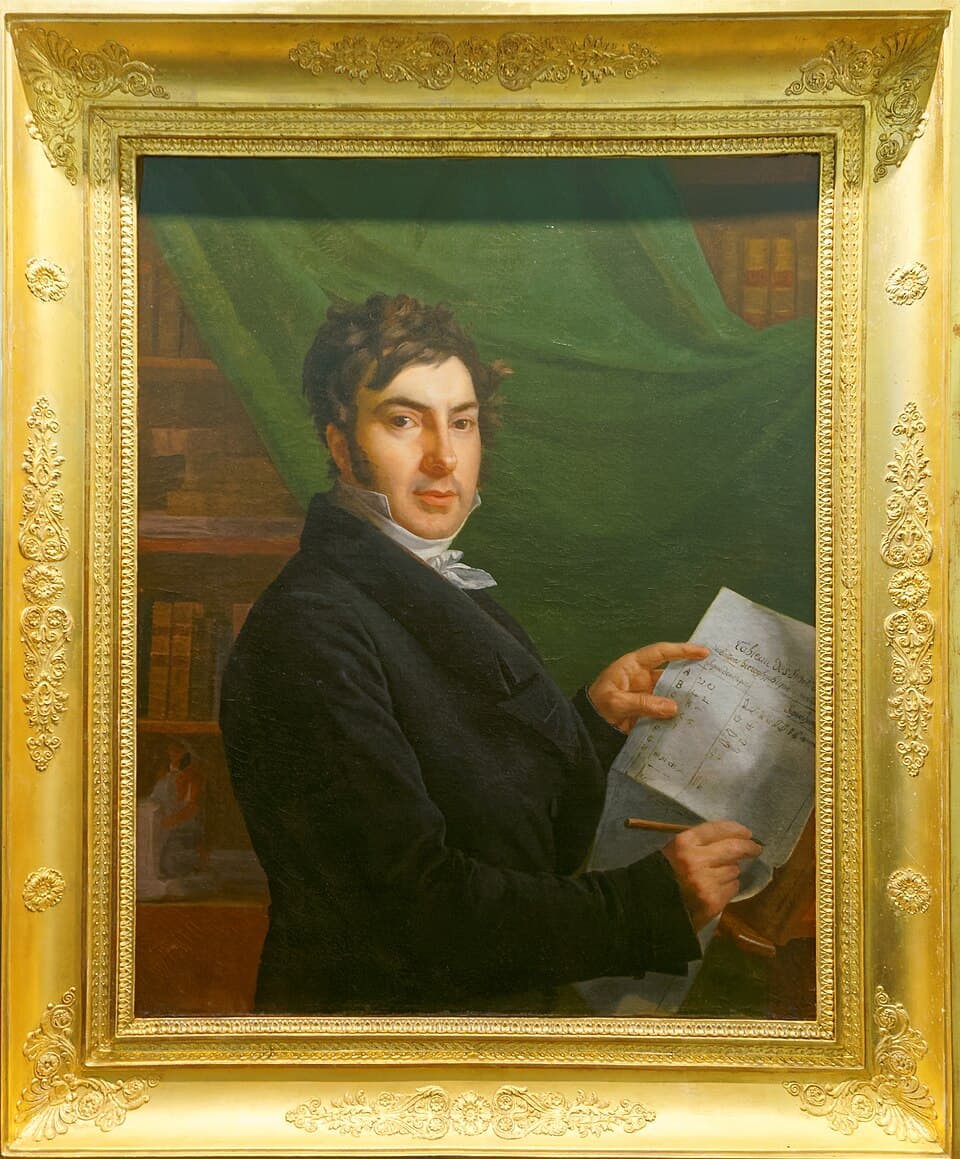
That morning, two twelve-year-old students push open the door of a room filled with stones covered in little drawings. A man with tired but bright eyes greets them with a smile. His name is Jean-François Champollion, and he spent his life making those silent signs speak.
—Is it true they say you spoke many languages when you were little?
Ah, you know, my child, I was a strange kid. At thirteen, I was already learning Arabic, Syriac, Chaldean, and Coptic, on top of Latin and Greek. Coptic is the last way the ancient Egyptians spoke, written with Greek letters. Imagine a child who, instead of running outside, fills notebooks with strange words from the East. That was me. They even appointed me professor of history at the University of Grenoble at nineteen! My older classmates made funny faces. But these languages, you see, were my toys. And one day, they would become my tools.
Those strange languages were my toys — one day they became my tools.
—Why did Coptic help you understand the Egyptian drawings?
Good question! Many scholars believed that hieroglyphs — those little sacred drawings carved in stone — were just pictures, like a rebus. I had a crazy idea. At sixteen, I presented a memoir before the scholars of Grenoble: I said that Coptic was the last form of the language of the ancient Egyptians. You see what that means? If I knew the end of the story, I could trace back to the beginning! I always kept my handwritten Coptic grammar. It was like having the last word of a sentence to guess all the others. Without Coptic, I would never have heard the voice of the pharaohs.
Knowing the end of the language allowed me to trace back to its beginning.
—What was the Rosetta Stone? Why was it so important?
Imagine a big black stone, hard as granite, found by soldiers in Egypt in 1799. On this stone, the same text was written three times: in Greek, in Demotic — a quick script of the people — and in hieroglyphs. See the trick? I could read Greek! So I had the same sentence in a known language and a mysterious one. It was like having the answer to an exercise right next to the question. I worked on copies of this stone, not the original. I compared the cartouches, those little oval frames that surround the names of kings. Hidden there were the first sounds I would manage to read.
It was like having the answer to an exercise written right next to the question.
—Do you remember the exact moment you understood? What did it feel like?
Oh, I will always remember. It was September 14, 1822. For years, I had been comparing the cartouches of the Rosetta Stone and those of an obelisk from Philae. And suddenly, everything clicked in my head — the sounds, the signs, the whole system! I leaped up, ran through the street to my brother Jacques-Joseph's office. I just had time to shout « I've got it! »... and I fainted from exhaustion. Can you imagine? I was unconscious for five days. My body had given out, but my mind had won. A few days later, I announced my discovery to the scholars in my Letter to M. Dacier.
« I've got it! » — then I fainted for five days.
—There was an Englishman who was looking for the same thing, right?
Yes, my child, his name was Thomas Young. A very clever scholar, I must admit. He too studied the cartouches of the Rosetta Stone. In 1821, he had already guessed that some signs represented sounds, especially for foreign names like those of Greek kings. But he stopped halfway. I understood something bigger: Egyptian writing mixes everything at once. Drawings that stand for an idea, and drawings that stand for a sound, all in one sentence! It wasn't a simple list of symbols. It was a living, clever, complete system. That's what set us apart, him and me.
He stopped halfway; I saw the whole system.
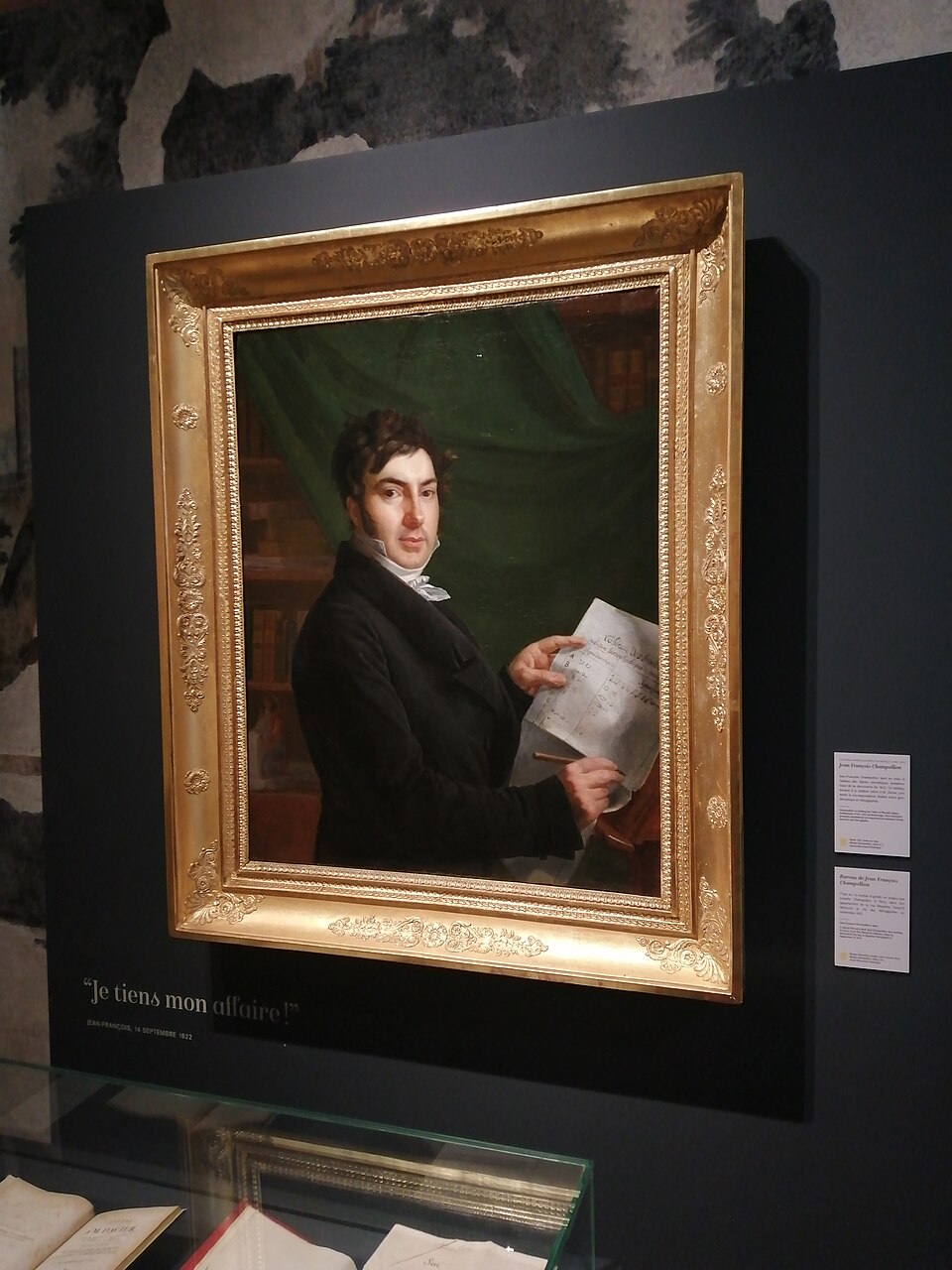
—So how do these hieroglyphs really work? Are they pictures or sounds?
Both at once, and that's the genius of it! In my Précis du système hiéroglyphique, in 1824, I showed that the same text could be figurative, symbolic, and phonetic. Let me explain simply. Sometimes a little drawing means the object itself: a drawing of the sun for the sun. Sometimes it means an idea. And sometimes — this is what they hadn't understood — it stands only for a sound, a letter, like in your alphabet. Imagine a writing where you could draw a bee to write the sound « b ». The Egyptians juggled these three games in a single sentence. What a marvel to untangle!
A single word could be at once an image, an idea, and a sound.
—Where did you work every day? What did your home look like?
You would have laughed coming into my home! Books everywhere, papyri, copies of inscriptions piled on my desk. From 1826, I also spent my days at the Louvre Museum in Paris. They had entrusted me with all the Egyptian antiquities, and I sorted them, classified them one by one. In the evening, I worked very late by candlelight — no other light in my time, you see. I compared signs with my magnifying glass until my eyes burned. My health was fragile, and these long vigils didn't help. But I was happy: around me slept the treasures of a people that no one could read anymore.
Around me slept the treasures of a people that no one could read anymore.
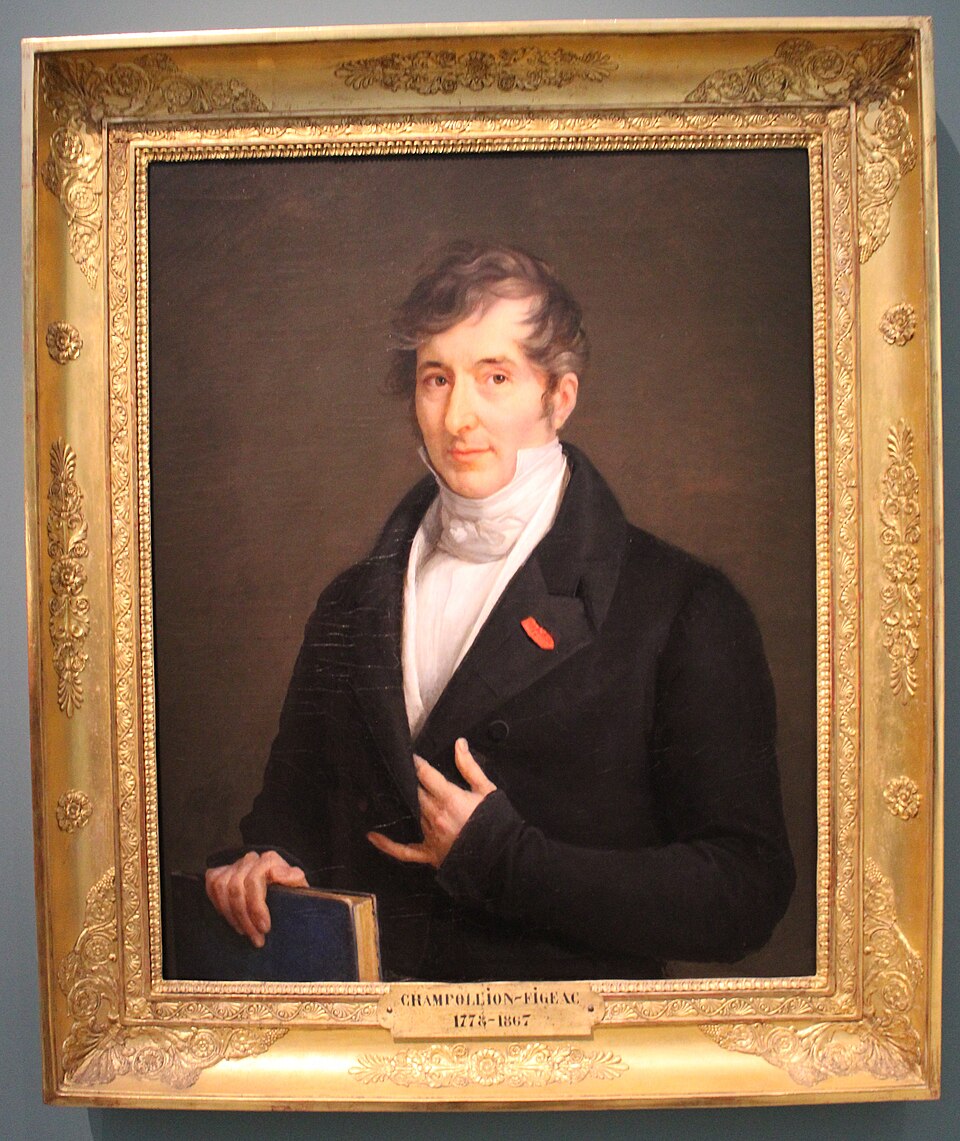
—Did you really go to Egypt one day?
Only once, my child, but what a journey! In 1828, I finally left, leading an expedition. For years, I had only touched copies and drawings. And then, suddenly, I was sailing up the Nile in a boat, the real river, with my notebooks to record everything! Imagine my joy: those inscriptions I had deciphered on paper, I could now read directly on the walls of the temples of Thebes. I wrote to my brother that nothing had been exaggerated by the ancients: the city was even larger than I believed. I was walking in my dream turned to stone.
I was finally walking in my dream turned to stone.
—Did you cry in front of a monument? That's what they say...
It's true, and I'm not ashamed. It was before the great temple of Abu Simbel, carved into the cliff. I approached the inscriptions engraved there for thousands of years. And I read them. You understand? Read them, like you read your schoolbook! Words that had been silent for so long began to speak again because of me. Emotion overwhelmed me, tears came on their own. Think of a child who finds the voice of a grandparent they thought lost. That was it, but for an entire civilization. In the Valley of the Kings, at Karnak, everywhere, I filled my notebooks, drunk with happiness.
Words silent for thousands of years began to speak again.
—And after you, what happened? Did people continue your work?
That's the most beautiful question. In 1831, they created for me the very first chair of Egyptology at the Collège de France — a chair is a special seat from which the scholar teaches. I was the first professor of a science that didn't exist before me! Alas, I was already very ill, and I only gave a few lectures. But I had left tools: a grammar and a dictionary of the Egyptian language, completed by my brother after my death. You see, I didn't just open a door. I gave the key to all who would come after. And you, perhaps, will one day read these signs in your turn.
I didn't just open a door: I left the key for those who would come.
This imaginary interview was generated by artificial intelligence from sources documented in Champollion's profile. It dramatises what the figure might have said based on what we know about them, but does not constitute attested historical testimony. For primary sources and factual documentation, refer to the full profile.