Kids interview Chen-Ning Yang
by Charactorium · Chen-Ning Yang · Sciences · 5 min read
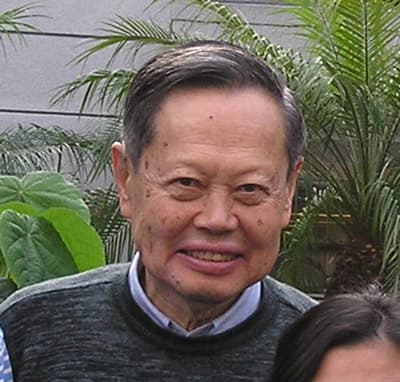
Two 12-year-old students visit a big lab with their discovery class. In a quiet room, a smiling old gentleman is waiting for them in front of a blackboard. He is Chen-Ning Yang, Nobel Prize winner in physics, and he has all the time in the world for them.
—Did you like math when you were little? Who taught you?
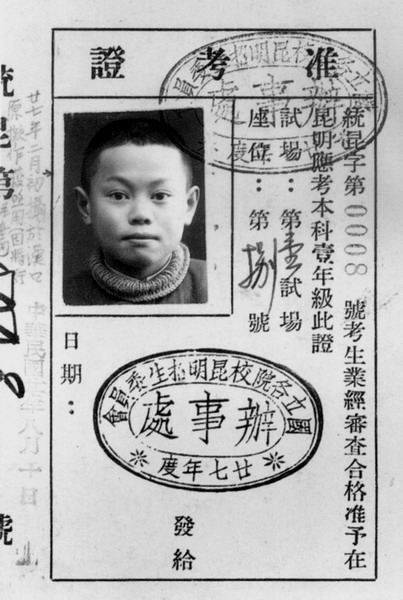
Yes, my child, I loved it very much. And I had a rare stroke of luck: my father, Ke-Chuan Yang, was a mathematician. Imagine a father who, instead of telling you a story at night, draws numbers and figures for you. That was my home. He never forced me. He just showed me that numbers hide very beautiful secrets. I was born in Hefei, China, in 1922. As a small child, I watched my father think in silence, pencil in hand. And I wanted to do the same. You see, you don't catch passion in a single lesson. You catch it by watching someone you love.
You catch passion by watching someone you love.
—What was it like to study during the war?
Hard, but unforgettable. In my time, Japan had invaded China. The universities fled south. We ended up in Kunming, in a makeshift school called Lianda. Imagine rooms with no real windows, sometimes no books, and the sound of planes in the distance. When the alarm went off, we ran to hide in the hills. Then we came back and picked up the lesson where we left off. Yet, you know, I never learned so much. Our teachers had lost everything except their knowledge. And that, no one could take from us.
Our teachers had lost everything except their knowledge.
—Is it true that a great scholar interrupted you in front of everyone?
It's true, and I still tremble a little at the memory. It was in 1954, at Princeton. I was presenting a new idea, what is called the Yang-Mills theory: a way to describe the forces of nature with symmetries. In the room was Wolfgang Pauli, a giant of physics. He interrupted me: “What is the mass of these particles?” A particle is a tiny grain of matter. I had no answer. He insisted. I was so ashamed that I stopped talking and sat down. A long silence. That day, I thought I had failed in front of the greatest minds.
I was so ashamed that I sat down in the middle of my talk.
—So was he right to bother you with his question?
He was right to ask it, yes. It was a real weakness in my idea. But you know what? It took almost twenty years to find the answer. Other scientists invented what is called the Higgs mechanism, which explains exactly where the mass of particles comes from. And suddenly, my whole 1954 theory became solid. Imagine a seed you plant. It looks dead, nothing grows. And twenty years later, it's a big tree. My theory was that seed. I learned that day that a good idea can wait. It is not in a hurry.
A good idea can wait: it is not in a hurry.
—What was your greatest discovery, the one that won the prize?
In 1956, with my friend T.D. Lee, we dared to do something crazy. All physicists believed in a law called parity conservation. Basically: nature would look the same in a mirror, left and right the same. No one doubted it, ever. We asked ourselves: what if it is false, for a certain force, the weak force that makes atoms transform? We wrote it up, and proposed an experiment to check. Imagine telling a whole class that two plus two might not equal four. That's the kind of audacity it took. And many thought we were crazy.
We dared to say that nature is not the same in a mirror.
—Were you afraid you had made a mistake in front of everyone?
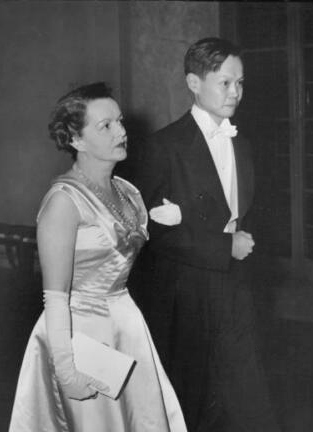
Terribly. The great Pauli, again, wrote to his friends that he was sure we were wrong. When such a scientist says that, your knees tremble. But a courageous female physicist, Chien-Shiung Wu, performed the experiment. She cooled atoms very, very strongly and watched how they transformed. And then, surprise: nature did NOT behave the same in the mirror. We were right! It was in 1957. The same year, we received the Nobel Prize. I was 35 years old. You see, I had been afraid for nothing... but that fear had pushed me to check every calculation carefully.
Fear did not stop me; it made me cautious.
—What does it feel like when an idea of yours becomes super important years later?
It is the most beautiful gift, and the strangest. My 1954 theory stayed in a drawer, almost forgotten, for a long time. People thought it was pretty but useless. Then, in the 1970s, it became the foundation of what is called the Standard Model: the big map that explains almost all the particles in the universe. Imagine you draw a plan, and no one looks at it. Then one day, a whole cathedral is built on top of it. I hadn't foreseen that. No scientist works thinking they will be proven right in twenty years. We just seek what is true.
We don't seek to be right later; we seek what is true.
—Did you find other things that bear your name?
Yes, a nice surprise in 1967. I was studying groups of particles colliding, a real puzzle. I discovered a relation, a small mathematical rule, now called the Yang-Baxter equation. At the time, I thought I was solving just one problem. But years later, it turned up everywhere: in knot theory, in other worlds of mathematics. Imagine you invent a key for one door, and later find it opens ten different doors. That moved me greatly. Nature likes to repeat its most beautiful ideas in places you least expect.
Nature repeats its most beautiful ideas where you least expect them.
—Why did you go back to live in China when you were old?
In 2003, I was 81 years old. I could have stayed quietly in America, where I had lived for a long time. But my heart pulled me toward China, my birthplace. I settled at Tsinghua University in Beijing. Do you know why? To pass on knowledge. An old scientist is not just memories: he is also a hand reaching out to the young. I wanted to help a new generation of Chinese physicists grow. Imagine an old tree giving its seeds to a young forest. That is what I wanted to be. You don't keep your knowledge in your pocket. You give it back.
You don't keep your knowledge in your pocket: you give it back.
—If you had one piece of advice for us, what would it be?
Just one, my child, very simple. Don't be afraid to be wrong. Look at my life: I was cut off mid-speech by Pauli, I doubted, I was afraid of being wrong with T.D. Lee. But each time, it was my crazy questions that moved me forward. The greatest discoveries begin with a sentence everyone thinks is stupid: “What if it's wrong?” In my time, we worked with blackboards and notebooks, without machines to think for us. What mattered was the courage to ask the question. That courage is already in you. Keep it all your life.
The greatest discoveries begin with: what if it's wrong?
This imaginary interview was generated by artificial intelligence from sources documented in Chen-Ning Yang's profile. It dramatises what the figure might have said based on what we know about them, but does not constitute attested historical testimony. For primary sources and factual documentation, refer to the full profile.