Imaginary interview with Chen-Ning Yang
by Charactorium · Chen-Ning Yang · Sciences · 6 min read
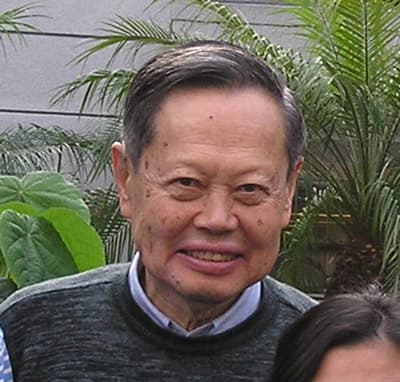
Autumn at Tsinghua University in Beijing. In a bright office where the wind rustles the foliage, a man in his eighties receives us, his voice calm, his eye still lively with the symmetries that have accompanied him all his life. Behind him, a blackboard patiently awaits his equations.
—Did you first feel destined for mathematics or physics?
For mathematics, without hesitation. My father, Ke-Chuan Yang, was a mathematician, and it was he who initiated me as a child, around a table, to figures and numbers, long before I understood what they would be used for. I kept from him this taste for pure form, for proof that stands on its own. But physics seduced me because it offered something that mathematics alone does not: a dialogue with nature. The gauge fields that I later loved are, at bottom, mathematical objects that the material world deigned to adopt. For a long time I stood on this frontier, one foot in the abstraction inherited from my father, the other in the reality of particles.
One foot in the abstraction inherited from my father, the other in the reality of particles.
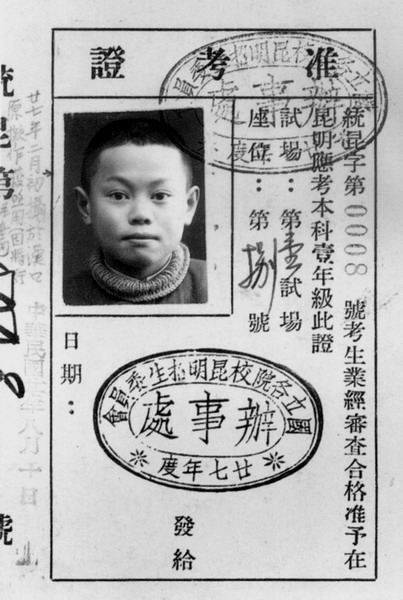
—How did one study physics in Kunming, in the midst of the Sino-Japanese War?
In destitution, and yet I never learned better. At Kunming, the National Southwestern Associated University was only a makeshift assembly of refugee professors from the north, driven out by the Japanese advance. The roofs leaked, books were scarce, and sometimes we heard the air-raid sirens. But around us gathered some of the finest scientific minds in China, concentrated there as if by a tragic accident of History. We discussed quantum mechanics on wooden benches, we copied rare articles by hand. This very scarcity made us eager. I understood then that intellectual intensity does not depend on comfort, but on the presence, around you, of men who think with fervor.
Intellectual intensity does not depend on comfort, but on the fervor of those around you.
—What do you remember from your doctoral years in Chicago?
The feeling of having entered the very hearth of modern physics. I arrived in the United States in 1945, and at the University of Chicago I prepared my thesis under the direction of Edward Teller, in the circle of Enrico Fermi. Fermi had this way of reducing the most complex problem to an estimate scribbled in an instant, almost on a corner of a table, with a slide rule. I wanted to be a pure theorist, but Chicago taught me never to despise experiment or order of magnitude. It was also there that I met T.D. Lee, with whom I would share some of the most beautiful intellectual adventures of my life.
—Tell us about that Princeton seminar in 1954, where Pauli interrupted you.
I can see it as if it were yesterday. We were at the Institute for Advanced Study, in front of the blackboard, and I was presenting with Robert Mills our idea of non-abelian gauge fields. Wolfgang Pauli, sitting in the room, cut me short: what is the mass of these gauge particles? I had no answer. I insisted for a moment, he asked again, and faced with his insistence I finally sat down, unable to continue under the perplexed looks of the audience. It was a terrible question, because it touched the weak point of the whole theory. It took nearly twenty years and the Higgs mechanism to answer it. Pauli had seen correctly about the difficulty; he had not seen that the difficulty was worthwhile.
Pauli had seen correctly about the difficulty; he had not seen that it was worthwhile.
—Why did the Yang-Mills theory remain in the shadows for so long?
Because it was beautiful but orphaned. In 1954, our paper in Physical Review proposed a local symmetry richer than any known, a non-abelian symmetry where the order of operations changes the result. But we had no concrete particles to offer it, no mass, no verifiable prediction. So it was long regarded as an elegant but useless mathematical curiosity. It was only in the 1970s, when the Standard Model of particles was built, that we understood it was the framework. I had the rare luck to see, in my lifetime, an idea judged sterile become the foundation of an entire discipline.
—Do you remember the moment when you dared to doubt the conservation of parity?
1956. With T.D. Lee, we were examining those decays that resisted all explanation, and a slow realization dawned: what if, in weak interactions, nature does not behave the same way in a mirror? The conservation of parity was held as absolute, a law that no one thought to question. We wrote that it had never really been tested in this domain, and we proposed experiments to decide. Believe me, the audacity was not in the theory; it was in the nerve to tell an entire community that its certainty was only a habit. We simply asked that one look, instead of believing.
The audacity was not in the theory: it was in saying that a certainty was only a habit.
—How did you experience Pauli's skepticism toward this prediction?
Pauli was convinced we were wrong. He wrote to his colleagues, he almost refused to consider the experiment, so much did he hold mirror symmetry sacred. Yet he was not a narrow mind, far from it — he was one of the greatest, a Nobel laureate himself. That is what made his opposition so formidable. Then came Chien-Shiung Wu and her experiment on beta decay, at low temperature, which spectacularly confirmed our prediction. The mirror lied: nature distinguishes left from right. I learned that day that no authority, however high, replaces a measurement. The certainty of a giant weighs nothing against a counter that clicks differently than expected.
The certainty of a giant weighs nothing against a counter that clicks differently than expected.
—The Nobel Prize came to you at thirty-five, barely a year after the paper. How did you feel?
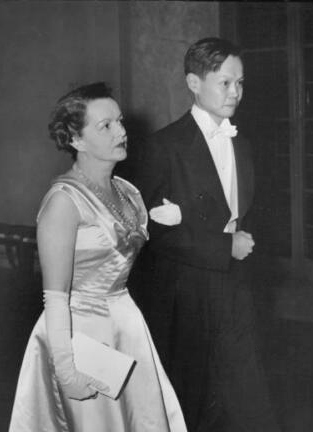
Stupefaction, as much as joy. In 1957, barely twelve months after publication, Lee and I went up to receive the Nobel in physics — one of the shortest delays ever seen between a prediction and its reward. I was thirty-five. In my lecture, I recalled how the law of parity conservation had been almost universally accepted, while evidence came only from gravitational, electromagnetic, and strong forces, never really from the weak interaction. It was dizzying: to see a theoretical intuition become, in so short a time, an established fact. But I already knew, deep down, that the blackboard of Princeton had offered me something more lasting than a medal.
—Much is said about parity, but another of your equations emerged almost by surprise. Tell us.
Yes, and it is in a sense even dearer to me. In 1967, I was working on a one-dimensional many-body problem, particles repelling each other via a point interaction — an arid subject in appearance. While looking for exact solutions, I stumbled upon a consistency relation, a condition that scatterings must satisfy for everything to fit together. I did not then realize that it would be called the Yang-Baxter equation, nor that it would become a pillar of integrable physics, knot theory, exactly solvable systems. Already in 1952, with Lee, our work on phase transitions had that same flavor: a hidden mathematical structure beneath a physical problem. That is my mathematician side resurfacing.
A hidden mathematical structure beneath a physical problem: that is my mathematician side resurfacing.
—You are a Chinese-American physicist at the heart of the Cold War. How did you bear this dual belonging?
As a permanent line of tension. I built my career in the America of the Korean War and Sputnik, when every discovery became a stake of supremacy between East and West, and I was a son of China working at the heart of that rivalry. I was sometimes viewed with suspicion, from both sides. In 1971, I was one of the first Chinese-American scientists to return to the People's Republic of China, after decades of rupture. That trip moved me deeply: to rediscover the land of Hefei where I was born, while having become a man from the other world. I have always refused to make science a weapon. It belongs to everyone, or it is no longer science.
I have always refused to make science a weapon: it belongs to everyone, or it is no longer science.
—In 2003, you chose to return permanently to China. What does this return mean to you?
A circle closing. At eighty-one, I left the United States to settle at Tsinghua University in Beijing, where I am speaking to you today. After Chicago, Princeton, then the institute I had founded at Stony Brook, I needed to return to the country that had seen me born in Hefei and grow up in Kunming under the bombs. I am not returning to rest: I want to transmit, to train a generation of young Chinese physicists, to show them that a patient idea can change the face of a discipline. A life, like a gauge theory, takes on its meaning only once one perceives its overall structure. Mine has been a long journey between two shores.
A life, like a gauge theory, takes on its meaning only once one perceives its overall structure.
This imaginary interview was generated by artificial intelligence from sources documented in Chen-Ning Yang's profile. It dramatises what the figure might have said based on what we know about them, but does not constitute attested historical testimony. For primary sources and factual documentation, refer to the full profile.