Imaginary interview with Christina Rossetti
by Charactorium · Christina Rossetti (1830 — 1894) · Literature · 5 min read
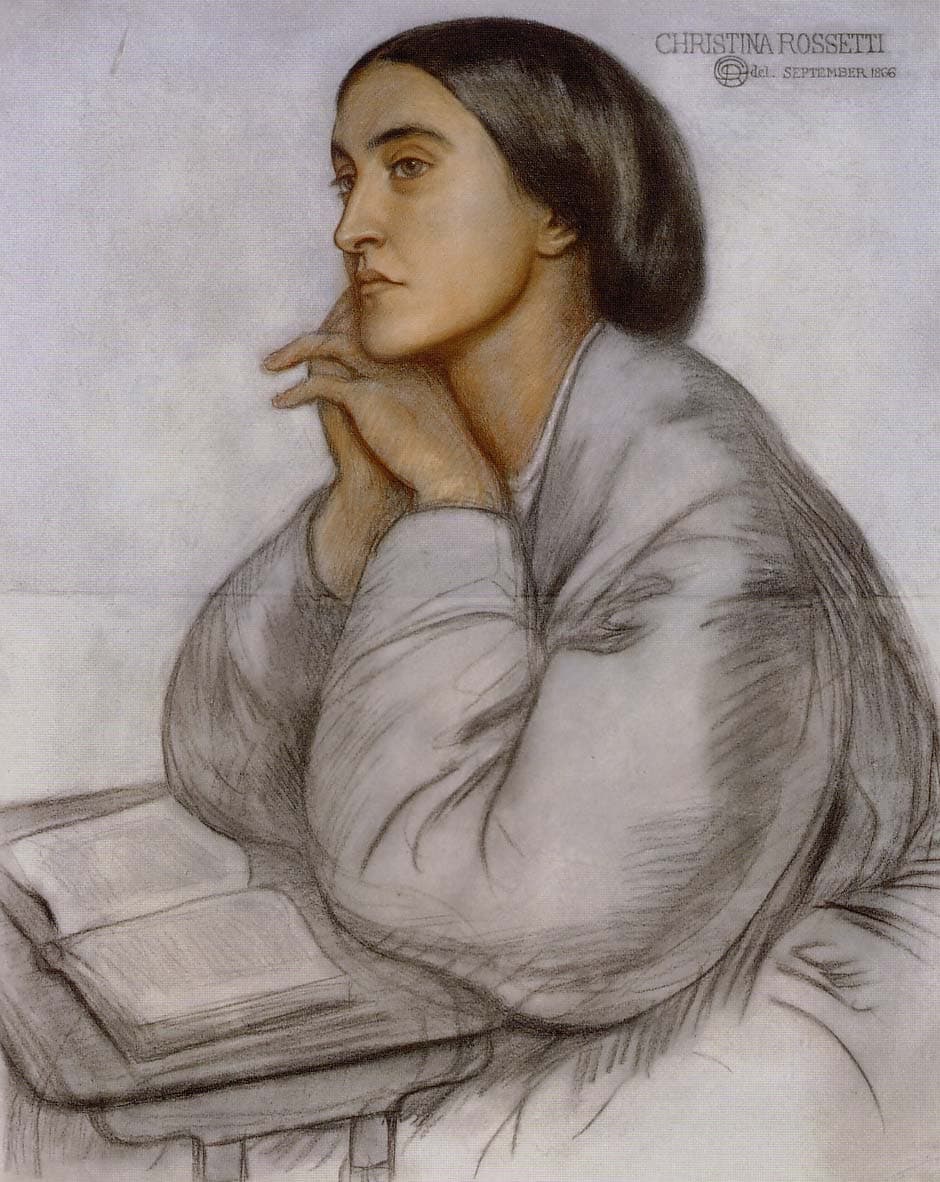
Late December afternoon at 30 Torrington Square, Bloomsbury. The gaslight is low, a coal fire glows, and on the table an annotated Bible sits next to sheets covered in fine handwriting. Wrapped in a dark shawl, Christina Rossetti rarely receives visitors—but she has consented to this conversation.
—Do you remember the day your brother asked you to pose as the Virgin Mary?
It was 1850, I was nineteen, and Gabriel had that way of looking at you as if you were already a painting before being a sister. He was painting Ecce Ancilla Domini and he needed a Mary who had nothing of a queen—a young girl surprised, almost frightened by the angel. I stood still for hours, my back against the cold wall of his studio, feeling my arms go numb. The Pre-Raphaelite Brotherhood liked to lend our ordinary faces to holy figures; they believed that by returning to a sincerity before Raphael, they touched something true. I mostly thought the Annunciation was not a pose, but a vertigo—and that no painting could ever capture its trembling.
He looked at me as if I were already a painting before being a sister.
—Did you enjoy this role of model within the Pre-Raphaelite circle?
Enjoy is not the word. There was in that Brotherhood founded in 1848 a fervor of young people who wanted to remake everything—painting, poetry, the world. I published my first verses in their journal, The Germ, under the name Ellen Alleyn—because a woman signing her own name, back then, raised eyebrows. Posing, writing in the shadow of a pseudonym, meant staying at the threshold of a room where men spoke loudly. I observed much, I said little. I was thought reserved; I was mostly attentive. What I kept to myself ended up on paper, at night, by pen, when the house slept and I could finally speak at full voice.
—How did you react when critics took Goblin Market for a simple children's story?
Goblin Market and Other Poems appeared in 1862, and I was amused, a little, by the embarrassment it caused. People saw goblins selling fruit—"Come buy our orchard fruits, / Come buy, come buy"—and wondered whether to read it to children or hide it from adults. Some cried allegory of temptation and redemption; others doubted a woman could have written that incantatory rhythm. I never cared to settle it. A poem that lets itself be fully explained is a dead poem. I wanted Laura and Lizzie to be sisters even in fault and redemption—the rest, the moral or the thrill, belongs to the reader, not the writer.
A poem that lets itself be fully explained is a dead poem.
—What do you say to those who judged your imagery too sensual for a female pen?
That they confused the flesh with truth. Yes, my goblins have juice-laden fruits, yes, Laura stains her lips; but the temperance I practiced in my life did not oblige me to impose it on my verses. In the Victorian era, people believed a lady should write only the tepid and proper. Yet temptation, to be fought, must first be made desirable—otherwise what merit in resisting it? I had read Keats and Tennyson too closely to ignore that a verse is tasted as much as understood. What I refused in a drawing room, I could write with my pen: there is the singular freedom of the poem, that place where one dares what life forbids.
Temptation, to be fought, must first be made desirable.
—You declined two marriage proposals. How did you come to those refusals?
Twice I said no, and twice for the same reason, which was not lack of love. In 1850, the painter James Collinson had returned to Roman Catholicism, and I could not follow him there; in 1866, Charles Cayley, that gentle linguist, did not share my faith. My parish of Christ Church, Albany Street, my Anglo-Catholic leaning, were not habits for me but the backbone of my days. Marrying a man whose soul did not walk in step with mine would have been building on sand. I preferred solitude to that compromise. People sometimes pity me; they are wrong. That renunciation was a choice, and it nourished every melancholy verse they know me by.
I preferred solitude to the compromise of a soul that did not walk in step.
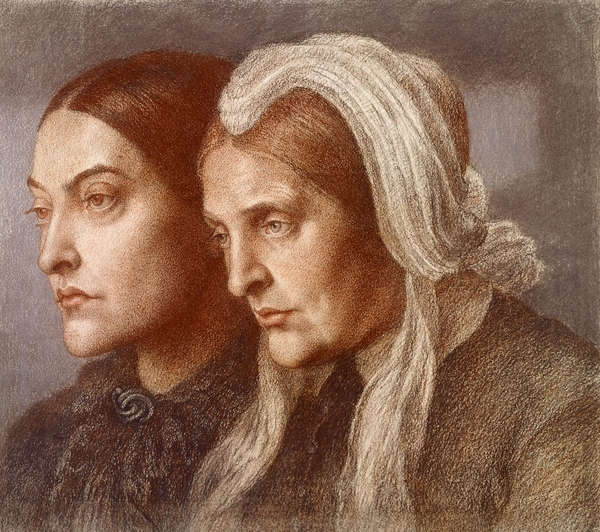
—How did this renunciation of earthly love run through your poetry?
It is the ground bass. In A Pageant and Other Poems, in 1881, I gathered the fourteen sonnets of Monna Innominata—a nameless woman who loves and withdraws, like the Petrarchan sonnets whose form I inherited. Petrarch sang Laura from afar; I wanted to give voice to the one never sung, the beloved become poet of her own renunciation. You can feel the memento mori that never left me: human love is true, but always measured against the eternal. To renounce is not not to love—it is to love knowing that nothing here below lasts, and to say it low enough that it remains.
—Several afternoons a week, you went to the St. Mary Magdalene Home in Highgate. What were you seeking there?
Not to save—that word is too big. I went to Highgate, to that house that took in what the age called fallen women—girls who had ended up on the street, whom they wanted to rehabilitate. I sat near them, I listened, I helped with needlework. Victorian society liked to draw a sharp line between the honest woman and the fallen one; I saw up close how thin that line was, often hinging on a dead father, a lost job, a single misstep. My Bible taught me that Christ did not turn away from Mary Magdalene; how could I? Those faces left their shadow in my verses more surely than any Bloomsbury drawing room.
That line between the honest woman and the fallen one, I saw how thin it was.
—How did these women change your view of the condition of women in your time?
They stripped me of all innocence about what a reputation was worth. A governess I briefly was, a poetess published under a pseudonym, a penitent of Highgate: we were all held by the same thread, that of a world that forgave women little and men much. I was not one to mount platforms—my temperament inclined me to withdrawal, to reverie rather than speech. But I believe compassion is also a politics, silent. In Goblin Market, when Lizzie offers herself to redeem her sister, it is no accident: I put into it all that those women had taught me about solidarity among those the world has judged.
—Illness struck you in 1871. How did it transform your work?
In 1871, Graves' disease disfigured my face—protruding eyes, altered skin—so that I sometimes wore a veil, I who had never liked being looked at. The social world closed of itself, and I did not much regret it. Here, at 30 Torrington Square, my days narrowed around morning prayer, the pen, the fire. What the body lost in radiance, devotional writing gained in depth. People think retreat impoverishes; it returned me to the essential. I no longer wrote for the drawing room or the journal, but for that inner conversation that would never turn its back on me.
What the body lost in radiance, devotional writing gained in depth.
—Your final years were devoted to a vast commentary on the Book of Revelation. Why that book?
Because it looks death in the face and passes through it. The Face of the Deep, in 1892, was born at the same time I was diagnosed with cancer; I was commenting on Saint John's Revelation while my own end was approaching, and I saw no irony, only fitness. I wrote there that "Love is the great Motive Power; Love Divine originates, sustains, and will consummate all things"—that is all my faith held in one sentence. Biblical typology, those echoes between the Old and New Testaments, had accompanied me since childhood. At the hour of departure, I needed a text vast enough to contain terror and hope together. Revelation was that book: the end that, for a Christian, is a beginning.
I was commenting on the end of the world while my own end was approaching—and saw no irony.
This imaginary interview was generated by artificial intelligence from sources documented in Christina Rossetti's profile. It dramatises what the figure might have said based on what we know about them, but does not constitute attested historical testimony. For primary sources and factual documentation, refer to the full profile.