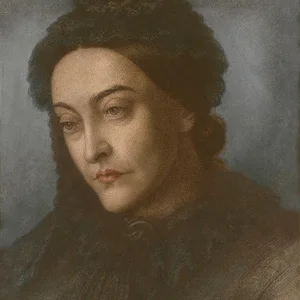

British poet of the nineteenth century and a leading figure of the Pre-Raphaelite movement. Author of Goblin Market (1862), a poetry collection blending symbolism and religious fervour. Her work explores love, death, and Christian faith with remarkable lyrical sensitivity.
Christina Rossetti(1830 — 1894)
Christina Rossetti
Royaume-Uni de Grande-Bretagne et d'Irlande
9 min read
Frequently asked questions
Famous Quotes
« Does the road wind up-hill all the way? / Yes, to the very end.»
« My heart is like a singing bird.»
Key Facts
- Born on 5 December 1830 in London, into a family of artists and intellectuals.
- Publication of Goblin Market and Other Poems in 1862, her most celebrated work.
- Sister of the painter and poet Dante Gabriel Rossetti, co-founder of the Pre-Raphaelite Brotherhood.
- Author of numerous devotional poems, deeply shaped by Anglican faith.
- Died on 29 December 1894 in London, leaving behind a substantial body of poetry.
Works & Achievements
Rossetti's first major poetry collection, dominated by the long narrative poem 'Goblin Market'. This text — blending fairy-tale imagery, religious symbolism, and feminist themes — is considered her masterpiece and one of the great Victorian poems.
Her second major collection, centred on an allegorical poem in which a prince arrives too late to save his beloved. The work explores themes of lost time, procrastination, and death that are central to Rossetti's poetry.
A collection of nursery rhymes and children's poems, illustrated by Arthur Hughes. Deceptively simple, these texts blend childhood joy with adult melancholy, demonstrating Rossetti's gift for reaching audiences of all ages.
A late collection containing the sonnet sequence 'Monna Innominata', often read as a meditation on impossible love and renunciation. This cycle of fourteen sonnets stands as one of the high points of Victorian women's love poetry.
A vast mystical and devotional commentary on the Book of Revelation, interspersed with original poems. This mature work reveals the depth of Rossetti's spiritual life and her biblical scholarship.
A Christmas poem of great lyrical beauty, published posthumously and set to music by Gustav Holst. It has become one of the most beloved carols in the English-speaking world, carrying Rossetti's voice to millions.
Anecdotes
Christina Rossetti herself served as a model for several Pre-Raphaelite paintings. Her brother Dante Gabriel painted her as the Virgin Mary in 'Ecce Ancilla Domini' (1850). This practice of painting loved ones as biblical or mythological figures was characteristic of the Pre-Raphaelite movement, which sought to recapture the sincerity of art predating Raphael.
Christina Rossetti turned down two marriage proposals for religious reasons. She declined the painter James Collinson in 1850 because he had converted back to Catholicism, and refused the linguist Charles Cayley in 1866 because he was not a practising Christian. She preferred to remain unmarried rather than compromise her Anglican convictions, a choice that profoundly shaped the melancholic tone of her poetry.
In 1862, the publication of 'Goblin Market' caused a genuine literary sensation. This long narrative poem, seemingly a children's tale, was interpreted by critics as an allegory of temptation, redemption, and female solidarity. Its incantatory rhythm and sensual imagery were so unusual that many doubted a woman could have written it.
For several years, Christina Rossetti volunteered at the St Mary Magdalene House of Charity in Highgate, a Victorian institution that helped women who had fallen into prostitution reintegrate into society. This experience deepened her social compassion and is reflected in some of her poems, notably 'The Fallen Woman' and her meditations on the condition of women.
Her poem 'In the Bleak Midwinter', written around 1872 and published posthumously, became one of the most widely sung Christmas carols in Britain. Set to music by Gustav Holst in 1906, it regularly tops polls of favourite British Christmas hymns — making Christina Rossetti a poet found in millions of homes, though few know her name.
Primary Sources
Morning and evening / Maids heard the goblins cry: / 'Come buy our orchard fruits, / Come buy, come buy.'
Too late for love, too late for joy, / Too late, too late! / You loitered on the road too long, / You trifled at the gate.
What are heavy? Sea-sand and sorrow. / What are brief? Today and tomorrow. / What are frail? Spring blossoms and youth. / What are deep? The ocean and truth.
I want to be a Poetess of my acquaintance — a far better Poetess than I shall ever be — and yet she is not satisfied.
Love is the great Motive Power; Love Divine originates, sustains, and will consummate all things.
Key Places
Christina Rossetti was born in 1830 in this house in the Fitzrovia neighbourhood of London, where her father, a professor of Italian, had settled the family. It was in this cosmopolitan and literary environment that she grew up surrounded by poets and artists.
Christina lived in this Bloomsbury house from 1876 until her death in 1894, first with her mother and then alone after her mother's passing. It was here that she wrote her final works, receiving few visitors due to her illness.
An Anglo-Catholic parish that Christina Rossetti attended devotedly throughout her life. Her deep faith and parish commitments — including volunteer work with women in hardship — were rooted in this religious community in Camden Town.
Christina Rossetti is buried in this famous Victorian cemetery in London, in the same grave as several members of her family. Highgate is also home to the tomb of Karl Marx and stands as a landmark of Victorian funerary heritage.
Christina stayed several times at this medieval castle belonging to her brother's friend, Alice Boyd. These Scottish retreats allowed her to recharge and write in a romantic, secluded setting, far from the tensions of London life.
Liens externes & ressources
Références
Œuvres
Goblin Market and Other Poems
1862
The Prince's Progress and Other Poems
1866
Sing-Song: A Nursery Rhyme Book
1872
A Pageant and Other Poems
1881
The Face of the Deep
1892
In the Bleak Midwinter (poème)
vers 1872, publié 1904