Imaginary dialogue between Elisa Lispector and Clarice Lispector
by Charactorium · Clarice Lispector (1920 — 1977) · Literature · 6 min read
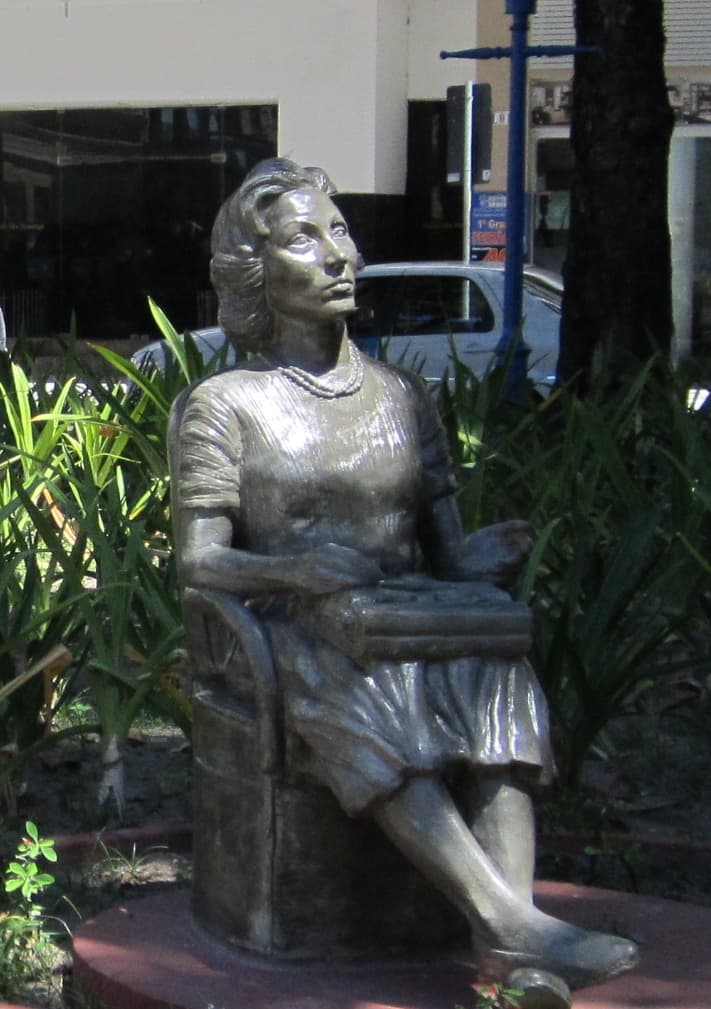
It is a humid late-autumn afternoon in 1976, in the Leme apartment where the window lets in the steady sound of the Copacabana sea. On the table, an Olivetti typewriter waits beside an already full ashtray and a few still-fresh canvases leaning against the wall. Elisa Lispector, the elder sister, has come to see her sibling as she has so many times since their childhood in Recife — they have crossed together the Ukraine they left, the mourning of their mother, and that Portuguese language neither of them received at birth. She comes not as a journalist, but as a confidante who would like, this time, to make Clarice say what she usually keeps quiet.
—Clarice, you remember we were carried out of Tchetchelnik when you were only two months old. What remains in you of that Ukraine you never saw?
Nothing and everything, Elisa. I keep no image, no face, no cold — and yet that is where my strangeness comes from. You know better than anyone: we left because they were killing our people, because the pogroms left no choice. I grew up in Recife believing Portuguese was my language, and it is, deeply, but like a house we inhabit without having built it. I write in a language that was not promised to my mouth. Perhaps that is why words never seem obvious to me: I have to conquer them one by one. This distance is not a wound. It is my vantage point. I look at Portuguese as one looks at a beloved face one hasn't finished understanding.
I write in a language that was not promised to my mouth.
—When Mom died, in Recife, we were still almost children. Do you think that loss deepened your need to write?
I think so, but not as a consolation. Our mother ill, and the three of us around her, powerless — I understood very early that there are pains no words can touch, and that it is precisely there that one must write. Not to heal: to stay standing. You wrote to me once, in one of our letters, that I must be afraid of writing and do it anyway. Writing is a way of having courage. That sentence still follows me. The void is not filled, Elisa; it becomes an ear tuned to the silence of others. My ordinary women who experience a sudden revelation in the middle of their kitchen — these are ways of saying that the essential makes no noise.
Writing is a way of having courage.
—In 1943, on the very day of your first novel, you married Maury. Then came Berne, Washington. How did you live those years away from us?
Like a gilded exile, and the gold changes nothing. In Berne, in that too-clean, too-silent Switzerland, I walked for hours without meeting a voice that resembled mine. In Washington later, it was another solitude, more worldly, where I was asked to be the wife of a diplomat while I could only be myself, awkwardly. I missed you terribly, you and Tânia, and our letters were my true homeland. But this solitude nourished my writing. It was there, in that isolation, that I carried A Maçã no Escuro, the story of a man who flees and tries to rebuild himself. I wrote so as not to disappear. When I finally returned permanently to Rio, in 1959, I felt as if I had found my own language again in the mouths of passersby.
I missed you terribly, and our letters were my true homeland.
—Your separation, returning alone with the boys to Rio — forgive my question, but did you feel liberated or amputated from a life?
Both at the same time, and that is what is hard to admit, even to you. A woman who returns alone with her children, in those days, is looked at as something damaged. I felt that look. But for the first time in years, my days belonged to me. I could write at night without having to explain why, receive whomever I wanted, devote myself to journalism and my texts without asking permission. It was not the joyful freedom of posters — it was something harsher, truer. I prefer a solitude that belongs to me over a company that dilutes me. You saw me at that time, Elisa, tired and yet more myself than ever. The loss had opened a space I immediately filled with words.
I prefer a solitude that belongs to me over a company that dilutes me.
—You were compared very early to Virginia Woolf, to Joyce, for that stream of consciousness. Do you recognize this kinship, you who read Woolf?
They stuck it on my back before I had even really read her, believe it or not. Later, yes, I read Woolf, and I recognized a distant sister, someone who followed the parade of thoughts without wanting to put them in order. But I distrust labels. 'Stream of consciousness' is a school word for something much simpler and much more terrible: trying to write thought as it forms, before it lies. I don't tell well-combed stories; I follow the inner movement. You know as well as I do that our real lives don't follow the order of chapters. If my sentences hesitate, correct themselves, it's because they imitate the way we actually live: by groping.
Writing thought as it forms, before it lies.

—In A Paixão Segundo G.H., your heroine collapses before a simple cockroach. How does such a lowly creature lead to God?
Because God, if there is one, is in the infinitesimal and not in the grandiose. This woman, alone in her room, crushes a cockroach and sees a white matter gush out — and her entire constructed world collapses. She loses what she thought essential and discovers she can do without it, that she even makes herself unnecessary to herself. This is not a religious story, Elisa, you who knew our childhood prayers and our silent Judaism. It is a mysticism without a temple. I wanted to touch the sacred where no one looks for it: in disgust, in the lowest thing. One had to descend to the cockroach to reach something immense. Repulsion and ecstasy are neighbors. It is the text that cost me the most, and freed me the most.
God, if there is one, is in the infinitesimal and not in the grandiose.
—I will never forget the call that December night in 1966. Will you tell me what happened, and how you have lived with your hand since?
I had fallen asleep with a lit cigarette in my hand — you know my vice, you scolded me enough for it. The fire started in the bedroom, and when I tried to save my papers, my right hand burned. My writer's hand, Elisa. I spent weeks in the hospital, they talked about amputation, I felt that fear, icy. It remained, deformed, painful, but it remained. I had to relearn how to hold a pen, to hit the keys differently. I did not stop writing for a single month. The pain became a work companion. One thinks a writer only needs his head; that night reminded me that I also write with a body that can burn.
I also write with a body that can burn.
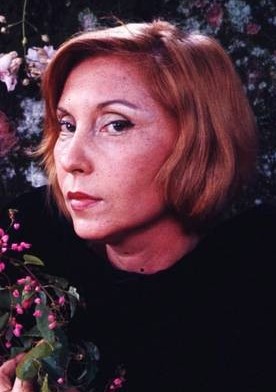
—And since the fire, you have taken up painting. What do you seek on the canvas that words do not give you?
Silence, perhaps. With colors, I don't have to make sentences, justify, chain things. I put the material directly on the canvas, sometimes with my fingers, and something passes without detour. After the accident, painting was first a therapy for that stubborn hand, a way to force it to move. Then it became something else: another language to explore the invisible, the very one I hunt in my books. Painting gives me the pure instant, without narrative. That is exactly what I am trying to write right now, a text that would be like a canvas, where each sentence would be a touch of color thrown onto the present. Words always want to tell a story; color, however, is content to be. I envy that.
Color, however, is content to be. I envy that.
—You are working, you told me, on the story of a poor girl from the Northeast, in Rio. Why that woman, so far from your interior heroines?
Precisely because she is far, and that distance makes me ashamed. Macabéa, I call her: a northeastern typist who came to Rio, without beauty, without a future, without even knowing she is unhappy. For years I wrote women who experience great inner revelations. But this one does not know she has an inner life. She is one of those people we pass without seeing, as we saw as children the misery of the Northeast around Recife. I wonder by what right I, the established writer, tell such a creature. This book questions my own responsibility toward those no one looks at. It is funny and heartbreaking at the same time, because life is. Writing Macabéa is making an invisible woman visible.
Macabéa does not know she has an inner life.
—You say 'making an invisible woman visible.' Do you really believe literature can do something for the Macabéas of this world?
I don't know, Elisa, and it is honest to tell you rather than a journalist. Literature feeds no one, houses no one. A young girl from the Northeast will probably never read the book in which I tell her story. But perhaps the person who passes her on the street, after having read me, will see her for one second longer. It is ridiculous, and it is all I can do. I don't write to save the world — I don't have that power. I write because I can't help it, it's like breathing. If a single consciousness expands, then the gesture will not have been in vain. The rest belongs to mystery, like everything that truly matters in our lives.
Perhaps the person who passes her, after having read me, will see her for one second longer.
This imaginary interview was generated by artificial intelligence from sources documented in Clarice Lispector's profile. It dramatises what the figure might have said based on what we know about them, but does not constitute attested historical testimony. For primary sources and factual documentation, refer to the full profile.