Kids interview Clovis
by Charactorium · Clovis (466 — 511) · Politics · 6 min read
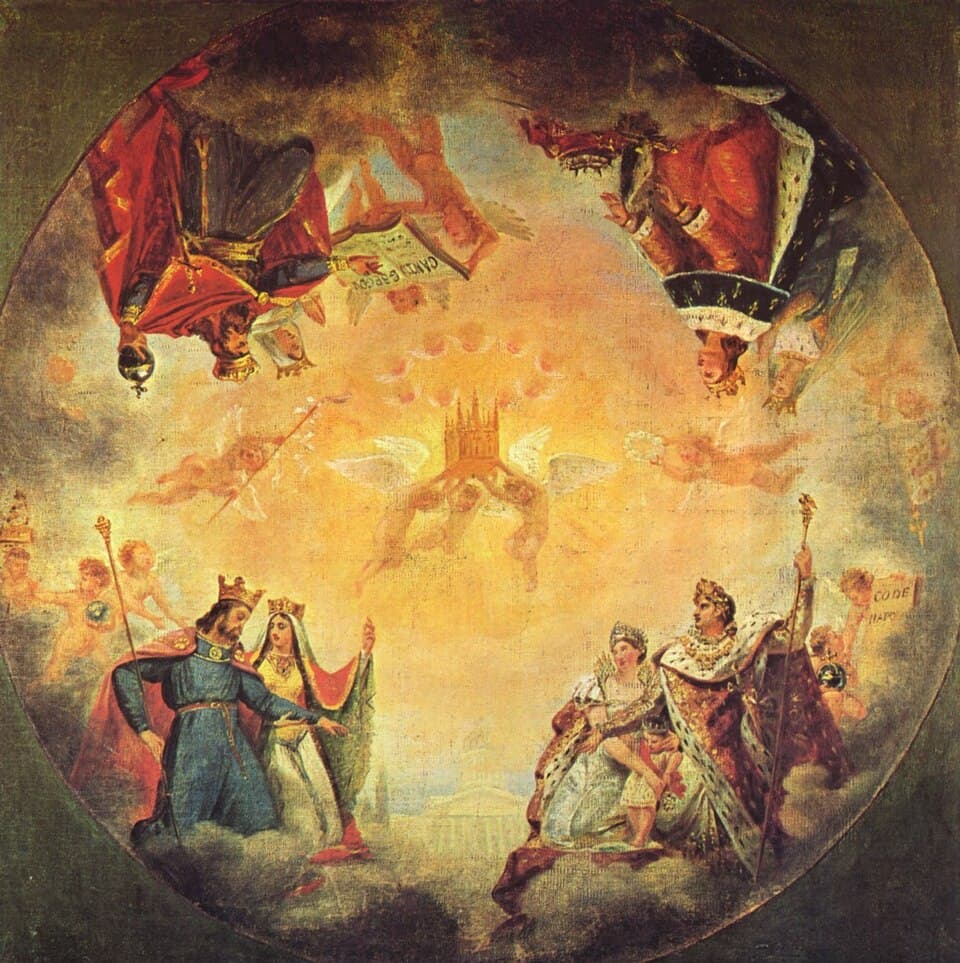
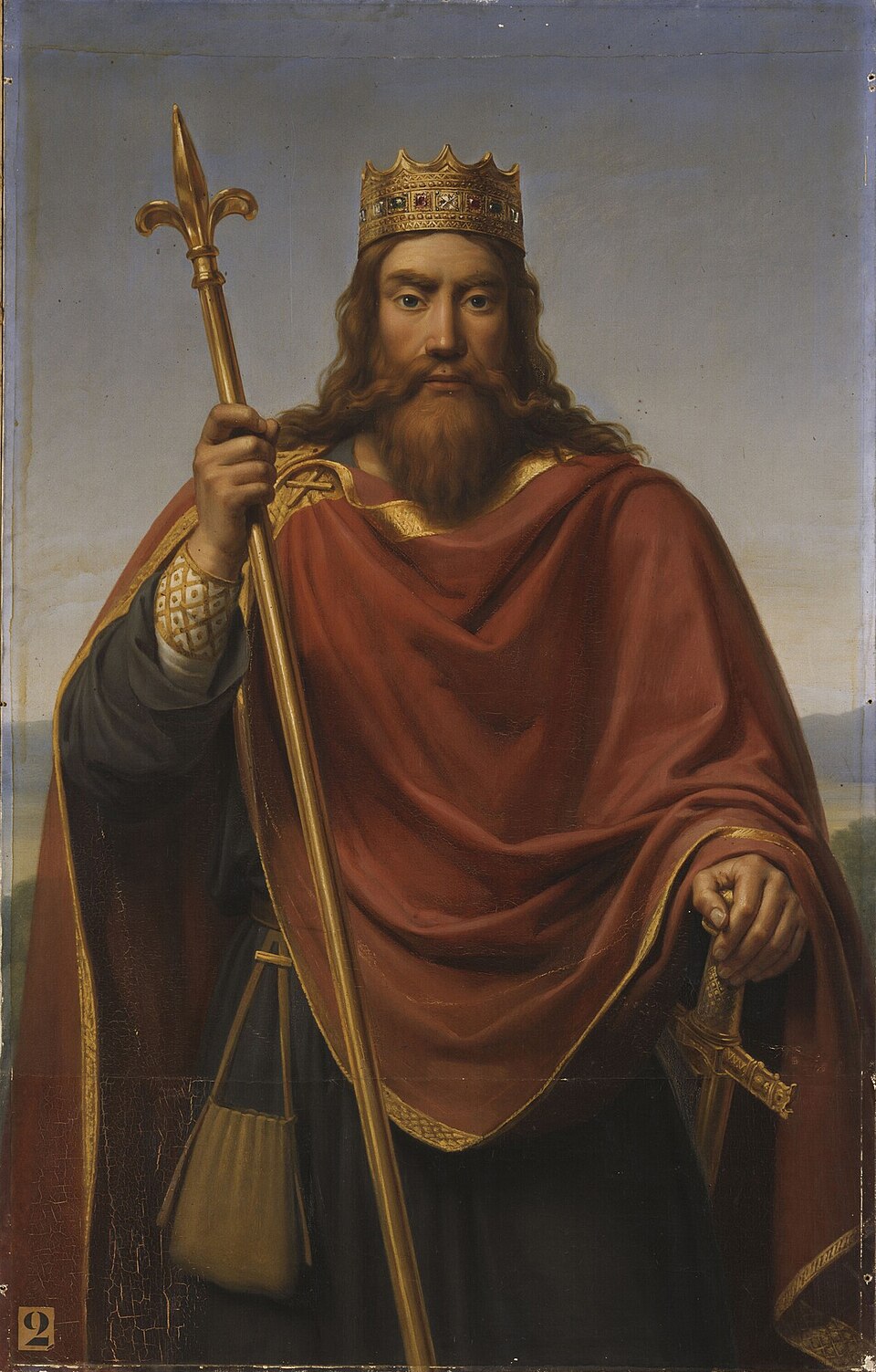
That morning, two young visitors on a school field trip pushed open the door of an old stone-walled villa. A long-haired man in a purple cloak greeted them with a smile. It was Clovis, King of the Franks, and he had agreed to answer all their questions.
—How old were you when you became king of the Franks?
You know, my child, I was barely older than you. Childeric, my father, died in 481, and I found myself king in Tournai at only about fifteen. Imagine: you are entrusted with an entire people of warriors while you are still learning to wield an axe! I was king of the Salian Franks, that is, of a single tribe, not all Franks. There were other kings like me everywhere. My dream from the start was to unite them under one crown. But that, believe me, would cost me dearly in tears and blood.
I was entrusted with an entire people while I was still learning to wield an axe.
—Is it true that you promised to change gods during a battle?
It's true. Listen carefully. In 496, I was fighting the Alemanni near Tolbiac. My warriors were retreating; we were about to lose everything. My wife Clotilde had been praying to her Christian God for years. So, in panic, I looked up to heaven and promised: if I win, I will convert. And we won! Imagine a man covered in mud and blood keeping his word. A few years later, Bishop Remi baptized me in Reims, along with three thousand of my warriors. The water in the baptistery was cold, but that day, everything changed for my kingdom.
In panic, I promised heaven: if I win, I will convert.
—Why did your wife want so badly for you to become Christian?
Ah, Clotilde... She was a Burgundian princess, and she believed with all her heart in the God of the Christians. She never stopped talking to me about him, gently, every day. But you know, it wasn't easy. Our first little boy died right after his baptism. I thought it was a bad omen, and I was angry. Imagine the grief of that mother who still kept hoping. She never gave up. And finally, after Tolbiac, I understood she was right. They say today that a dove brought the Holy Ampulla from heaven for my baptism. A beautiful legend, isn't it?
She spoke to me about her God every day, gently, never giving up.
—What was your home like in the morning when you got up?
Imagine a large stone villa, ancient, inherited from the Romans, surrounded by a wooden palisade. In the morning, a great hearth crackles in the center of the hall to warm us. My breakfast? No feast: spelt bread, cheese, a little dried meat. Simple. Then my leudes would arrive—these are my great lords, bound to me by an oath of loyalty. We would handle the kingdom's affairs. I would put on my tunic fastened with a belt of gold and garnets, and my purple cloak held by a fibula, a large brooch. And above all, I never cut my hair: among us, it was the sacred sign of the king.
I never cut my hair: among us, it was the sacred sign of the king.
—Why was it so important to write down laws on paper?
Good question, my child! Before me, the Franks kept their customs in their heads, and it changed according to everyone's mood. So, around 507, I had the Salic Law written in Latin. Imagine a big rulebook that says exactly how much you must pay if you steal, wound, or kill. They called it the wergeld, the 'man-price.' Instead of avenging by endlessly killing each other, the culprit paid a sum to the family. It was fairer, and it stopped vendettas. This law lasted for centuries after my death. Writing, you see, is more solid than men's memory.
Writing, you see, is more solid than men's memory.
—What did you eat in the evening? And what were your evenings like?
Ah, the evening was a feast! A great banquet gathered my warriors in the throne room. We served roast meat on the spit—pork, game, beef—and drank mead, a sweet drink made from honey, and Gallo-Roman wine. Bards sang of our ancestors' exploits. Imagine the noise, the laughter, the smell of grilled meat and smoke. But beware: these feasts were also political. I distributed gifts, sometimes gold coins, to ensure my men's loyalty. A good king, you see, feeds his warriors as much as he commands them.
A good king feeds his warriors as much as he commands them.
—How did it feel to change religion in front of all your warriors?
It was impressive, I won't hide it. In Reims, Bishop Remi was waiting for me. And behind me, about three thousand Frankish warriors! Imagine the line of those rough men, accustomed to battle, accepting the baptismal water because their king did. I had an enormous responsibility. If I was wrong, I would lead my entire people with me. But by becoming Catholic, I bound myself to the Church and to the Gallo-Romans who already lived on my lands. It was also a calculation, I admit. Reims later became the city where the kings of France are crowned. It all started on that day.
If I was wrong, I would lead three thousand men with me.
—What's that story about a broken vase after a battle?
Ah, the famous vase! Listen. After my victory at Soissons in 486, the bishop of Reims asked me to return a beautiful liturgical vase taken from the spoils. I wanted to give it to him. But according to our custom, the spoils were divided among warriors. A soldier, furious, smashed the vase with his axe, shouting that I would only get my share! I said nothing at the time. But a year later, during a troop review, I recognized that man. I threw his weapons to the ground, then split his skull: 'Remember the Vase of Soissons!' Harsh, I know. But a king had to command respect.
Remember the Vase of Soissons!
—Is it true that a distant emperor sent you a gift?
Yes! And what a gift. Emperor Anastasius, who ruled in Byzantium, far to the east, sent me the insignia of honorary consul. Imagine a prestigious Roman title traveling thousands of kilometers to reach me! At the Basilica of Saint-Martin in Tours, I donned the purple tunic and diadem. Then I distributed gold coins, solidi, to the cheering crowd. Why do that? Because the old Romans still respected their emperor. By wearing the purple, I was telling them: I am your king, but also a bit of your Roman. It was a way to make myself accepted by all.
By wearing the purple, I was saying: I am your king, but also a bit of your Roman.
—Were you sad to have eliminated people from your own family?
You ask a difficult question, my child... and an honest one. Yes, to unite all the Franks, I made the other kings disappear, even cousins of my blood. I wanted a single kingdom, a single crown. They say that afterward I complained aloud that I had no relatives left to help me. In truth, it was a ruse: I hoped to flush out hidden survivors to eliminate them too. It's not glorious, I know. Power, you see, sometimes forces terrible things. I unified the Franks, yes. But never believe that a great kingdom is built without costing tears.
A great kingdom is not built without costing tears.
—What was your greatest victory in war?
Without hesitation: Vouillé, in 507! There, near Poitiers, I faced the Visigoths and their king Alaric. They held all of southwestern Gaul. Imagine two immense armies facing each other on the plain, shields locked. We prevailed, and Alaric fell. In one stroke, I conquered all of Aquitaine and pushed the Visigoths beyond the Pyrenees into Spain. My kingdom nearly doubled in size! After that, I established my capital in Paris, a city well placed in the center of my lands. That's where I rest today, in the church I had built.
At Vouillé, my kingdom nearly doubled in size in a single day.
—If we lived in your time, what would surprise us the most?
The silence, perhaps! Imagine a street with no sound of fast wheels, just the step of horses and the voices of merchants. And then my warriors would impress you: the francisca, their throwing axe hurled before combat, the scramasax, that large knife at the belt. You would also see judges settle disputes by ordeal: they would plunge their hand into boiling water, and if the wound healed, they were declared innocent! Strange to you, isn't it? In my time, people believed that God rendered justice that way. That world was harsh, but it is on its foundations that France was born, much later.
That harsh world, it is on its foundations that France was born, much later.


This imaginary interview was generated by artificial intelligence from sources documented in Clovis's profile. It dramatises what the figure might have said based on what we know about them, but does not constitute attested historical testimony. For primary sources and factual documentation, refer to the full profile.