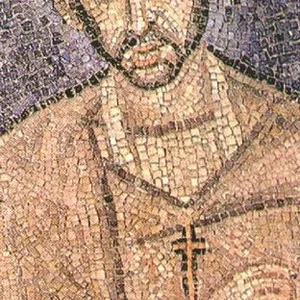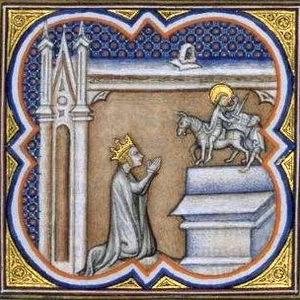

Queen of the Franks and wife of Clovis I, she played a decisive role in her husband's conversion to Christianity. Venerated as a saint by the Catholic Church, she embodies the bringing together of Frankish royalty and Christianity at the dawn of the Middle Ages.
Clotilde(474 — 545)
Clotilde
royaume de Bourgogne
7 min read
Frequently asked questions
Key Facts
- Born around 475, a Burgundian princess, daughter of King Chilperic II of Burgundy
- Married Clovis I, king of the Franks, around 492–493
- Played a key role in Clovis's conversion to Christianity, leading to his baptism at Reims (around 496–508)
- After the death of Clovis in 511, she withdrew to Tours, near the tomb of Saint Martin
- Died around 545, she was canonized and is celebrated on June 3
Works & Achievements
Her influence led the king to choose Catholicism over Arianism, lastingly aligning the Frankish monarchy with the Church of Rome.
Built together with Clovis, it became the tomb of the royal couple and, later, the Abbey of Saint Genevieve.
A convent for nuns in Normandy; legend credits her with the miracle of a spring turned into wine to quench the thirst of the workers on the building site.
She endowed and protected the great pilgrimage site of Gaul, where she withdrew during her widowhood.
Venerated as a saint (feast day 3 June), she embodies the model of the Christian queen who brought about the conversion of a kingdom.
Anecdotes
A Burgundian princess, Clotilde belonged to a people who were already Christian, but of the Arian faith. When she married Clovis, the pagan king of the Franks, around 493, she at once set about turning him away from his idols. According to Gregory of Tours, she would tell him again and again that his gods of stone and wood were incapable of saving even themselves, let alone saving men.
The first son of Clovis and Clotilde, Ingomer, died shortly after his baptism, still clothed in his white christening robe. Clovis bitterly reproached the queen that the Christian God had failed to save the child. But when their second son, also baptized, survived an illness, Clotilde saw it as a sign: the new faith was slowly winning over the court.
The conversion of Clovis, so the story goes, was decided on a battlefield. On the verge of being crushed by the Alamanni at Tolbiac around 496, the pagan king is said to have called upon “the God of Clotilde,” promising to be baptized if he won. Having gained the victory, he kept his word.
On the day of his baptism at Reims, Clovis heard Bishop Remigius address him with a phrase that has remained famous: “Bow your head meekly, proud Sicamber; adore what you have burned, burn what you have adored.” Tradition holds that thousands of Frankish warriors were baptized in his wake.
Widowed in 511, Clotilde gave up the intrigues of the court and withdrew to Tours, near the tomb of Saint Martin. There she spent more than thirty years praying, relieving the poor, and founding churches, earning a reputation for holiness that led her to be venerated after her death.
Primary Sources
“The gods you worship are nothing and can do nothing, neither for themselves nor for others, for they are carved out of stone, wood, or some metal.”
“Jesus Christ, you whom Clotilde proclaims to be the son of the living God, if you grant me victory over these enemies, I will believe in you and be baptized in your name.”
Bishop Remigius said to the king: “Bow your head gently, O Sicamber; adore what you have burned, burn what you have adored.”
The account celebrates the queen as a pious mother who brought her husband to the true faith, distributed her possessions to the poor, and founded many churches before dying in holiness at Tours.
Key Places
Heart of the Burgundian kingdom where, according to tradition, Clotilde was born and grew up at the court of her royal family.
One of the Frankish royal residences under Clovis, a center of power where Clotilde lived as queen.
Site of the battle against the Alamanni where Clovis is said to have called upon Clotilde's God and vowed to convert.
City where Bishop Remigius baptized Clovis, the culmination of the long work of conversion led by Clotilde.
Royal residence where Clotilde and Clovis founded the Basilica of the Holy Apostles, which became their burial place.
Near the tomb of Saint Martin, Clotilde spent her widowhood in prayer and charity, and died there in 545.
Typical Objects

A band of gold and precious stones marking her rank as regina of the Franks; Clotilde laid it aside after her widowhood for a life of penance.

After the death of Clovis in 511, she gave up her ceremonial garments for the dark veil of consecrated widows, a sign of her withdrawal from the world.

A perfumed oil used for the anointing of baptism; it was this rite, secured for Clovis, that sealed the passage of Frankish royalty to Christianity.

A goldsmith's brooch of gold cloisonné set with garnets that fastened the cloak; an object typical of the dress of the Frankish elite of her time.
A symbol of her charity: the chronicles report that she gave away her possessions unsparingly to the poor, to churches, and to monasteries.
📷 CC0 · Wikimedia Commons ↗
A precious casket holding the bones of a saint; the cult of Clotilde gave rise to such shrines, venerated notably in Paris.
📷 CC0 · Wikimedia Commons ↗School Curriculum
Vocabulary & Tags
Key Vocabulary
Daily Life
Morning
A Frankish queen's day began with prayer and Mass, a duty all the more important for a devout Christian like Clotilde. She would then confer with her ladies-in-waiting and the stewards in charge of the palace.
Afternoon
The afternoon was divided between managing the royal estates, receiving petitioners, and performing works of charity. Clotilde was renowned for distributing alms and gifts to churches, monasteries, and the poor.
Evening
The evening brought the family and the court together around a meal, sometimes enlivened with tales or songs. The queen often extended the evening with devotions and pious readings.
Food
The royal table blended Roman heritage with Germanic customs: bread, game and pork, fish, vegetables, cheeses, and fruit. Wine, either imported or produced in Gaul, accompanied the feasts; after she was widowed, Clotilde adopted a more austere diet, close to monastic fasting.
Clothing
She wore long tunics of linen and wool, sometimes silk, draped with a cloak fastened by gold fibulae. Jewels, brooches, and a veil signaled her rank; as a widow, she traded these adornments for dark, simple garments.
Housing
The Frankish court resided in palaces and villas inherited from Roman times or built of wood, surrounded by outbuildings and farming estates. Power was itinerant: the queen moved from one residence to another, from Soissons to Paris, before settling near the churches of Tours.
Historical Timeline
Period Vocabulary
Liens externes & ressources
Références
Œuvres
La conversion de Clovis au christianisme nicéen
vers 496
Fondation de la basilique des Saints-Apôtres (Paris)
vers 502-511
Fondation du monastère des Andelys
VIe siècle
Mécénat du sanctuaire de Saint-Martin à Tours
511-545
Le culte de sainte Clotilde
à partir du VIe siècle