Imaginary interview with Delilah
by Charactorium · Delilah (1100 av. J.-C. — 1100 av. J.-C.) · Mythology · Spirituality · 5 min read
We found her where the story places her: in the Valley of Sorek, among the vineyards that give the region its name, at the hour when women return from the wells. She does not flee the question; she turns it back. Here is what the woman by whom the strongest of men was delivered has to say.
—Where should we imagine you, before Samson ever entered your life?
Here, in the Valley of Sorek, between the hills of Judah and the plain of the Philistines. They have made me a Philistine, made me a traitor by birth; but only one thing is certain about me: that I live in this land of vineyards, this borderland called the Shephelah, where you never quite know on which side of the field the shadow will fall. In the morning I grind barley at the millstone like all the women here; in the afternoon I spin flax and set the warp on the loom propped against the wall. This valley belongs to no one, and that is why it belongs to all who come to take what they covet — princes as well as heroes.
This valley belongs to no one, and that is why it belongs to all who come to take what they covet.
—Why are people so determined to make you an enemy of the Hebrew people?
Because it is more convenient to hate a foreigner than to understand a neighbor. The story gives me neither father, nor city, nor god: it places me in Sorek and leaves me there, without a coat of arms. Those who came to me had a clear name — the seren, those princes of the coastal cities. I was just a woman from a border valley, between the olive trees and the fig trees, where a Hebrew and a Philistine can drink from the same well in the morning and fight at sunset. They put me on the wrong side because someone had to be there. The truth is, the border ran through my house.
The truth is, the border ran through my house.
—How did the Philistine princes come to you?
They came up to me, all five, one for each city of the Pentapolis — Gaza, Ashkelon, Ashdod, Ekron, Gath. Each promised me eleven hundred pieces of silver; count it, that is five thousand five hundred shekels, a fortune such that a man here would not see a tenth of it in a lifetime. They did not ask me to kill, only to know: where did his strength come from? People think the money made me weak. I say rather that they had well measured what such a weight of silver weighs on a landless woman. The seren do not fight themselves; they buy those who can approach the enemy closer than any spear could.
The seren do not fight themselves; they buy those who can approach the enemy closer than any spear.
—Would you say that sum was enough to decide you?
Money opens the door; it does not cross the threshold for you. Eleven hundred pieces per prince, yes, but between the promise and the deed there were days, nights, questions asked and withdrawn. Consider: a man who snaps new ropes like a burnt thread, who breaks fresh bowstrings tied around his arms — what woman would not have wanted to know where such a thing came from, even without a single shekel at stake? Curiosity was already there before the princes came to feed it. The money only gave a name, and an excuse, to what I already wanted to understand.
Money opens the door; it does not cross the threshold for you.
—Tell us about the three times he lied to you.
Three times I asked him, three times he played. The first, he swore that seven fresh bowstrings, still damp, would make him weak like any other; I tied them, I called out, he snapped them laughing. The second, it was new ropes never used: same bonds, same burst of laughter. The third, he let me weave his seven locks into the warp of the loom set up in my room — the same loom where I spend my afternoons — and he tore the whole thing, beam and all, as one plucks a twig from one's hair. Each time I thought I held the secret; each time he took it back from my hand. It was a game, and I was losing while smiling with him.
Each time I thought I held the secret; each time he took it back from my hand.
—What happened the night the secret finally came out?
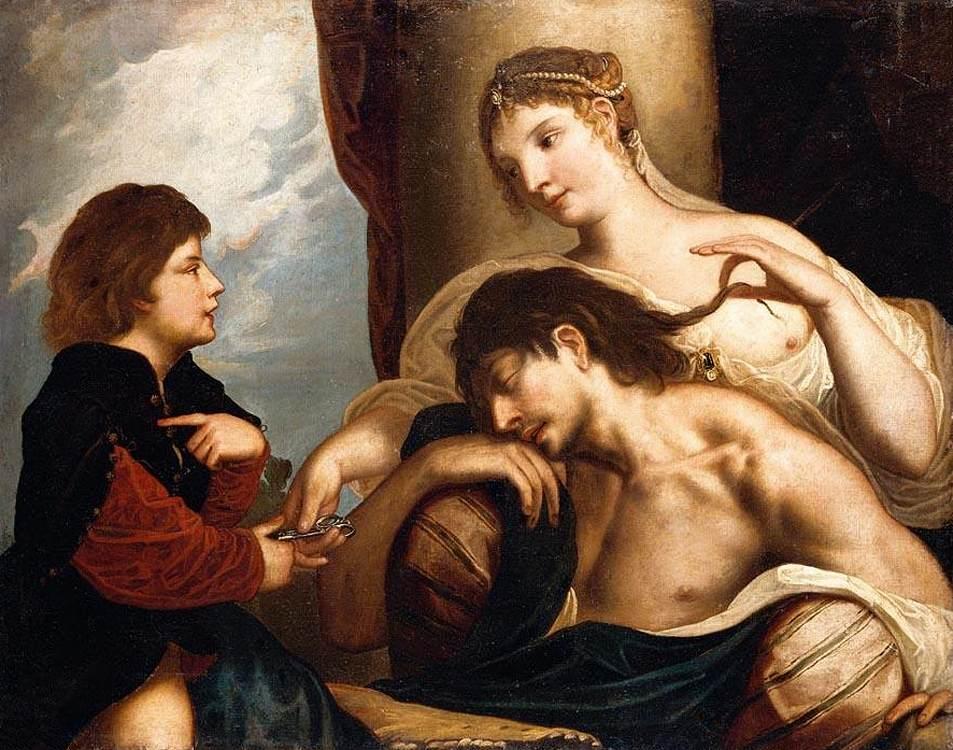
He fell asleep on my knees, heavy with all his trust. I sent for a man, and under the razor his seven locks fell one by one, without him stirring. When I woke him saying the Philistines were upon him, he tried to shake himself as before, to rise, to break everything. But nothing came. The text says it better than I: he did not know that the Lord had left him. That is what I cannot forget — not the sound of the razor, but that moment when a man searches within himself for a strength that is no longer there, and does not yet understand that he is already alone.
He searches within himself for a strength that is no longer there, and does not yet understand that he is already alone.
—Did you think, in cutting his hair, that you were severing a magical power?
That is what everyone believes, and that is where they are wrong about me. His strength did not sleep in his hair like fire in a lamp. Those locks were the sign of a vow, the Nazirite vow: from his mother's womb, the razor had never passed over his head, for he was consecrated to God. I did not cut a power; I broke a promise. A nazir drinks no wine, touches no dead, does not cut his hair — and he, by my hand, gave all that up in one night. Weakness came not from the steel on his scalp, but from the bond undone between him and his God.
I did not cut a power; I broke a promise.
—Do you remember the moment he confessed everything to you?
He finally opened his whole heart to me, and it was worse than a confession: it was a surrender. He told me he had been a Nazirite to God from the womb, and that if shaved, his strength would leave him. Understand: this was not the secret of a weapon, but of a soul. A man who entrusts you with his Nazirite vow entrusts you with the thread that holds him to heaven. I knew, as I listened, that I no longer held a warrior but a man who had ceased to guard himself. The locks, those seven braids counted as a number of fullness, were only the visible knot of an oath that he, in speaking, had begun to untie.
A man who entrusts you with his Nazirite vow entrusts you with the thread that holds him to heaven.
—You have been much sung and painted, long after your time. What do you think of that?
I am told that men of distant centuries have made paintings and songs of me. That in an opera, a certain Saint-Saëns lends me an aria where my heart opens to his voice — as if I had loved in order to betray better. That a painter, Rubens, captured the moment of the razor, my hand bent over his sleep. If I could imagine that I would be looked at like this, I would say they all wanted me as a seductress, because a woman who thinks is less frightening when reduced to her beauty. They painted my fingers in his hair; none painted what I weighed, at night, between the princes' silver and a man's trust.
A woman who thinks is less frightening when reduced to her beauty.
—And the man you delivered, how is he seen through these works?
Always after me. He is the blinded hero, the giant led to Gaza to turn the prisoner's millstone, eyes gouged out, until he shakes the pillars of Dagon's temple on his enemies and himself. A Flemish master, Rembrandt, painted his capture, that terrible moment when the light is taken from him. I no longer appear in that ending: my role stops at the razor, his continues until the collapse. Perhaps that is justice. I gave the secret; he paid for all the rest. And of the two of us, it is the one who dies crushed that is pitied, never the one who must live knowing by whose hand he fell.
I gave the secret; he paid for all the rest.
Read further
This imaginary interview was generated by artificial intelligence from sources documented in Delilah's profile. It dramatises what the figure might have said based on what we know about them, but does not constitute attested historical testimony. For primary sources and factual documentation, refer to the full profile.