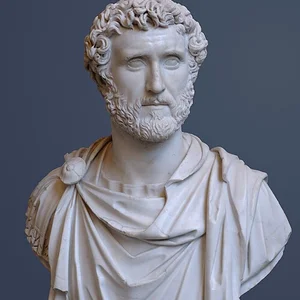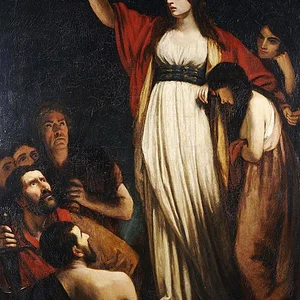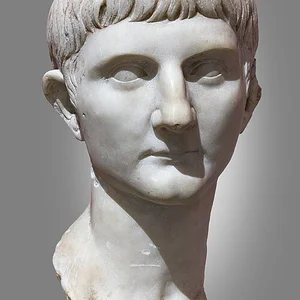

Roman emperor from 180 to 192, son and successor of Marcus Aurelius. His authoritarian and eccentric reign marked the end of the Antonine dynasty and the close of the imperial golden age. He was assassinated in 192, opening a period of turmoil.
Commodus(161 — 192)
Commodus
Rome antique
6 min read
Frequently asked questions
Key Facts
- Son of Emperor Marcus Aurelius, he became co-emperor in 177 and then sole emperor upon his father's death in 180
- Ended the wars against the Germanic tribes by signing peace on the Danube in 180
- Identified himself with Hercules and fought in the arena himself as a gladiator, scandalizing the aristocracy
- His authoritarian reign relied on favorites (Perennis, Cleander) and numerous executions of senators
- Assassinated on 31 December 192, his death triggered the Year of the Five Emperors (193)
Works & Achievements
Commodus brings his father's long Germanic wars to an end through peace treaties, a choice that was criticized but temporarily stabilized the Danube frontier.
After a great fire, Commodus renames Rome after himself, illustrating his drift toward a cult of personality.
He had the twelve months of the year, the legions, and the Senate renamed after his Herculean titles, marking the height of his megalomania.
Commodus organizes and takes part in grand games where he fights as a gladiator and slays wild beasts, winning popular favor but the hostility of the elite.
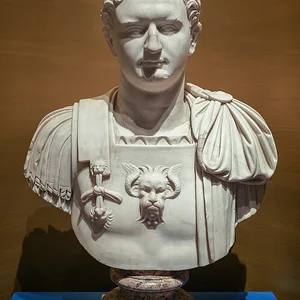
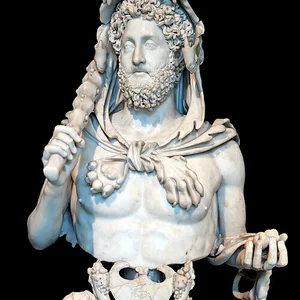
He spreads an iconography depicting him as a Roman Hercules (the Capitoline bust), asserting his quasi-divine nature.
Creation of a fleet (Classis Africana Commodiana) intended to secure Rome's supply of grain from Africa.
Anecdotes
Commodus believed he was the reincarnation of Hercules: he had himself depicted wearing a lion's skin and holding a club, and appeared this way in the arena. He even went so far as to rename Rome “Colonia Commodiana,” the colony of Commodus.
The emperor himself went down to fight in the arena as a gladiator, which scandalized the aristocracy because this activity was considered unworthy of a high-ranking Roman. He claimed to have won hundreds of fights and had the public treasury pay him a colossal salary for each appearance.
During spectacular hunts in the Colosseum, Commodus shot down ostriches, lions, and even elephants from a secured platform. According to the historian Cassius Dio, an eyewitness, one day he decapitated an ostrich and brandished its head toward the senators with a threatening look, forcing them to chew on laurel leaves to hide their fits of laughter.
Commodus renamed the twelve months of the year after his own nicknames and titles, such as “Amazonius” or “Herculeus.” He also renamed the legions, the fleet, and the Senate itself by attaching his name to them.
He escaped several plots, including one led by his own sister Lucilla in 182. The final conspiracy succeeded in 192: after an attempted poisoning, he was strangled in his bath by Narcissus, an athlete in charge of his training.
Primary Sources
This hero, this Commodus, killed a hundred bears all by himself in a single day... He cut off the head of an ostrich and, advancing toward us with the head in his left hand and his bloody sword in the right, he showed us that he would treat us the same way.
He neglected the affairs of state and gave himself over to pleasures, leaving power in the hands of favorites, while he devoted himself to gladiatorial combats and public hunts.
He fought under the name of Paulus, a famous gladiator; he was so fond of this name that it was enrolled among the gladiators.
Marcia presented him with a cup of poisoned wine; as the poison was slow to take effect, they sent Narcissus, a strong young man, who strangled him while he was weakened.
Key Places
City of Latium where Commodus was born in 161, southeast of Rome.
Capital of the Empire where Commodus reigned, staged his spectacles and was assassinated. He tried to rename it Colonia Commodiana.
Amphitheatre in Rome where Commodus fought as a gladiator and staged spectacular hunts before the people and the Senate.
Military camp on the Danube where Marcus Aurelius died in 180; Commodus concluded peace with the Germanic tribes there before returning to Rome.
Hill in Rome where the emperors' residence stood. Commodus lived there and survived several plots against him.
Typical Objects

Attribute of the mythological hero whose incarnation Commodus claimed to be. He had himself depicted and appeared in public with a club and a lion skin.

Short sword used in the arena. Commodus personally fought as a gladiator under the name Paulus, an act considered scandalous for an emperor.

The hide of a lion worn over the head and shoulders, a traditional attribute of Hercules. Commodus draped himself in it to display his divine lineage.

A woven crown symbolizing the victory and authority of the emperor. It adorned official portraits and coins bearing the likeness of Commodus.

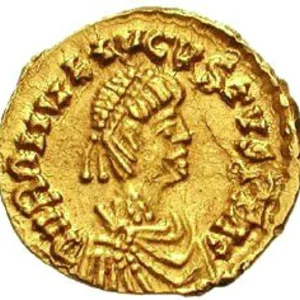
A silver coin struck with the image of the emperor, sometimes depicted as Hercules. The coinage spread his propaganda throughout the Empire.

A richly dyed and embroidered ceremonial garment, reserved for the emperor during ceremonies and triumphs. The supreme symbol of imperial status.
School Curriculum
Vocabulary & Tags
Key Vocabulary
Daily Life
Morning
As emperor, Commodus often began his day with the morning greetings (salutatio), when courtiers and senators came to pay their respects at the palace on the Palatine Hill. He dispatched affairs of state quickly, gladly delegating them to his prefects and favourites, preferring leisure to administrative paperwork.
Afternoon
The afternoon was devoted to physical exercise: Commodus trained in combat, wrestling and archery with an all-consuming passion. He often went to the baths or practised in the arena in preparation for his public appearances as a gladiator.
Evening
In the evening, the emperor held lavish banquets surrounded by his court and favourites. These feasts, blending entertainment and pleasures, stood in stark contrast to the sobriety expected of an heir to Marcus Aurelius.
Food
The imperial table offered an abundance of dishes: roasted meats, fish, fruit, wheat bread and imported wines, seasoned with the famous fish sauce (garum). Commodus's banquets were renowned for their luxury and excess.
Clothing
Day to day, Commodus wore the tunic and toga, but he loved to show himself in ceremonial costumes: a purple toga embroidered with gold during ceremonies, or even a lion's skin and club to embody Hercules in public.
Housing
He resided in the vast imperial palace on the Palatine Hill, overlooking the Forum and the Circus Maximus. Decorated with marble, frescoes and statues, this complex housed gardens, private baths and reception halls.
Historical Timeline
Period Vocabulary
Liens externes & ressources
Références
Œuvres
Fin des guerres marcomanes
180
Refondation symbolique de Rome (Colonia Commodiana)
191-192
Renommage des mois et des institutions
vers 192
Jeux et spectacles du Colisée
190-192
Statuaire et monnaies à l'image d'Hercule
190-192
Réorganisation de l'annone et de la flotte d'Afrique
vers 190