Imaginary interview with Du Fu
by Charactorium · Du Fu (712 — 770) · Literature · 6 min read
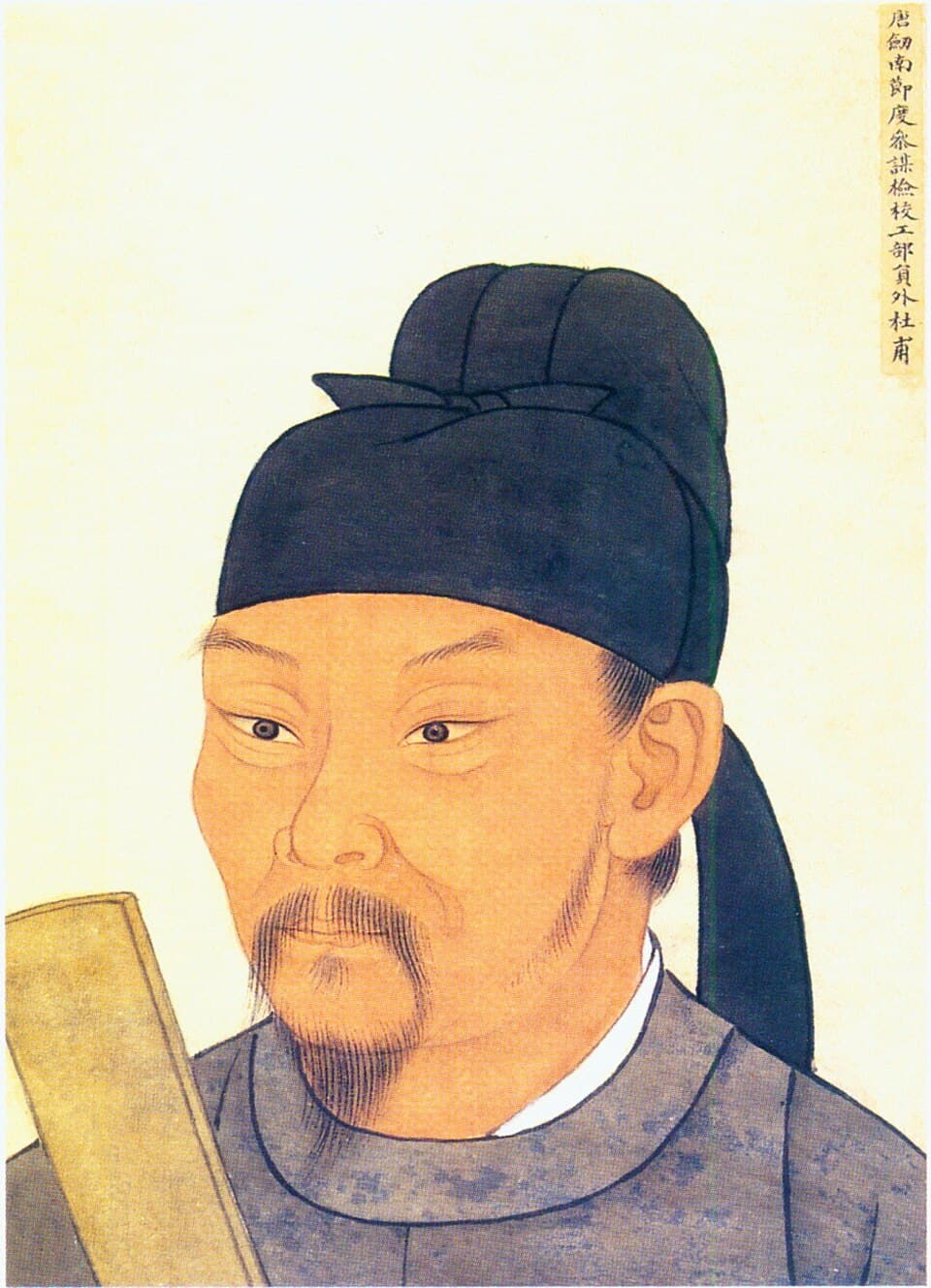
Autumn 766, in Kuizhou, upstream of the Three Gorges. The old poet, ill, receives his visitor under a bamboo awning from which the river's roar can be heard. He pours some murky wine into a chipped cup and consents to speak of his long wandering.
—How do you explain that, already a recognized poet, you failed the imperial examinations twice?
The first time, in 735, at Chang'an, I told myself that Heaven had not judged my brush mature enough, and I accepted it as a scholar should accept a trial. But 747 was of a different nature. Premier Li Linfu, who feared free-spirited men of letters, had all candidates rejected without exception, then proclaimed to the emperor that no new talent deserved promotion. Understand my shame: I had ground my ink on the stone, stayed up by candlelight over the classics, and I was denied the title of jinshi not for my unworthiness, but for the fear of a single man. I waited years for a modest post. That day I learned that the virtue of the wenren is not enough when the administration is corrupt.
I was denied the title not for my unworthiness, but for the fear of a single man.
—Do you remember your meeting with Li Bai?
It was in 744, at Luoyang, the city of my childhood. I was introduced to a man with a falcon's gaze, already known as the Immortal of Poetry, and I was still just the young Du. We wandered for weeks through the countryside of Henan and Shandong, a cup of wine always at hand, exchanging our verses like two travelers sharing bread. He composed quickly, in one breath, as if words fell from the sky; I revised every line until I found the right character. Later I wrote many poems to express my admiration, and I dreamed of him at night. Today I am called the Sage of Poetry, but before Li Bai I always felt like the awestruck junior.
We exchanged our verses like two travelers sharing bread.
—What happened when the An Lushan Rebellion reached the capital?
In 755, General An Lushan marched on us with a hundred and fifty thousand men, and the order I had believed eternal shattered like a jar. I had wanted to join the new emperor in exile; the rebels seized me and held me in occupied Chang'an, in 756 and 757. I saw with my own eyes the looting of the palace, the streets strewn with rubble, the greatest city in the world given over to the soldiery. It was there, a prisoner, that I composed View of Spring. I can recite the first lines, for they never left me: 'The empire is shattered, mountains and rivers remain; spring returns to the city, grass and trees grow green.' Spring kept greening over the ruins — that is what broke my heart.
Spring kept greening over the ruins — that is what broke my heart.
—Why did you choose to sing of peasants torn from their homes rather than the glory of princes?
Because a shiren, in our tradition, has the duty to bear witness to the people's suffering. As early as 750, before the great catastrophe, I had written the Ballad of the War Chariots against Emperor Xuanzong's endless frontier campaigns: 'The chariots rumble, the horses neigh, the soldiers march, bows and arrows at their belts.' Then came the civil war, and in 759 I composed the Three Officials, Three Partings. Think of the old man of Shihao: at night, the recruiters come to take the men; the old man climbs the wall to flee, and it is his wife who goes out to face the soldiers. I only reported what I saw on the roads. The old fubing system had collapsed; they were throwing old men and children into the armies. A poet who looks away from that is nothing but a flatterer.
A poet who looks away from the people's suffering is nothing but a flatterer.
—Tell us about the night the storm destroyed your thatched hut in Chengdu.
In 759, I had fled the court and built in Chengdu, on the banks of the Huanhua, a modest caotang — a few low rooms, a bamboo frame I had planted myself, a thatched roof. An autumn wind tore it away in shreds, the rain soaked everything, my children shivered on the soaked mat, and I could not sleep. Yet that night, it was not my own misery I thought of. I thought of all the poor scholars of the empire who, like me, trembled under leaky roofs. And I composed this wish: 'Ah! let a vast mansion of a thousand rooms suddenly arise, sheltering all the destitute scholars of the world, all with radiant faces!' Let my own hut be broken and let me die of cold, that would be enough, if only the others were sheltered.
It was not my own misery I thought of, but all the leaky roofs of the empire.
—How did a man faithful to the Mandate of Heaven live to see the Tang dynasty falter?
You touch on the most painful point. I grew up under the reign of Xuanzong, when the empire was at its zenith, the capital radiating over the known world. I believed the Tang order as solid as the mountains. Then came the revolt, and I understood that the tian ming, the Mandate of Heaven, withdraws from a ruler whose administration becomes corrupt. I never renounced my emperor — a scholar must revere the throne. But my poems whispered what the prince's virtue should have prevented: unjust conscriptions, greedy officials, blood shed for nothing. The rebellion lasted eight years and cost countless lives. I mourned a golden age that my children would never know.
I believed the Tang order as solid as the mountains.
—What did this friendship between poets mean to you, in a world where one mostly served one's career?
In the China of the wenren, one courts the powerful for a post, flatters the official for a meal of fish. My friendship with Li Bai had nothing of that. Neither of us had favors to exchange, only verses to share and wine to drink. I remember our rides in Shandong, those evening fires where we recited the ancients. He carefree as a cloud, I consumed by worries for the empire — we were wind and stone, and yet brothers. They say a man happy in his career finds a thousand companions, and a man faithful in friendship finds only one in his life. Li Bai was that one. Even now, old, on this river, I still think of him.
He carefree as a cloud, I consumed by worries — we were wind and stone, and yet brothers.
—Your compassion for the humble is sometimes compared to that of the greatest storytellers. What drove you to descend to the wretched?
I did not descend to them: I was among them. A man who has known hunger from his own children's eyes does not look down on the people. On the roads of 759, between the posts I was fleeing, I shared the roadside with chained recruits, widows, old men torn from their fields. The fubing, that old militia system, had collapsed, and anyone who could stand was thrown into war. My Three Partings are not cabinet inventions: they are faces. Regulated poetry, the lüshi, demands perfect form; but the strictest form can carry the rawest pain. That is what I sought all my life: to lock the people's cry into eight unflinching lines.
To lock the people's cry into eight unflinching lines.
—Do you regret having run so much after a court post, you who finally left it?
For a long time I believed that serving the state was the only path of the accomplished wenren. I presented my odes to the emperor, I waited, begged, hoped for that modest post that came so late. Then, in 759, I resigned and took the road west. Strange confession: it was in losing my career that I gained my work. In my thatched hut in Chengdu, nearly four peaceful years, I wrote over two hundred poems; there, among my bamboos and my chive patch, the brush was worth more than the official's cap. I do not renounce my youthful ambition: a scholar must want to be useful to the world. But Heaven made me a poet rather than a minister, and I now believe it did well.
It was in losing my career that I gained my work.
—Here in Kuizhou, ill and far from everything, what still makes you take up the brush?
Illness gnaws at me, my teeth are falling out, and the boat that carried me to these Three Gorges seems moored forever to my heart that longs to return. I have never seen my hometown again; I drift on these rivers like a leaf on the water. And yet, this autumn, seeing the white dew ravage the maples and the chrysanthemums bloom for the second time far from my loved ones, I composed my Autumn Meditations, eight poems I believe are the peak of my art. An old man no longer has the court to hope for nor Li Bai to find; he has only the inkstone and the duty to speak true. As long as an image comes to me at dawn, I seize the brush. Perhaps that is all that remains of a scholar when mountains and rivers have seen the empire fall.
I drift on these rivers like a leaf on the water.

This imaginary interview was generated by artificial intelligence from sources documented in Du Fu's profile. It dramatises what the figure might have said based on what we know about them, but does not constitute attested historical testimony. For primary sources and factual documentation, refer to the full profile.