Kids interview Du Fu
by Charactorium · Du Fu (712 — 770) · Literature · 5 min read
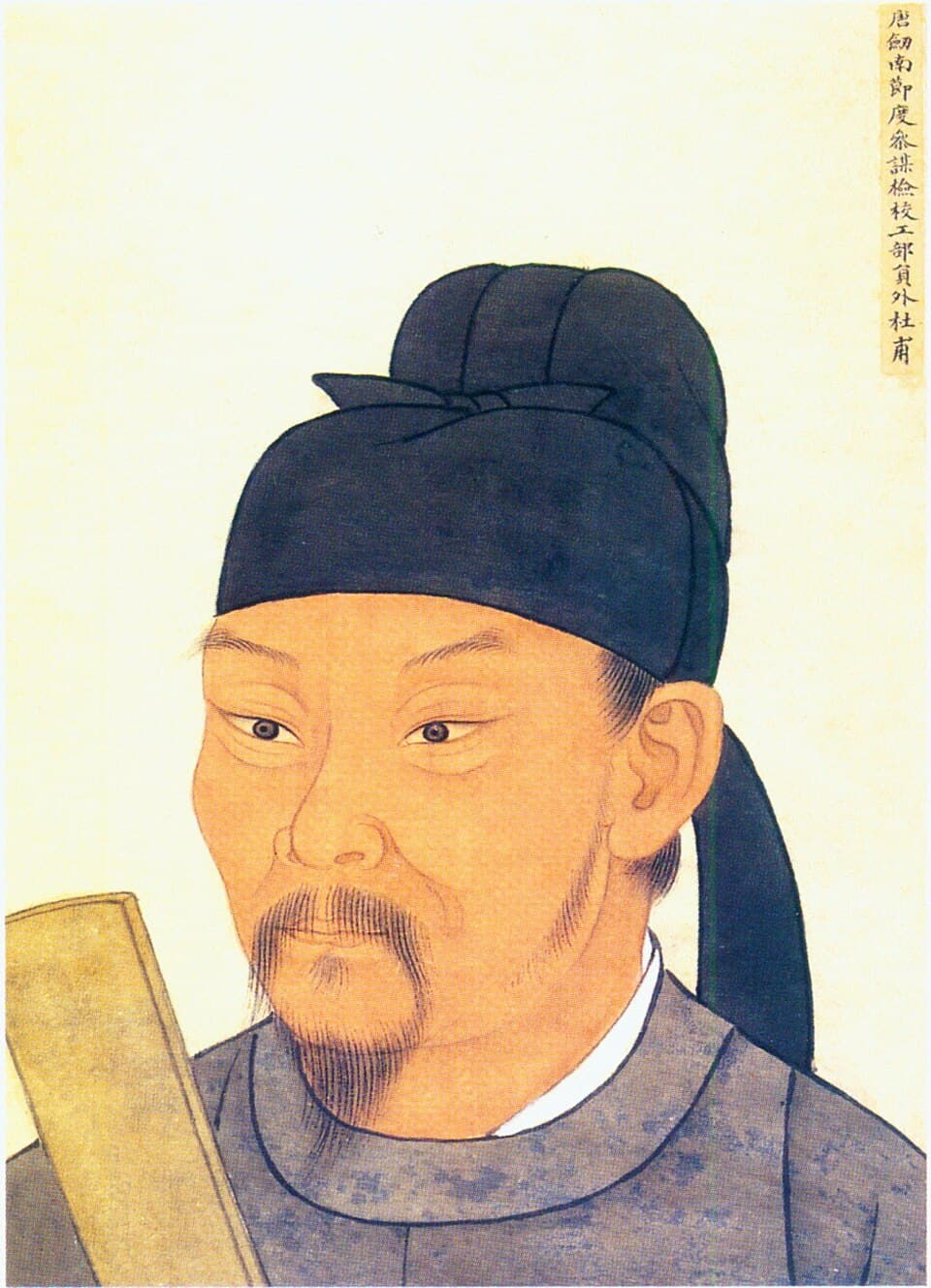
Two twelve-year-old students, on a school trip, push open the door of a modest bamboo hut. An old man in a black hat greets them with a smile: it's Du Fu, the poet. He sets down his brush and invites them to sit by the fire.
—How old were you when you failed your famous exams?
Ah, my child, you touch on an old wound. I was twenty-three at my first failure, in 735. But the worst came in 747: I was already thirty-five. That exam, the jinshi, was the great competition that opened the doors to high posts in the empire. Imagine a huge hall full of scholars all dreaming of it. That year, Prime Minister Li Linfu, jealous of us, had us all rejected—not a single one passed! He dared tell the emperor that no new talent deserved promotion. I, already a wenren, a recognized man of letters, had to wait years for a tiny post.
—What was your friend Li Bai like? What did you do together?
Oh, Li Bai! Just his name warms my heart. We met in Luoyang in 744. Imagine two poets riding into the countryside, aimless, just to see the world. We walked through Henan and Shandong, drank millet wine from small cups, and recited poems to each other until nightfall. He was called the Immortal of Poetry; I, later, the Sage of Poetry. Two opposite temperaments: he light as the wind, I solemn as the earth. But what a friendship! I wrote many poems just to express my admiration.
—What's the difference between the Sage and the Immortal of Poetry?
Good question! Li Bai was the Immortal of Poetry. His verses seemed to fall from the sky, free as a drunken bird, full of moon and wine. I was called the Sage of Poetry, the shīshèng. The sage is not one who flies: it's one who works, observes, builds patiently. He sang his dreams; I told the sufferings of ordinary people—the peasants, the soldiers, the weeping mothers. In our Tang world, being a poet, a shīrén, was not just a pretty talent. It was a duty: to bear witness to the life of the people. Two different paths for the same passion.
—Were you afraid when the rebels took the city?
Yes, I was afraid, I won't lie. In 756, General An Lushan rebelled, and the great capital Chang'an fell. I tried to join the emperor, but the rebels captured me. I was a prisoner in a pillaged city, watching the palace burn. That's where I wrote Spring View. Listen to these words: "The nation has shattered, mountains and rivers remain; spring returns to the city, grass and trees grow green." Do you understand? Even destroyed, nature returned, indifferent to our misfortune. The very flowers made me shed tears.
—What's that story about the old man at Shihao, that night?
Ah, that night I'll never forget. During the civil war, the army lacked men; so soldiers came at night to villages to forcibly conscript peasants. I saw it with my own eyes, in a village called Shihao. An old man jumped over the wall to escape; his poor wife came out to face the soldiers. Their anger was terrible, her sobs tore at the heart. I wrote a series of poems from it, Three Officials, Three Partings. I didn't want fancy words. I just wanted no one to ever forget those families broken by war.
—Is it true a storm tore the roof off your house?
Absolutely true, my child! In 759, I had settled in Chengdu, in a small hut of bamboo and thatch, my Caotang—that means "thatched cottage," the modest home of a scholar. One autumn day, a furious wind carried away the straw from my roof. My children shivered, rain came in everywhere. And do you know what I thought? Not of myself. I wrote: "Oh! Let a vast mansion of a thousand rooms suddenly rise, sheltering all the poor scholars of the world!" My own house could fall, if only all the poor had a roof.
My hut could collapse, if only all the poor had a roof.
—What did you eat in the morning in your hut?
Ah, the morning! I was woken by the neighbor's roosters and the sound of the Huanhua River. I started with a cup of hot tea, brewed on my little stove. Our food was simple, you know, and often too meager: rice boiled in water, stir-fried vegetables, cabbage, turnips, sometimes millet porridge. On good days, a bit of fish from the river. I had planted the bamboos around the house myself, and a vegetable garden where scallions grew. Then, if an image came to me, I quickly grabbed my brush—a máobǐ, made of hair mounted on a bamboo handle—before the dream flew away.
—Is it true you could spend hours on a single word?
Oh yes, and my friends gently mocked me for it! In the afternoon, I reread my poems over and over. I could search for hours for the right word, just one, that sounds perfect. You see, I mainly wrote lüshi, "regulated poems": eight lines, with very strict rules on sounds and rhymes. Imagine a construction game where every piece must fit perfectly, or everything collapses. It's not ease, it's patience. A successful poem is not a gift from heaven.
—Did you write your most beautiful poems when you were old?
Strange, but yes. In 766, I was old and ill, stranded in Kuizhou, near the immense Three Gorges of the great river. The water roared between the cliffs, autumn ravaged the maples. There, alone, I composed my Autumn Meditations, eight poems said to be the summit of my art. I was just a tired old man, far from home, but my verses had never been so precise. Later, posterity gave me that beautiful title: shīshèng, the "Sage of Poetry."
Sadness, when you know how to write it, becomes beauty.
—Does it make you sad that you never returned home?
A little, yes... My last years I spent wandering the rivers of Hunan, on a small boat, sick and penniless. I died in 770, on Lake Dongting, without seeing my hometown again. It's a sorrow I still carry. But let me tell you something sweet. You two are here, children from far away, more than a thousand years after me, listening to my stories. So I'm not really dead, you see? My words keep walking, from mouth to mouth, long after me.
A poet who bears witness to the misfortunes of the humble never truly fades away.

This imaginary interview was generated by artificial intelligence from sources documented in Du Fu's profile. It dramatises what the figure might have said based on what we know about them, but does not constitute attested historical testimony. For primary sources and factual documentation, refer to the full profile.